


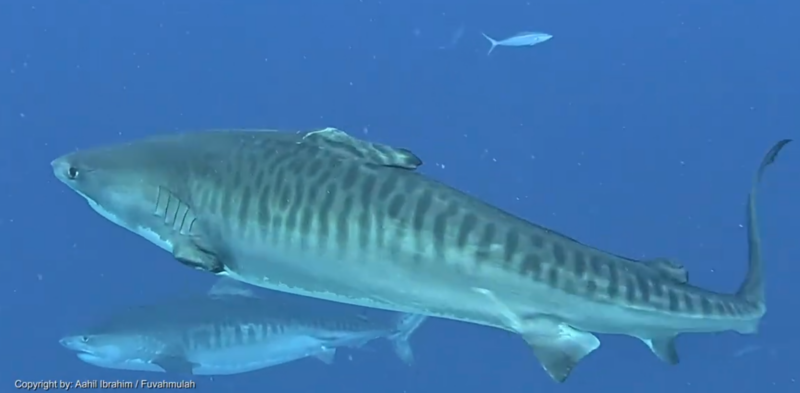
A female tiger shark with conspicuously missing fins has been observed off Fuvahmulah in the Maldives. Named Fin, she is listed as F-263 in Fuvahmulah Shark Research’s photo-ID catalogue. Her story raises two separate questions: how does she cope with her injuries, and what caused them?
Repeated sightings rather than a single photograph
A TV Azteca report based on CNN interviews describes photographer Romero’s encounter with Fin in August 2025. Different diving groups reportedly saw her almost daily afterwards. Laser photogrammetry put her length at approximately three metres. The report describes missing dorsal fins and a missing lower tail-fin lobe. It would therefore be inaccurate to say that she has no fins at all.
According to the observations, Fin moves her body differently from uninjured tiger sharks and has also been seen feeding on carrion. These sightings document that she continues to live after her injuries. They do not establish how severely her movement is restricted, how she obtains food over the long term or how her condition will develop.
Finning is suspected, but the cause remains unresolved
The media report interprets the injury pattern as an indication of finning: removing a shark’s fins and returning the animal to the water. The affected fins are associated with the fin trade. However, it documents neither an observed capture nor an investigation conclusively establishing this cause in Fin’s case. Where and when the injuries occurred also remains unknown. Seeing Fin off the Maldives today does not establish that she was injured there.
What research off Fuvahmulah adds
Systematic observation of individual tiger sharks at Fuvahmulah has a scientific foundation. A Scientific Reports study published in 2024 identified 239 animals from images collected between 2016 and 2023. Around 84.5 percent were female. Many sharks were recorded repeatedly; some returned over several years.
Photo identification uses distinctive external features to match sightings to the same animal. Laser photogrammetry adds measurements without capture or tagging. The study also describes how fish waste attracts sharks to the harbour area. It therefore cautions against simply extrapolating the conditions observed there to undisturbed habitats. The investigation ended before Romero’s reported encounter with Fin and does not provide scientific evidence about her particular case.
We have previously reported on Fuvahmulah’s shark research and conservation hub. For an animal such as Fin, documented repeat sightings could help track changes in body condition and movement. An arresting individual case could thus become a traceable series of observations. Until such data are available, claims of complete adaptation or a confirmed cause of injury remain premature.
