


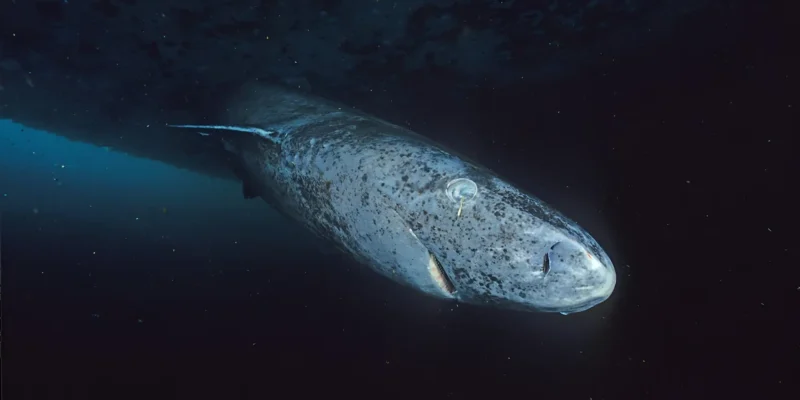
The Greenland shark can live for several centuries. A Aging Cell study now shows that its heart bears clear signs of advanced aging: fibrosis, lipofuscin, oxidative stress and incompletely removed damaged cell components. Even so, the animals examined appeared capable and healthy when caught.
In mammals, this combination is often associated with declining cardiac performance. The findings therefore point less to a heart that avoids aging than to one that may tolerate or compensate for accumulated damage unusually well.
Fibrosis in both layers of the heart muscle
Shark ventricles contain a compact outer layer and a spongy inner layer. The researchers assessed collagen deposits in hearts from ten Greenland sharks measuring 300 to 390 centimetres. Fibrotic tissue occurred in both layers, between muscle cells and around blood vessels.
A comparison with the velvet belly lanternshark, Etmopterus spinax, found no comparable interstitial fibrosis. The pattern therefore cannot simply be explained as a normal adaptation shared by sharks with similar circulatory pressure.
Age pigment and oxidative stress
The team also detected lipofuscin, a pigment that accumulates when lysosomes, autophagosomes and mitochondria do not completely dispose of damaged material. Its distribution is a familiar cellular hallmark of aging.
The marker 3-nitrotyrosine provided evidence of oxidative and nitrosative stress. That such changes coexist with exceptional longevity is precisely what makes the Greenland shark interesting: a long life does not mean an absence of molecular damage.
Healthy when caught—but no direct performance test
The sharks were caught on longlines off Greenland. They had detected, pursued and taken bait and appeared outwardly healthy. The authors treat this as indirect evidence that the cardiovascular system remained functional.
The study did not directly measure pumping capacity, heart rhythm or endurance. Resilience is therefore a plausible interpretation, not a conclusive functional test.
Not every experiment used the same animals
The work combines staining, microscopy and molecular markers. Different analyses used different subsets, and some quantitative species comparisons included only three individuals per species. This limits conclusions about sex, exact age and the entire lifespan.
The sample also contained none of the very largest—and probably oldest—animals. It remains unclear whether the changes level off or continue to progress. Based on body size, the sharks studied may have been roughly 100 to 155 years old, but age estimates for Greenland sharks remains subject to considerable uncertainty.
Longevity as resistance to damage
The Leibniz Institute on Aging – Fritz Lipmann Institute (FLI) places the heart findings alongside genomic evidence for DNA repair and cell protection. Which mechanisms preserve cardiac function remains unresolved; possibilities include unusually robust cells, tissue architecture or metabolism.
The key idea is not that the Greenland shark escapes aging, but that it may continue functioning despite damage that would be more consequential in other vertebrates. Any medical relevance is still speculative and requires direct functional and mechanistic studies.
