


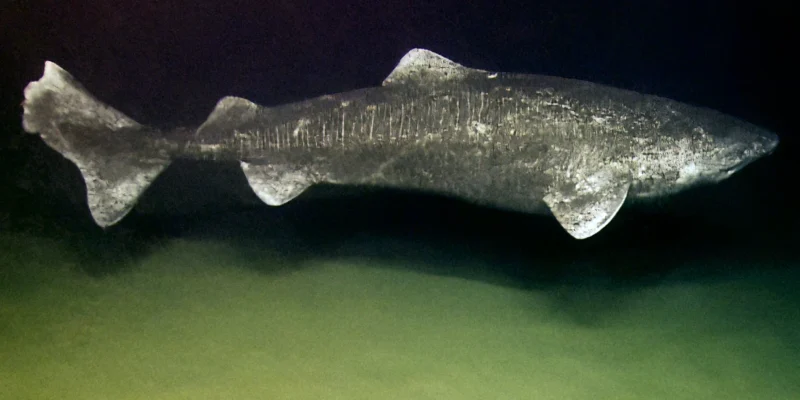
A pup born today in the cold North Atlantic might not reach sexual maturity until the 2170s. With this comparison, a recent article by SpaceDaily makes the exceptionally slow life history of the Greenland shark clear. The calculation is not the result of observing a young animal directly for 150 years, but an extrapolation from age and size estimates.
There is an important scientific statement behind the impressive thought experiment: Greenland sharks probably live for several centuries and females only reach reproductive maturity at an age that is longer than the human lifespan. This time dimension is crucial, especially for the protection of the species.
How to determine age without growth rings
For the study published in 2016 in Science, an international team examined the eye lenses of 28 female Greenland sharks. The animals were 81 to 502 centimeters long and came from scientific surveys off Greenland in the years 2010 to 2013. So it was not a series of observations that ran over centuries, but rather an age reconstruction.
In many sharks, growth zones in calcified structures can be evaluated. This doesn’t work reliably with the Greenland shark. The researchers therefore used proteins in the innermost core of the eye lens. This tissue is created before birth and is not replaced later, thereby preserving a chemical signal from the early phase of life.
The key method was bomb-pulse dating with the radiocarbon isotope carbon-14 (14C). Above-ground nuclear weapons tests increased its share significantly from the mid-1950s. This bomb pulse also reached marine food webs. In younger sharks it serves as a time marker; for animals from before that, the age must be narrowed down using calibration curves and probability models.
At least 272 years – not an average lifespan
The research showed a lifespan of at least 272 years. This number is sometimes referred to in popular representations as average life expectancy. That’s too broad: 272 years marks the lower limit of the age estimate for the largest animal studied and not a measured population average.
The 502 centimeter long female was estimated to be 392 ± 120 years old. The large range is not an irrelevant detail, but part of the result: For animals that were born long before the start of nuclear weapons tests and thus before the 14C signal that can be used for bomb pulse dating, the exact year of birth cannot be determined. What is certain above all is the scale of centuries.
The often mentioned growth rate of around one centimeter per year is also an approximation. The Science study refers to older marking and recapture data with a maximum of about one centimeter increase per year. The 2016 study did not measure every animal annually.
Sexual maturity only beyond four metres
It was known from previous catches that female Greenland sharks are only considered sexually mature when their bodies are around four meters long. When the team applied its age-size relationship to this threshold, the result was an age of at least 156 ± 22 years. This leads to the striking but understandable calculation: a female born in 2026 might not produce offspring until the 22nd century.
The calculation does not predict when a particular animal will actually become pregnant for the first time. Mating, gestation period, birthing areas and natural mortality remain only incompletely researched. However, it shows how long a female has to survive before she can even contribute to the next generation.
Why uncertainty makes protection no less urgent
Greenland sharks end up as bycatch in arctic and subarctic bottom fisheries. If an adult female dies, she cannot be replaced by a new animal within a few years. Even at the lower age estimate, the renewal of the reproductive population occurs on a time scale of generations.
The authors of the study therefore explicitly deduced the need for a precautionary protection approach. Gentle release of live bycatch, reliable reporting data and avoiding unnecessary mortality are particularly important for this species. Late sexual maturity does not automatically make populations smaller, but it does make them very slow in their response to additional losses.
What remains of the headline
The catchy idea of a shark that only has offspring in the 22nd century goes to the heart of biological slowness. The claim remains scientifically sound if three restrictions are mentioned: the growth rate is an approximation, the maturity age is a model-based estimate and 272 years is not an average.
Despite these uncertainties, the Greenland shark is one of the most extraordinary vertebrates in the Arctic Ocean. Research does not need to know exactly every year of birth in order to draw a clear conclusion: an animal that takes more than a century to reproduce is highly vulnerable to avoidable losses.
