


Greenland shark - Somniosus microcephalus
Body structure, features & anatomy
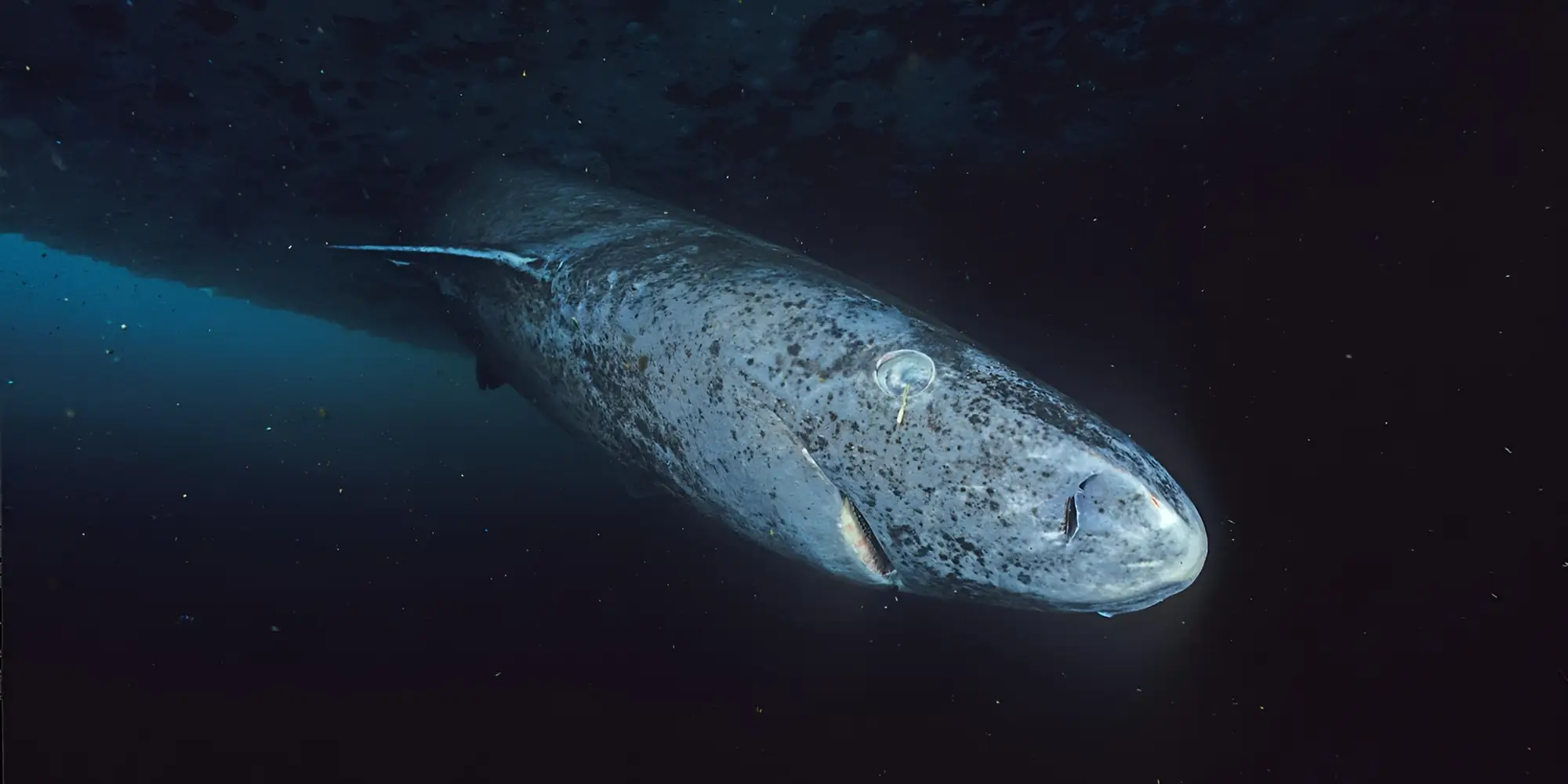
The Greenland shark is a massive, slow-moving sleeper shark of the cold northern seas. Its body is cylindrical and strong, the head is short and rounded, the eyes are small and the two dorsal fins are noticeably low. Taxonomically leads WoRMS the species within the Selachii, the superordinate Squalomorphi, the order Squaliformes, the family Somniosidae and the genus Somniosus.
The Florida Museum describes the Greenland shark as one of the largest sharks in cold waters. The upper surface is mostly gray to brown, sometimes with faint spots or bands; the underside remains lighter. What is striking are the very small dorsal fins without fin spines and the strong caudal fin.
Identifying features
- Very heavy, cylindrical body with a short, rounded snout.
- Small eyes; Copepods often sit on or near the cornea.
- Two small dorsal fins located far back; an anal fin is missing.
- Upper jaw with small, rather pointed teeth; Lower jaw with wider, cutting teeth.
- Large animals can reach over five meters; the species grows extremely slowly.
The combination of a massive body, low dorsal fins, tiny eyes and cold habitat makes the species relatively easy to recognize. Similar sleeper sharks exist in parts of the North Pacific, but in the North Atlantic and Arctic the Greenland shark is the central species.
A heart with pronounced signs of aging
A 2026 study published in Aging Cell found extensive fibrosis in both the compact and spongy myocardial layers of Greenland shark hearts. Further analyses revealed large lipofuscin deposits, oxidative stress, altered lysosomes and damaged mitochondria. In many vertebrates, these features are considered characteristic signs of tissue and cellular aging.
Despite these changes, the captured animals appeared outwardly healthy and were able to locate and take bait. This provides indirect evidence of exceptional cardiovascular resilience. However, the study did not measure cardiac performance directly; how and to what extent the tissue compensates for the damage remains to be tested.
Seeing in darkness – and for more than a century
A 2026 study published in Nature Communications combined histology, genome and RNA analyses with functional tests. In the adult Greenland sharks examined, the retinal layers and all cell types needed for rod-based vision were preserved; even the oldest animal, estimated to be more than 130 years old, showed no obvious retinal degeneration. However, the study did not measure visual acuity or hunting performance in the wild.
The retina consists of densely packed, elongated rods and is specialised for very dim light. Rhodopsin responds most strongly at 458 nanometres, matching the remaining blue light in Arctic depths; many genes for cone-based vision are missing or have become non-functional.
Despite parasites at their edges, six preserved corneas transmitted 66 to 100 percent of blue light. Increased activity of DNA-repair genes may contribute to the retina’s long-term preservation, but it remains a proposed explanation rather than a proven single mechanism.
Distribution & habitat
The Greenland shark lives primarily in the Arctic Ocean and in the north Atlantic Ocean. The core area includes the waters around Greenland, Canada, Iceland, Norway and the Faroe Islands; documented occurrences also extend in the direction Denmark, United Kingdom, USA and in peripheral areas like that North Sea.
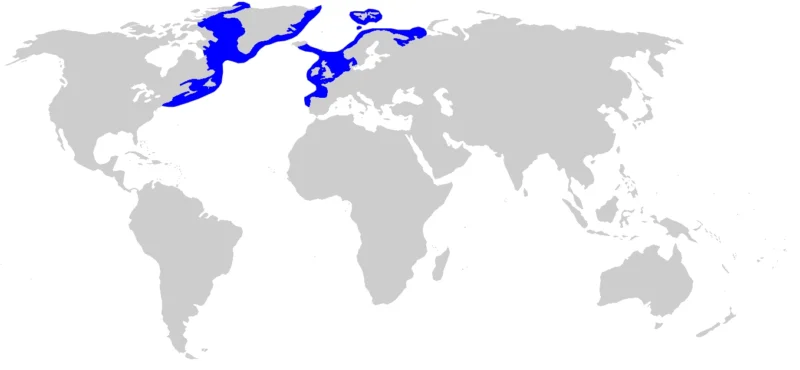
FishBase summarizes the species as a large shark of cold seas with a boreal to arctic distribution. The distribution appears very wide on maps, but in practice it is strongly tied to cold, deep or seasonally cool water masses.
Depth, temperature and habitat
The Greenland shark uses coastal areas, fjords, continental slopes and deep basins. The species profile states 0 to 3000 m depth; in practice, animals can appear both in relatively shallow Arctic waters and at depths of several hundred meters. In more southern parts of the range they tend to stay deeper and cooler.
This means that divers can only rarely plan for this species. Encounters in shallower fjords or under ice conditions are exceptional; Most evidence comes from research, fisheries, camera systems or bycatch data.
Life history, diet & reproduction
MacNeil et al. 2012 describes the Greenland shark as an important but long poorly studied cold-water shark of the North Atlantic and the Arctic. It is a slow swimmer, but not a simple scavenger: stomach contents and observations show a mixture of active hunting, opportunism and use of carcasses.
food and behavior
The diet includes fish such as halibut, cod, redfish and other deep or bottom fish, as well as seals, squid, crabs and carrion. The shark swims slowly, but can search persistently for a long time in cold water. Smell, lateral line and short attacks of opportunity probably play a large role in foraging.
Longevity and growth
Radiocarbon measurements of the eye lenses of 28 females revealed a lifespan of at least 272 years. The largest animal examined was 502 centimeters long and was estimated to be 392 ± 120 years old. The 272 years is a lower limit and not a determined average age of the population.
The frequently cited growth rate of approximately one centimeter per year is based on older marking and recapture data and should be understood as an approximation. For the very old animals, the radiocarbon values provide wide probability ranges, but confirm a lifespan of centuries.
Reproduction
From the age-size relationship, sexual maturity of at least 156 ± 22 years was derived for females. A body length of more than four meters was considered a threshold. The graphic statement that an animal born today can only have offspring in the 22nd century is therefore an extrapolation and not a long-term observation.
Greenland sharks are viviparous; however, there is still little certainty about mating, gestation period, litter size and birth areas. It is precisely the very late maturity that makes the species sensitive to additional mortality: populations can only compensate for losses of adult females extremely slowly.
Threats & protection status
The IUCN Red List assesses the Greenland shark globally as Vulnerable. The decisive factors are not spectacular individual events, but the combination of historical exploitation, present-day bycatch, an extremely slow life history and major knowledge gaps.
The Canadian COSEWIC report emphasizes that bycatch data, population size and recovery capacity remain uncertain. For an animal that may live for centuries, short observation series are especially difficult to interpret.
Main hazards
- Bycatch in bottom longlines, nets and other fisheries for halibut, cod and deep-sea fish.
- Historical use for liver oil and regional foods.
- Growth of a maximum of approximately one centimeter per year and sexual maturity of females estimated at 156 ± 22 years.
- Climate change and altered Arctic food webs with consequences that are still unclear.
- Data gaps because much evidence comes from bycatch, research surveys or individual finds.
Late sexual maturity means that a young animal has to survive for more than a century before it can produce its own offspring. If an adult female is lost, a newly grown animal is not available to replace it in the short term. Even small additional mortality can have an impact over long periods of time.
Effective protection requires better reporting, reliable species identification in bycatch, the gentlest possible release of live animals and long-term Arctic monitoring programmes. For the Greenland shark, it is especially important to avoid removing adult animals from the population unnecessarily.
Greenland shark & humans
The Greenland shark in water usually does not pose a realistic threat to humans. It lives cold, deep and slow, far from most swimming and diving spots. Encounters are rare, and the species is more likely to be endangered by human fishing than the other way around.
Animal Diversity Web describes the Greenland shark as a large, sluggish shark of cold waters. The culturally best-known human relationship is not diving tourism, but rather the processing of otherwise poisonous meat: Fresh meat contains high amounts of trimethylamine oxide and can be problematic for health without special fermentation or drying.
Observation and handling
- Do not harass, pull or block animals directly in front of their heads with cameras and lamps.
- When researching or fishing, take your mouth, tail and physical strength seriously despite moving slowly.
- Release live by-catch animals as quickly, coolly and gently as possible.
- Document sightings with location, depth, temperature, photo or video without touching the animal.
Shark-References leads the species under Somniosus microcephalus and shows how closely research, fishing and taxonomy are connected here. For shark diving, the Greenland shark is above all a symbol that some of the most impressive sharks do not live on colorful reefs, but in cold, dark and difficult to access sea areas.
Profile
- First described:
- Max. size:
- Depth:
- Max. age:
- Max. weight:
- Water type:
- IUCN Status:
Taxonomy
- Kingdom:
- Phylum:
- Subphylum:
- Infraphylum:
- Parvphylum:
- Class:
- Subclass:
- Superorder:
- Order:
- Family:
- Genus:
News


Newsletter
Shark Alert in Your Inbox