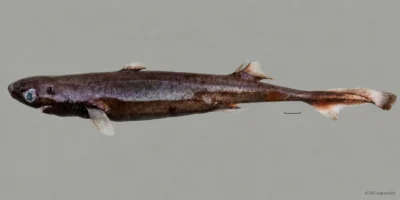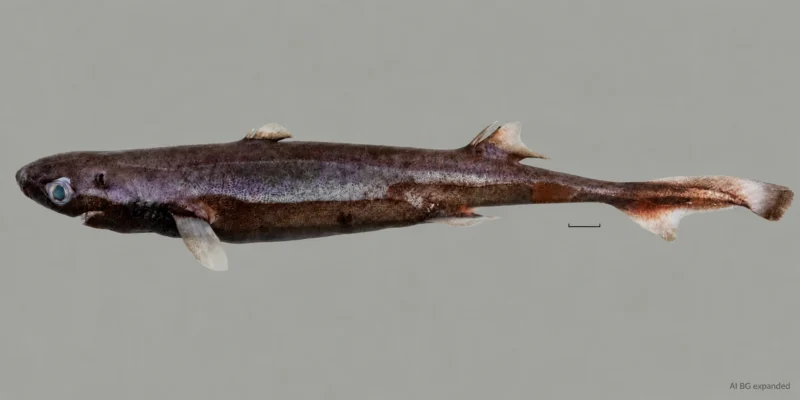
A previously unknown species of shark has been scientifically described off Mauritius: Etmopterus bulbosus, a small lanternshark with a conspicuously bulbous snout. The new study is based on physical characteristics and DNA data. So far, however, only a single specimen is known – therefore, little can be said about the species’ distribution and population.
A find from 400 to 500 meters depth
The animal was caught on June 7, 2025, during a research trip of the Dr. Fridtjof Nansen using a trawl net in open water. The find comes from the southwestern Indian Ocean off Mauritius, presumably from about 400 to 500 meters depth. The net was over a steep underwater slope; therefore, the catch depth does not equate to the water depth at the seabed.
It is a female that measured 21.5 centimeters long before preservation and afterwards still measured 21 centimeters. This is the length of this individual animal, not a confirmed maximum size of the new species. The size at sexual maturity is also unknown. As a holotype, that is, as a reference specimen for the species name, it is kept in the fish collection of South African Institute for Aquatic Biodiversity.
Snout and dermal denticles make the difference
The name bulbosus refers to the bulbous, swollen snout. In English, the researchers call the species ‘Big-nosed Lanternshark.’ However, what is decisive for differentiation is a combination of several features: the shape of the snout, a distinct field of enlarged, thorn-like dermal denticles above the pectoral fin base, as well as the shape of dark markings on the flanks and tail.
Particularly similar is Etmopterus sentosus, a lanternshark from waters off East Africa and Madagascar. It lacks the bulbous snout; moreover, its enlarged dermal denticles are arranged in two or three straight rows. In contrast, in E. bulbosus, they form a flat, non-linear field. The patterns also differ. The research team assigns the new species to the Etmopterus pusillus group.
DNA supports the new species, but does not clarify all relationships
Additionally, the researchers examined a section of the mitochondrial COI gene, which is frequently used for genetic differentiation of species. Compared to available comparison sequences of other species, the smallest measured difference was 10.29 percent. Together with the anatomical features, this supports recognition as a distinct species.
The exact position in the family tree remains open, however. The branching within the investigated group was only weakly supported statistically. The significant genetic distance is thus an argument for the independence of E. bulbosus, but it does not yet provide a reliable answer as to which species is its closest relative.
A single animal says little about the population
So far, the new species is known only from the location near Mauritius. This does not mean that it occurs only there or is necessarily rare. Further catches and investigations must show how widespread it is, which habitats it uses, and whether fishing affects its populations. From this single finding, neither a threat nor an all-clear can be derived.
The authors therefore emphasize the benefits of better identification aids and trained fisheries observers. If small deep-sea sharks caught as bycatch are not reliably identified at the species level, important foundations for stock monitoring and protective measures are missing.
How different new findings about lanternsharks can be is also shown by another already presented study: Off Albania, 319 examined animals provided indications of a possible deep-sea nursery. It concerned a known species and a larger sample; off Mauritius, research on the new species has only just begun.