


Etmopterus bulbosus
Body structure and characteristics
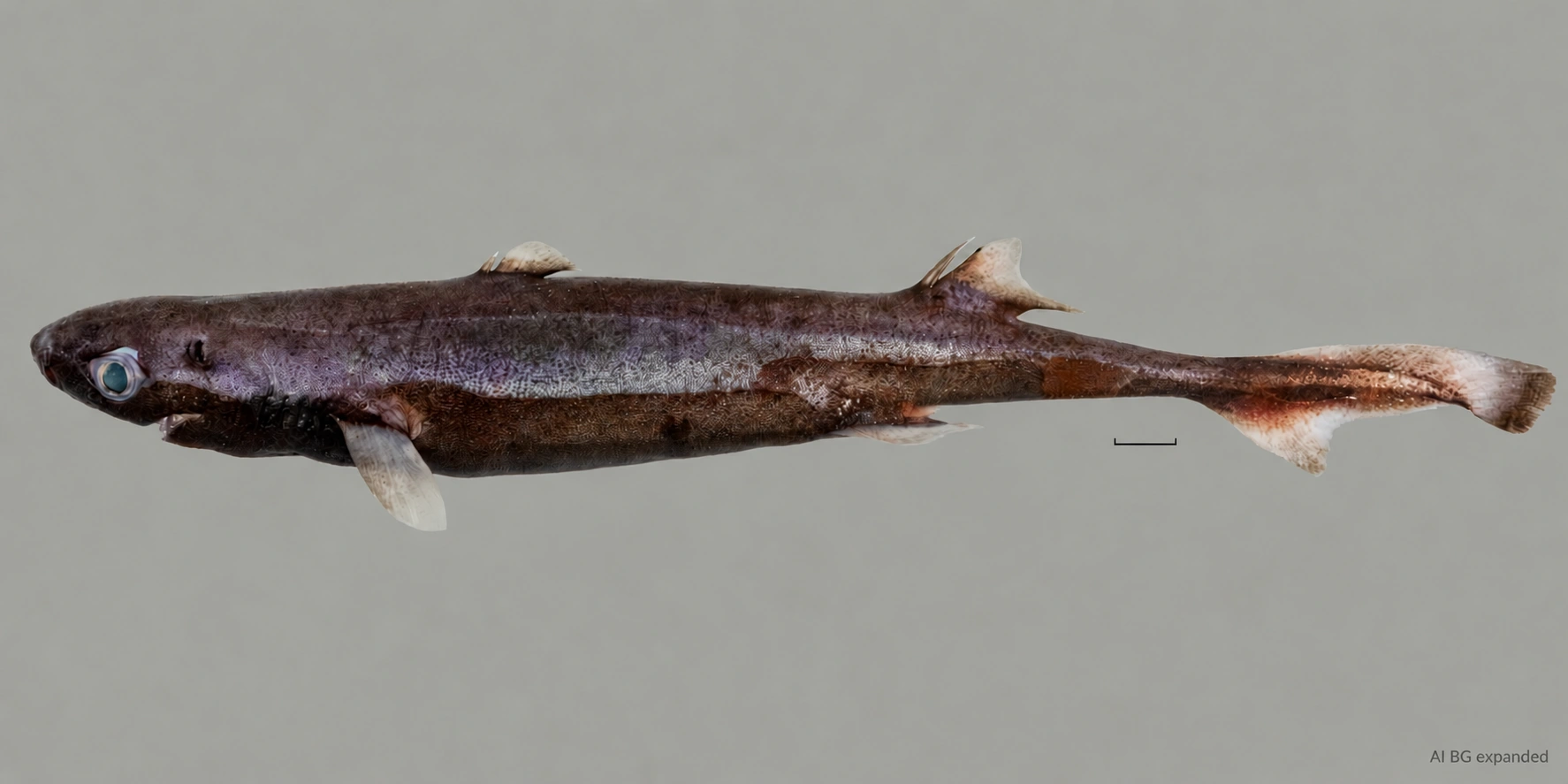
Etmopterus bulbosus has a spindle-shaped, nearly cylindrical body and a strikingly bulging snout. Above the base of the pectoral fins is a distinct area of enlarged, thorn-like dermal denticles. It extends upward to the middle of the back and backward slightly beyond the free tip of the first dorsal fin. Together with the shape of the dark flank and tail markings, this feature serves to distinguish it from related species.
The only known specimen is a female. It measured 215 millimeters in length when fresh; after preservation, its length was 210 millimeters. Therefore, the maximum size of the species and the size at sexual maturity are not determined. The fresh body was dark brown on top and on the sides with a purple sheen, the belly was black. The purple hue faded during preservation.
The second dorsal fin is significantly larger than the first; a spine stands in front of both. The teeth differ between the jaws: on top, they have several points, on the bottom, they form a cutting row with a single main point each. On the belly, flanks, and tail, the researchers describe characteristic light organ patterns. A direct observation of the bioluminescent behavior in the living animal is not reported.
The similarly appearing Etmopterus sentosus has no swollen snout and carries the enlarged dermal denticles in two or three straight rows. In the new species, they are arranged in a non-linear field. The original description combines these anatomical differences with a comparison of mitochondrial COI sequences. The smallest measured distance to the available comparison sequences of other species is 10.29 percent; however, the exact relationship within the E. pusillus group remains unresolved.
Threats and research needs
From the so far only specimen of Etmopterus bulbosus, neither the size of the population nor its development can be inferred. A concrete threat from fishing has not been demonstrated for the species. Likewise, the small number of finds does not justify classification as rare or immediately threatened.
The original description calls for additional samples in order to assess distribution, population status, and possible conservation issues. Capture with a research net shows that the species can be caught with this fishing method; it does not measure its pressure from commercial fishing.
Better identification aids and the training of fishery observers could help document lanternsharks in deep-sea catches at the species level. Without such records, misidentifications and unnoticed bycatch remain an obstacle to stock monitoring. A documented species-specific IUCN assessment is not provided here.
Distribution and habitat
So far, Etmopterus bulbosus is only known from one location off Mauritius in the southwestern Indian Ocean. This confirms its presence there, but neither a distribution limited exclusively to Mauritius nor a particular rarity.
The specimen was caught on June 7, 2025, during a research cruise of the Dr. Fridtjof Nansen using a mesopelagic trawl. The suspected capture depth was between 400 and 500 meters in open water above a steep slope. According to the description, the seabed at the fishing area descends from about 560 to 1120 meters; these seabed depths are not the capture depth of the shark.
The body shape leads researchers to assume a lifestyle near the bottom and in the overlying deeper open water. However, a single trawl capture does not allow a reliable description of the preferred habitats, the full depth range, or possible migrations. Further evidence is lacking to date.
Life and reproduction
For Etmopterus bulbosus, there are so far no direct observations of its behavior in its natural habitat. Diet, hunting behavior, daily rhythm, and migrations are unknown. A reliably confirmed list of food cannot be derived from body structure and teeth alone.
Reproduction, litter size, birth size, growth, and lifespan are also not documented for this species. The known female does not provide a determination of size at sexual maturity. The characteristics of other lanternsharks may stimulate research questions but do not replace species-specific evidence.
The description documents light organ patterns on several body regions. How the animal uses its light in open water and whether it serves camouflage, communication, or other functions has not been studied for this species.
Relationship to humans
The contact documented so far with Etmopterus bulbosus is of a scientific nature: the only known animal comes from a research catch. It is preserved under the collection number SAIAB 214299 in the South African Institute for Aquatic Biodiversity as the holotype and serves as a reference for the species description.
Diving encounters, attacks on humans, or deliberate commercial use are not documented in the original description. The suspected catch depth of 400 to 500 meters is far beyond ordinary recreational dives. However, this does not lead to any studied statement about the shark’s behavior towards humans.
For research and fishery observation, particularly the bulbous snout, the field of enlarged dermal denticles, and the flank and tail markings are useful identification features. Further well-documented finds could close important gaps regarding lifestyle and distribution.
Profile
- First described:
- Max. size:
- Depth:
- Max. age:
- Max. weight:
- Water type:
- IUCN Status:
Taxonomy
- Kingdom:
- Phylum:
- Subphylum:
- Infraphylum:
- Parvphylum:
- Class:
- Subclass:
- Superorder:
- Order:
- Family:
- Genus:
Newsletter
Shark Alert in Your Inbox