


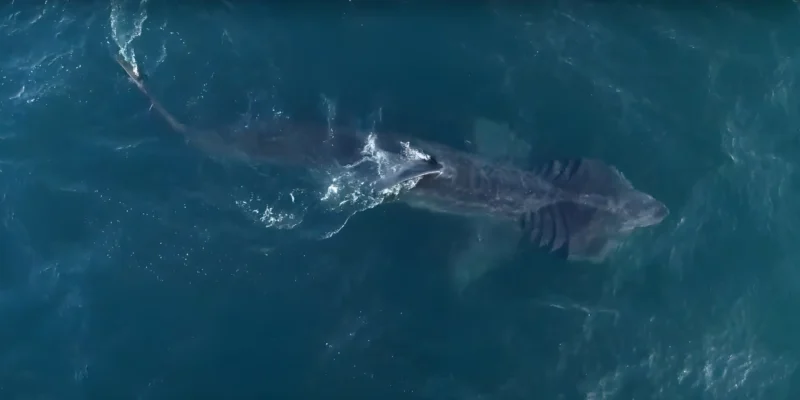
In front of Cap d’Agde, a juvenile basking shark was observed in the marine protected area of Côte Agathoise on Tuesday, June 2, 2026. For bathers and boat crews, a shark several meters long on the surface quickly appears spectacular. Biologically, the report is particularly exciting because it documents a rare but not unusual visit by a harmless plankton eater to the French Mediterranean.
You are currently viewing a placeholder content from Facebook. To access the actual content, click the button below. Please note that doing so will share data with third-party providers.
More InformationLoud Hérault Tribune came the tip from a member of Bateaux Agathois. The Aire Marine Protégée de la Côte Agathoise team then went out, observed the animal and confirmed the identification. This test was also important because basking sharks and blue sharks can be confused during fleeting sightings on the surface.
The local portal L’Agathois also classified the observation as a sighting of a basking shark in front of or near the harbor entrance of Cap d’Agde and refers to the Aire Marine Protégée as a source. This is not just a chance observation, but a confirmed report from the local protected area management.
Young, calm and apparently unharmed
Renaud Dupuy de la Grandrive, director of Aire Marine Protégée de la Côte Agathoise, told Hérault Tribune that the shark was seen again further east the following day. According to the experts’ impression, the animal did not appear injured. It also appeared to be a very young basking shark.
Such encounters are rare enough off the coast of Agde to attract attention, but not entirely surprising. According to the sanctuary, basking sharks have been observed several times in the region, mostly further out. Last year an animal was even said to have passed between Brescou and the port of Cap d’Agde.
For divers, boat crews and coastal visitors, the most important classification is simple: despite its size, a basking shark is not a dangerous predator for humans. It often swims slowly near the surface, filtering plankton from the water, making it appear impressive but calm.
Why basking sharks are so easily misunderstood
The basking shark (Cetorhinus maximus) is the second largest fish in the world. Large animals can reach lengths of several meters, the dorsal fin often protrudes above the water when feeding, and the wide-open mouth can look dramatic from a distance. It is precisely this silhouette that quickly raises alarm, even though the animal has a completely different ecological role than large hunting sharks.
basking sharks are plankton eaters. They follow small crustaceans and other concentrations of plankton that can collect near shore due to currents, temperature, nutrients, and season. If an animal appears in front of Cap d’Agde, it is not an indication of a threat to bathers, but rather a sign that the coastal waters currently offer food.
This distinction is particularly important in the Mediterranean. Sightings of large sharks quickly become emotionally discussed in local media. Factual identification, good photos or videos and a calm assessment by experts prevent a rare protected guest from being misunderstood as a danger.
Every report helps research
For the protected area, the observation is more than just a nice story. Every confirmed sighting is documented and incorporated into databases on marine biodiversity on the Mediterranean coast. Such entries help to better understand seasonal presence, migration and recurring residences.
In the case of migratory species such as the basking shark, individual observations are particularly valuable because the animals migrate far and are often only visible in one place for a short time. A single detection does not replace a long-term study, but many clean reports together can reveal patterns: when animals appear, whether young individuals use the coast, and what conditions make sightings more likely.
This is also relevant for marine protected areas. The Aire Marine Protégée de la Côte Agathoise does not protect an isolated setting, but a vibrant stretch of the Mediterranean where seagrass beds, fish, invertebrates, marine mammals and the occasional large cartilaginous fish come together. A young basking shark makes this connection visible.
How to behave in the event of a sighting
Anyone who sees a basking shark from a boat should keep their distance, do not cut off the path and do not make any hectic attempts to approach it. Young animals in particular can be stressed by being chased, made loud or crossing the swimming path multiple times. Good recordings are valuable, but they are no reason to harass an animal.
Instead, it makes sense to report the time, location, behavior, estimated size and, if possible, photos or videos to the responsible local authorities. This turns an impressive moment at sea into a usable data set for research and protection.
The sighting off Cap d’Agde shows exactly the side of shark protection that often remains quiet: not every shark near the coast is a conflict. Sometimes it’s a rare, peaceful visitor, reminding us how much life passes through the Mediterranean just outside popular resort towns.
