


Zebra Shark - Stegostoma tigrinum

Body structure, features & anatomy
The zebra shark, scientifically known as Stegostoma tigrinum, is one of the most fascinating shark species in tropical seas. It is known for its distinctive spots as an adult and the contrasting stripes as a juvenile. This striking change in markings makes the zebra shark an exceptional sight for both divers and marine biologists. Below, we take a detailed look at its body structure, external characteristics and the differences between female and male animals.
Body structure of the zebra shark
The zebra shark belongs to the so-called carpet sharks and can reach a length of up to 3.5 metres. Its body is elongated yet muscular and extremely flexible. This anatomy enables it to search for food in narrow crevices in reefs. Particularly striking is its broad, flattened head with laterally positioned eyes and the conspicuously long barbels, which help it to detect prey even in the sand.
Distinctive fin structure
Characteristic of the zebra shark are its long pectoral fins, which appear almost wing-like. Combined with its powerful tail fin, it can glide through the water elegantly and seemingly effortlessly despite its size. The dorsal fins are comparatively small and inconspicuous, which clearly distinguishes it from many other sharks.
Skin and markings
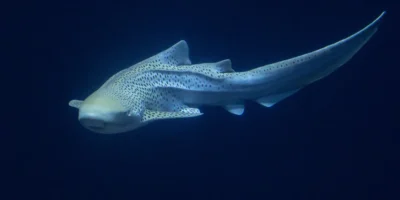
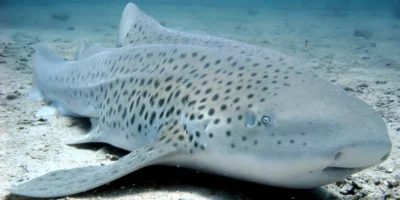
The skin of the zebra shark is covered with small dermal denticles, giving it a slightly rough surface. While juveniles are still dark with white transverse stripes – hence the name “zebra shark” – they lose these stripes as they age. Adults instead display a pattern of dark spots on a light-brown background, strongly reminiscent of a leopard. This is where the alternative name “leopard shark” comes from. This change in colour is a unique feature within the shark family and also serves an important camouflage function.
Anatomical features in detail
The zebra shark’s skull is robust and houses a powerful set of jaws with pointed, but comparatively small teeth. These are perfectly suited to taking its preferred food, which consists mainly of molluscs, crustaceans and small fish. Particularly noteworthy is also the enormous flexibility of its body, which enables it to manoeuvre through narrow rock crevices and reef structures.
Respiratory organs and sensory systems
Like many bottom-dwelling sharks, the zebra shark has small spiracles behind the eyes, which allow it to pump water through the gills even while resting. This makes it particularly adaptable during its frequent breaks on the seabed. Its sensory organs, including the ampullae of Lorenzini, are highly developed and give it the ability to detect even weak electrical fields from potential prey.
Differences between males and females
When looking at the differences between the sexes, it is noticeable that adult females are generally larger and more robustly built than males. While males reach an average length of about 2.5 to 3 metres, females can grow up to 3.5 metres long. Another clearly recognisable distinguishing feature is the so-called claspers: these are paired appendages in males on the pelvic fins that play a role in reproduction. Female zebra sharks do not show this anatomical feature.
Body proportions also differ slightly. Females usually have broader flanks, which is linked to their reproductive capacity, as they can develop larger eggs. Males, by contrast, appear somewhat slimmer and often have a longer tail fin in relation to the body.
Habitat & distribution
The zebra shark, also known as the leopard shark, is an impressive shark species of tropical seas. With its striking patterning and adaptable way of life, it is one of the most distinctive representatives of the underwater world. Particularly fascinating is its distribution in the warm regions of the Indo-Pacific, as well as its close association with specific habitats such as coral reefs and lagoons. This article provides a detailed overview of the geographical range and preferred habitats of the zebra shark.
Geographical distribution
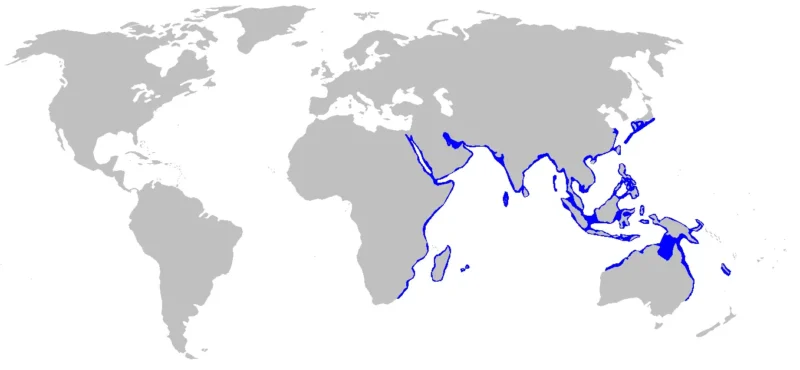
The zebra shark is found primarily in the Indo-Pacific. Its range extends from the east coast of Africa to the tropical waters of the western Pacific. It is frequently observed off Tanzania, Mozambique and Madagascar, as well as around India, South-East Asia and northern Australia. Further east, its habitat extends to the Philippines, the Solomon Islands and New Caledonia. This wide distribution shows that it is a very successfully adapted inhabitant of tropical seas.
Fringe areas of its range
Although the zebra shark is primarily native to tropical climate zones, there are also records from somewhat more temperate regions. It has occasionally been sighted as far north as the southern waters of Japan and as far south as New Zealand. However, such marginal areas are more the exception for it, as it depends on warm water temperatures.
Preferred habitat
The zebra shark is considered a bottom-dweller that prefers to stay in shallow coastal waters. Its habitat consists mainly of coral reefs, lagoons and sandy areas between reef structures. There it not only finds protection from larger predators, but also an abundant food supply. During the day it is particularly often found lying in rock crevices or on the seabed, where its pattern provides excellent camouflage.
Depth and temperature
Most zebra sharks live at depths of 5 to 30 metres. They rarely move deeper than 70 metres. They prefer warm tropical waters with temperatures between 24 and 30 degrees Celsius. These conditions are crucial for their reproduction and growth.
Role in the ecosystem
In their habitat, zebra sharks play an important role as bottom hunters. They feed on molluscs, crustaceans and small fish that they find in sandy seabeds or among corals. In this way, they help regulate populations of smaller marine organisms and promote ecological balance in the reefs.
Adaptability to habitat
A special feature of the zebra shark is its ability to camouflage extremely well. While adult animals appear almost invisible among corals and rock structures thanks to their spotted patterning, juveniles use their striped pattern to hide in seagrass beds. This adaptation protects them from predators and shows the shark’s close connection to its environment.
Movement patterns within the habitat
Unlike many predatory sharks, the zebra shark is not specialised in long migrations. Most animals remain in their familiar area for long periods. Studies suggest that they only travel short distances when searching for new hunting grounds or hiding places. However, this site fidelity makes them particularly vulnerable to changes in their habitat, such as coral die-off or human interference.
Lifestyle, diet & reproduction
The zebra shark has specialised as a crepuscular and nocturnal hunter. During daylight hours it usually rests motionless on the seabed and develops a remarkable breathing technique: it props itself up on its pectoral fins and points its open mouth into the current.
This passive ventilation occurs by alternately opening and closing the mouth, pumping oxygen-rich water over the gills. This ability for buccal pumping distinguishes zebra sharks from many other shark species, which must swim constantly to obtain sufficient oxygen.
Swimming behaviour and movement characteristics
Zebra sharks are generally slow and unhurried swimmers, but can become surprisingly agile when needed. Their swimming technique is characterised by eel-like undulating movements of the entire body and tail, enabling efficient locomotion.
Particularly notable is their ability to squeeze through narrow crevices and caves, made possible by their flexible, slender body shape. This trait is essential to their hunting strategy and allows them to search for prey even in the tightest reef crevices.
Diet and hunting behaviour
Specialised in invertebrates on the seabed
The zebra shark’s diet mainly focuses on invertebrates on the seabed. Bivalves and snails form the main food, supplemented by various crustaceans such as crabs and prawns, as well as small bony fish.
The small, trident-shaped teeth are perfectly adapted to these feeding habits. With 20 to 23 rows of teeth in each jaw, they can effectively crush hard shells. The muscular oral cavity generates a strong suction effect, allowing them to extract prey from its hiding places.
Nocturnal hunting strategy
As dusk falls, the zebra shark, which rests during the day, turns into an active hunter. It methodically searches the seabed for food, using its barbels on the snout as sensory organs. These whisker-like sensory organs help it to locate hidden prey in crevices and under sand.
Its flexible body structure enables it to penetrate areas that are inaccessible to other sharks. In narrow caves and reef crevices, it systematically tracks down the hiding places of molluscs and crustaceans.
Reproduction and development
Egg-laying as a reproductive strategy
Zebra sharks are among the egg-laying shark species (oviparous) and display fascinating reproductive behaviour. Males reach sexual maturity at a body length of 150 to 180 centimetres, females at around 170 centimetres.
Mating takes place through characteristic courtship behaviour: the male follows the female and bites vigorously into her pectoral and caudal fins before coiling around her and inserting one of his claspers into her cloaca. Copulation lasts between two and five minutes.
You are currently viewing a placeholder content from Facebook. To access the actual content, click the button below. Please note that doing so will share data with third-party providers.
Unique egg cases and development
After fertilisation, the female produces up to four large egg capsules at once, among the most impressive in the shark realm. These dark brown to purple eggs measure about 17 centimetres in length, eight centimetres in width, and five centimetres in thickness.
Particularly noteworthy are the hair-like fibres along the sides of the egg cases. The female uses these fibres skilfully to anchor the eggs to coral structures or other solid objects on the seabed. In doing so, it swims around vertical structures and wraps the fibres around them to ensure secure attachment.
The embryos’ development takes between four and six months, depending on the water temperature. The hatchlings are already 20 to 36 centimetres long and have proportionally longer tails than adult animals.
Parthenogenesis as an evolutionary peculiarity
One of the most remarkable biological traits of the zebra shark is its ability to reproduce by parthenogenesis, or virgin birth. Several cases have been documented in which female zebra sharks in aquariums produced viable offspring even without the presence of males.
Particularly spectacular was the case of the zebra shark female “Leonie” in an Australian aquarium, which suddenly produced offspring again three years after being separated from her partner. Genetic tests confirmed that the young had arisen through parthenogenesis and not, for example, through sperm storage.
Threats & conservation status
The IUCN’s assessment of the zebra shark as “Endangered” is alarming and highlights the dramatic situation of this species in the wild. The main threats come from targeted and incidental fishing, particularly in the Indo-Pacific, where zebra shark eggs are traded and the adults are brutally killed for the shark-fin market.
The situation in aquariums is particularly critical. Although captive-breeding programmes and animal exhibits can make a localised contribution to species conservation and communicating marine protection, keeping them in captivity often conflicts with their species-specific needs. Zebra sharks are demanding animals that, in cramped tanks, often show behavioural abnormalities such as apathy or stereotypical swimming. Injuries caused by transport and husbandry errors are frequently documented. In the long term, aquarium keeping and captive breeding amount to little more than symbolic politics as long as natural habitats continue to be destroyed. The real solution lies in protecting and restoring intact wild populations and in consistently limiting the trade in shark fins and wild-caught specimens.
Profile
- First described:
- Max. size:
- Depth:
- Max. age:
- Max. weight:
- Water type:
- IUCN Status:
Taxonomy
- Kingdom:
- Phylum:
- Subphylum:
- Infraphylum:
- Parvphylum:
- Class:
- Subclass:
- Superorder:
- Order:
- Family:
- Genus:
Dive Centres


News


Newsletter
Shark Alert in Your Inbox