
Atlantic nurse shark - Ginglymostoma cirratum
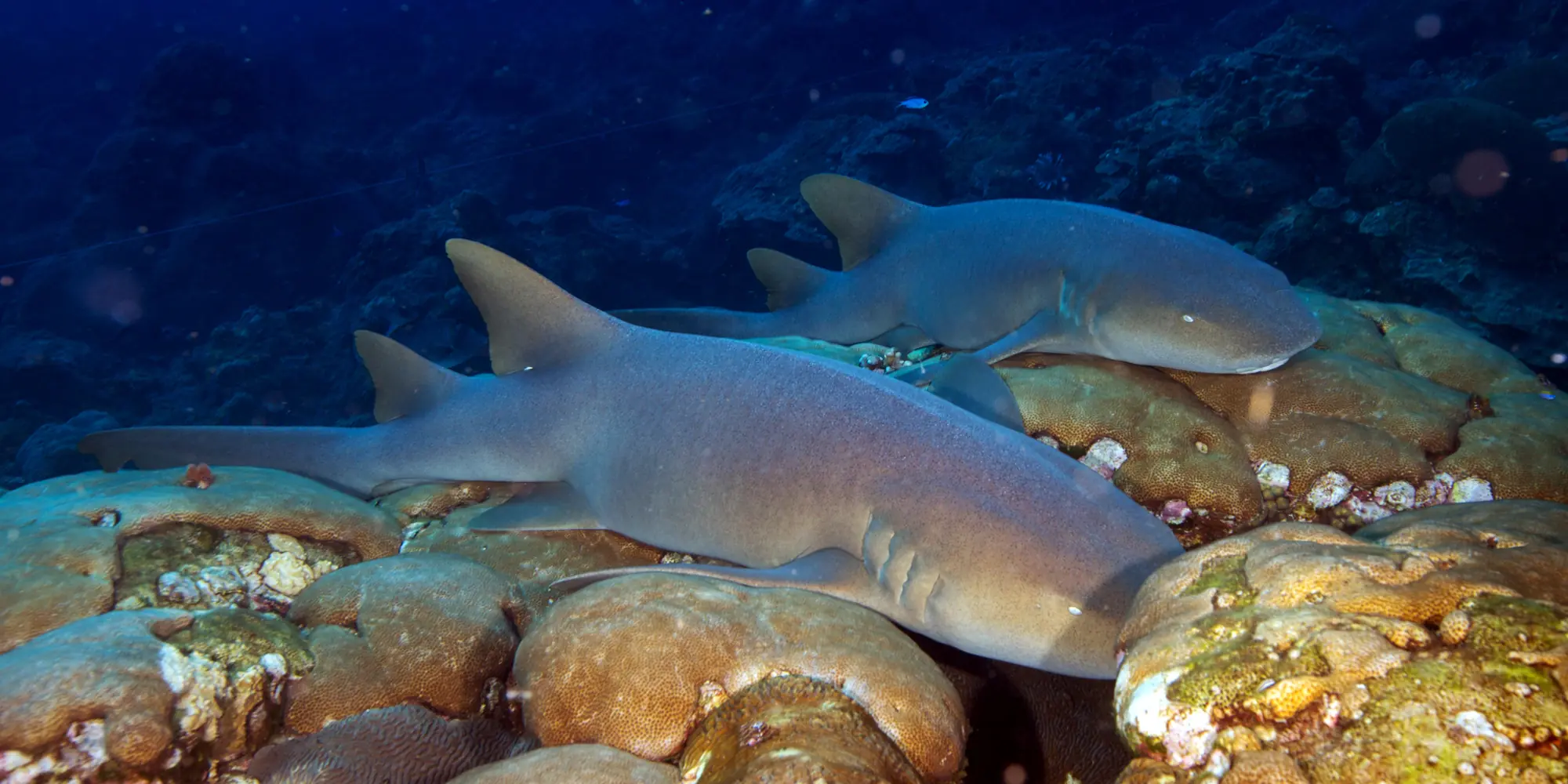
Body structure, features & anatomy
Body shape and basic structure
The Atlantic nurse shark has a stocky, massive body with a distinctly cylindrical cross-section. The trunk is broad and muscular, giving the animal high stability on the seabed. The head is broad and flattened, clearly set off from the trunk and, relative to the overall length, unusually large. The body shape is designed for slow, controlled movements and differs markedly from the streamlined pelagic sharks.
Skin structure and surface features
The skin is covered with thick, closely spaced placoid scales. These dermal denticles are small, rounded and create a comparatively smooth surface. The structure reduces mechanical stress when in contact with the bottom and protects against abrasion. The upper side usually shows brown to grey-brown tones with variable spotting. The underside is distinctly lighter. Overall, the skin is more robust and thicker than in many other shark species of similar size.
Fin arrangement and construction
The Atlantic nurse shark has two strikingly large dorsal fins that are set far back. The first dorsal fin begins behind the base of the pelvic fins. The second dorsal fin is only slightly smaller. The pectoral fins are broad, fleshy and strongly muscled. They serve less for buoyancy than for stabilisation and bracing against the substrate. The tail fin is asymmetrical with an elongated upper lobe, but is less pronounced than in fast-swimming species.
Mouth position, jaws and teeth
The mouth is underslung and sits well behind the tip of the snout. This position is typical of bottom-dwelling sharks. The lips are strongly developed and, together with the oral cavity, form an effective suction structure. The jaw apparatus is powerful, but not designed for cutting. The teeth are small, conical and arranged in several rows. They have no sharp cutting edges, but serve to hold onto prey.
Gills and respiratory organs
Five gill slits are located laterally behind the head. In addition, the Atlantic nurse shark has large spiracles behind the eyes. These allow water intake for breathing even when resting on the seabed. The spiracles are functionally more important than in many other shark species and compensate for the limited forward movement during breathing.
Musculature and locomotor system
The musculature is compact and evenly distributed along the trunk. Red muscle fibres predominate compared with fast-swimming species, which is suited to sustained, slow movements. The tail musculature is powerful, but not optimised for high acceleration. The pectoral fin musculature is particularly well developed and supports bracing as well as precise changes of direction.
Skeleton and cartilage structure
Like all sharks, the Atlantic nurse shark has a fully cartilaginous skeleton. The skull is massively built and provides stable attachment points for the strong jaw muscles. The vertebral column is flexible, but less specialised for lateral undulations than in pelagic species. The cartilage structure is partially calcified, which increases the body’s stability.
Sense organs and sensory anatomy
The eyes are relatively small and positioned on the sides. They are adapted to low-light conditions, but play a subordinate role. The ampullae of Lorenzini are clearly pronounced, mainly concentrated in the head region. They enable the perception of electric fields. The lateral line organ runs clearly visible along the sides of the body and detects pressure waves and water movements. In addition, the Atlantic nurse shark has paired barbels in front of the mouth, which pick up mechanical and chemical stimuli.
Internal anatomical features
The liver is large and rich in oil, which contributes to buoyancy regulation. The stomach is expandable and adapted to irregular feeding. The intestine has a spiral structure that increases the surface area for nutrient absorption. The heart and circulatory system correspond to the typical structure of cartilaginous fishes and are designed for a slow, energy-efficient metabolism.
Lifestyle, Diet & Reproduction
Lifestyle
The Atlantic nurse shark Ginglymostoma cirratum shows a distinctly bottom-oriented lifestyle. It spends most of its time resting on the seabed and remains motionless for large parts of the day in caves, under overhangs, or on sandy and rocky bottoms. Periods of activity are mainly concentrated during the night. This nocturnal activity is directly linked to its search for food.
The species is comparatively site-faithful. Individuals use the same resting places over long periods. During resting phases, the shark often lies closely packed with others of its species, which is rather rare among sharks. These gatherings do not serve social interaction, but arise from the shared use of suitable refuges.
Movement is usually slow and controlled. The Atlantic nurse shark is not a continuous swimmer and uses its ability to actively pump water over the gills. This allows it to remain on the bottom for long periods without moving.
Diet
The diet of the Atlantic nurse shark consists mainly of bottom-dwelling invertebrates and smaller fish. These include crustaceans, molluscs, sea urchins, as well as benthic bony fish. Prey is usually taken close to the bottom or from crevices and caves.
Prey capture does not occur through pursuit, but through a combination of touch, chemoreception and a suction mechanism. The shark uses its barbels to search the substrate. As soon as prey is located, it creates a strong negative pressure by rapidly opening its mouth. This sucks the prey in. Hard shells can be crushed with the powerful jaw apparatus.
This feeding method allows the Atlantic nurse shark to exploit food sources that are difficult to access and are scarcely reachable for fast-swimming shark species. The hunting strategy is energy-efficient and adapted to a calm way of life.
Reproduction
The Atlantic nurse shark is ovoviviparous. The embryos develop in the mother’s womb from yolk-rich eggs, without a direct placental connection. After a gestation period of around five to six months, the female gives birth to live young.
Depending on the female’s body size, litter size is usually between 20 and 30 pups. Newborns measure around 25 to 30 centimetres in length. Birth takes place in shallow coastal areas, which serve as protected nursery grounds.
Mating is characterised by pronounced copulatory behaviour. Males bite the female’s pectoral fins to hold position for fertilisation. This behaviour can lead to visible injuries, which usually heal without lasting effects.
The young grow slowly. Sexual maturity is only reached after several years, which makes the species sensitive to intensive exploitation and habitat loss.
Distribution & Habitat
The Atlantic nurse shark is distributed in the western and eastern Atlantic. Its occurrence is concentrated in tropical and subtropical regions with warm water temperatures.
In the western Atlantic, its range extends from the coasts of the south-eastern United States via the Gulf of Mexico and the Caribbean down to Brazil. The species is particularly frequently recorded in the shallow coastal waters of Florida, the Bahamas and the Greater Antilles.
In the eastern Atlantic, the species is significantly rarer. Confirmed records exist along the West African coast, including off Senegal, Ghana and Cameroon. These occurrences are considered fragmented and markedly less dense than in the western Atlantic.
Habitat types
The Atlantic nurse shark is strongly tied to coastal habitats. It prefers shallow marine areas with a structurally rich substrate that offers shelter and resting places.
Coral reefs
Coral reefs are among the most important habitats for the species. The shark prefers to stay close to reefs, where it rests during the day in crevices, caves or under overhangs. The complex structure of the reefs provides protection from currents and disturbance.
Seagrass meadows and sandy bottoms
Seagrass meadows and adjacent sandy areas are also used regularly. These zones are usually in shallow water and serve both as resting areas and as transitional habitats between reefs and deeper areas.
Mangrove areas
In some regions, mangroves are used as habitat. Shallow, sheltered lagoons with muddy or sandy substrates provide stable environmental conditions. Juveniles, in particular, spend time there at certain periods.
Depth distribution
The Atlantic nurse shark lives predominantly in very shallow water. Most observations come from depths between one and twenty metres. Occasionally, the species is also recorded at depths of around seventy metres, but it remains the exception there.
The strong association with shallow depths is linked to the species’ preferred habitat and resting behaviour. Deeper open water is avoided.
Environmental conditions
The Atlantic nurse shark prefers water temperatures above twenty degrees Celsius. Cold currents and seasonal cooling limit its permanent occurrence. In marginal areas of its range, seasonal migrations to warmer coastal stretches may occur.
The species shows high site fidelity. Individual sharks use the same reefs or coastal stretches over long periods, provided these offer stable environmental conditions.
Importance of coastal habitats
The close association with coastal ecosystems makes the Atlantic nurse shark particularly dependent on intact shallow-water habitats. Coral reefs, seagrass meadows and mangroves are crucial for its long-term occurrence.
Changes to these habitats through coastal development, pollution or reef damage directly affect the species’ regional distribution.
Threats & Conservation status
Threat level
The Atlantic nurse shark Ginglymostoma cirratum is exposed to several anthropogenic pressures, which vary in severity from region to region. One of the main threats is accidental capture in coastal fisheries. The species is regularly caught as bycatch in gillnets, bottom trawls and longlines. Due to its bottom-dwelling habitat, it is particularly vulnerable to fishing methods that affect the seabed.
In some regions, the Atlantic nurse shark is targeted by fisheries. Its meat, liver oil and skin are used locally. Live animals are also captured for public aquariums. These removals often affect sexually mature individuals and can sustainably weaken local stocks.
Another significant factor is the loss of suitable habitats. Nearshore coral reefs, seagrass meadows and shallow lagoons serve as resting and breeding areas. These habitats are increasingly affected by coastal development, pollution, sediment input and physical destruction. As the Atlantic nurse shark is site-faithful, the loss of individual habitats can have direct impacts on local populations.
The slow reproductive rate increases the species’ vulnerability. The combination of late sexual maturity, limited litter size and a long generation time means that populations recover only slowly from declines.
Conservation status
The Atlantic nurse shark is classified as Near Threatened by the International Union for Conservation of Nature. This assessment is based on regional population declines and its high sensitivity to fishing pressure and habitat loss. In some sub-areas, populations are already considered significantly reduced.
In several countries, nurse sharks are protected under national legislation. Catch bans, possession bans and restrictions on trade have been introduced to reduce pressure on the species. In protected areas and marine reserves, the Atlantic nurse shark demonstrably benefits from strictly regulated uses.
Internationally, there is no uniform protection status. The species is not comprehensively covered by global species-protection agreements. As a result, regional differences in legal treatment and management persist.
Effectiveness of conservation measures
Studies from protected areas show that local populations can stabilise or recover when fishing is excluded or severely restricted. Large-scale protected areas with clear enforcement mechanisms are particularly effective. Due to the Atlantic nurse shark’s site fidelity, such measures can be targeted effectively.
In the long term, the conservation of suitable coastal habitats is crucial. Measures to protect reefs, mangroves and seagrass meadows indirectly contribute to the protection of the species. In addition, monitoring programmes are necessary to detect population trends at an early stage and to adapt management strategies.
Profile
- First described:
- Max. size:
- Depth:
- Max. age:
- Max. weight:
- Water type:
- IUCN Status:
Taxonomy
- Kingdom:
- Phylum:
- Subphylum:
- Infraphylum:
- Parvphylum:
- Class:
- Subclass:
- Superorder:
- Order:
- Family:
- Genus:
Dive Centres

Epic Diving
{post_terms_country}
Atlantis Divers
{post_terms_country}
Dressel Divers Montego Bay
{post_terms_country}
Ocean Encounters
{post_terms_country}
Splash Dive Centre
{post_terms_country}
Eco Dive School
{post_terms_country}
Green Turtle
{post_terms_country}Jedivers
{post_terms_country}
Deep Dive Mexico
{post_terms_country}


News


Newsletter
Shark Alert in Your Inbox


