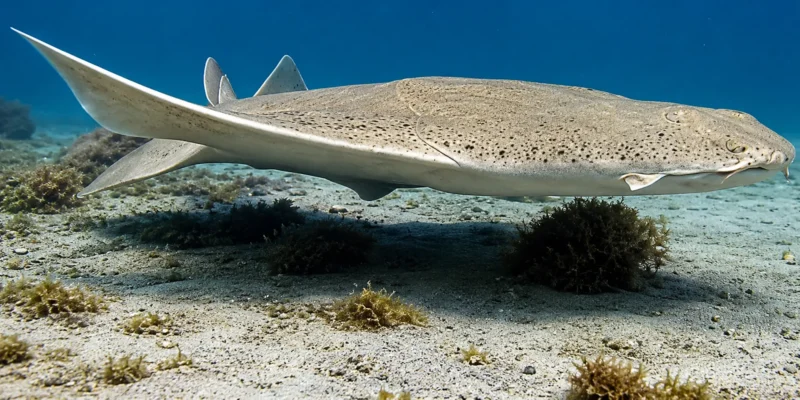
An extremely rare sawback angelshark (Squatina aculeata) accidentally landed in a trammel net. The discovery is sad, but scientifically valuable: a new one Open access study in Marine Biodiversity combines morphology, DNA analysis, stomach contents and vertebral ligaments to learn more about one of the Mediterranean’s rarest shark species.
The animal was a female 144.7 centimeters long and weighed around 25 kilograms. It was found in April 2023 off Avola, on the east coast of Sicily, during a commercial cuttlefish fishery at a depth of about 16 meters on a sandy bottom. By the time the net was hauled in, the shark was already dead.
Precisely because the species is so rarely observed, every reliable data set counts. The researchers were not only able to identify the animal externally, but also genetically confirm the species classification. This is important because angel sharks can be confused in the Mediterranean and misidentification directly weakens conservation programs.
A single shark, a lot of data
The study evaluated the find in an unusually broad manner. In the laboratory, 72 morphological measurements were taken, the tissue was used for COI DNA analysis, the stomach contents were examined and vertebral bodies were ground thin to make growth bands visible. In addition, older reports of finds from the central and eastern Mediterranean region were brought together.
The genetic analysis confirmed the morphological determination: the examined sequence matched Squatina aculeata. The external characteristics also matched the sawback angelshark, including thorns on the back, heavily fringed nose flaps and the lack of noticeable eye spots on the body.
The reproductive state is particularly exciting. According to the authors, the female was in a post-reproductive stage. So it had apparently recently reproduced or was in a post-reproduction recovery phase. By itself, this doesn’t prove a nursery, but it fits with other evidence from the region.
Why the nursery question is so important
A marine area is not considered a nursery or breeding area simply because a young animal appears there. What is crucial is a recurring pattern: pregnant females, newborns or young animals have to be observed there more often or over longer periods of time than elsewhere. This is exactly where the find from Sicily becomes interesting.
The study points to several pieces of the puzzle from the central Mediterranean: a pregnant female sawback angelshark southeast of Lampedusa, very small animals, juveniles and larger sexually mature individuals from the region between southern Sicily, Malta, the North African coast and the Aegean Sea. Together, this doesn’t create a finished protected area on the map, but it does create a clear search image.
The authors therefore formulate it cautiously: The central and eastern Mediterranean could be particularly important for certain life phases of the sawback angelshark. For a species that is so rare, this very caution can be crucial. Protection shouldn’t just start when all the data is perfect.
What the stomach and the vertebrae reveal
The diet also provided clues about the life of this animal. The stomach was more than half full. The researchers found eight prey remains, all from bony fish; A prey fish was identified as a two-banded bream (Diplodus vulgaris) can be identified. This suits the shallow fishing location on sandy bottom.
The researchers interpret the vertebral ligaments even more carefully. They counted 28 transparent bands in the vertebral bodies examined and identified a birth mark from which an estimated birth length of around 21.8 centimeters can be derived. This is not a reliable age value because it has not yet been validated how regularly such bands form in angel sharks.
But that is exactly where the value of the work lies: it does not provide a simple number, but rather shows which methods could help with this type of research in the future. Validated growth data is missing for many sharks and rays in the Mediterranean. Without them, population models, recovery times and conservation priorities remain unclear.
A species on the verge of disappearance
The sawback angelshark is one of the most endangered shark species in the Mediterranean. Angel sharks live close to the bottom, resting on sandy or muddy surfaces and therefore easily get caught in bottom trawls, gillnets, longlines or trammel nets. These same fishing gears are active in many parts of their historical range.
The study recalls that the catch and trade of the three Mediterranean angel shark species have been banned since 2012 following recommendations from the General Fisheries Commission for the Mediterranean and the species are listed in conservation agreements. So on paper the protection is there. In practice, bycatch, misidentification and missing data remain the major weak points.
- Bycatch remains the key immediate threat.
- Fishermen and observers need safe identification aids and release protocols.
- Possible growth areas must be specifically monitored.
- Finds should be documented with location, depth, fishing gear, photo and condition of the animal.
- Protective measures must take effect where angel sharks actually still occur.
Why the discovery off Avola counts
A dead shark is not good news. But for a species that has become almost invisible in the Mediterranean, even tragic bycatch can provide crucial clues. The discovery off Avola shows that sawback angelsharks still occur in the region, that adult females appear there and that modern methods can be usefully combined even from rare individual events.
For divers, the story is a silent reminder of how much hidden life exists on the ocean floor. Angel sharks are not spectacular blue-water silhouettes. They lie flat in the sand, perfectly camouflaged, and disappear from the statistics when no one is looking closely.
The most important message of the study is therefore not that Sicily is now definitely a nursery of sawback angelshark. The message is more cautious and perhaps more important: the central Mediterranean deserves significantly more attention because it is where several clues about critical life stages of this endangered species converge.