


Region Réunion will allocate a total of €643,165 in 2026 for two pillars of coastal safety. Of this, €493,165 will go to the Centre Sécurité Requin and €150,000 to the RESSAC rescue and monitoring network. This was reported by Imaz Press and Mémento following the meeting of the Standing Committee of the Regional Council on August 21, 2026.
This decision thus secures both operational measures to reduce the risk of shark attacks and patrols, rescue operations, and assistance for water sports enthusiasts. At the same time, it includes a politically important caveat: the continuation of the preventive fishing strategy will be renegotiated with government authorities.
€493,165 for Centre Sécurité Requin
The Regional Council confirmed its funding contribution for Groupement d’intérêt public Centre Sécurité Requin, abbreviated GIP CSR. The facility is designated as the central operator for shark risk reduction under Réunion. According to the published meeting minutes, in 2025 it continued preventive fishing and conducted research programs on shark populations and the effectiveness of the implemented risk management measures.
For 2026, the resolution specifies two concrete next steps: The mandate for preventive fishing is to be renewed, and a research call on sharks is planned. The two press releases do not specify catch numbers, target species, fishing methods, or the exact conditions of the research call. Therefore, it is not possible to determine from the approved sum what proportion is allocated to fishing, research, data collection, or other tasks.
Preventive fishing is under review again
The combination of funding and the review mandate is noteworthy. On the one hand, the regional contribution for 2026 was approved and the renewal of the fisheries mandate was announced. On the other hand, the Standing Commission explicitly requested that the question of continuing this strategy be discussed with the services of French state.
This is not yet a decision to end preventive fishing. Nor do the sources specify a date, procedure, or criteria for the announced consultation. What is certain is that the measure is not to be treated as a permanently unchanged component of the strategy, but will be discussed again at the political and administrative levels.
€150,000 for patrols, rescue, and coastal safety
You are currently viewing a placeholder content from Facebook. To access the actual content, click the button below. Please note that doing so will share data with third-party providers.
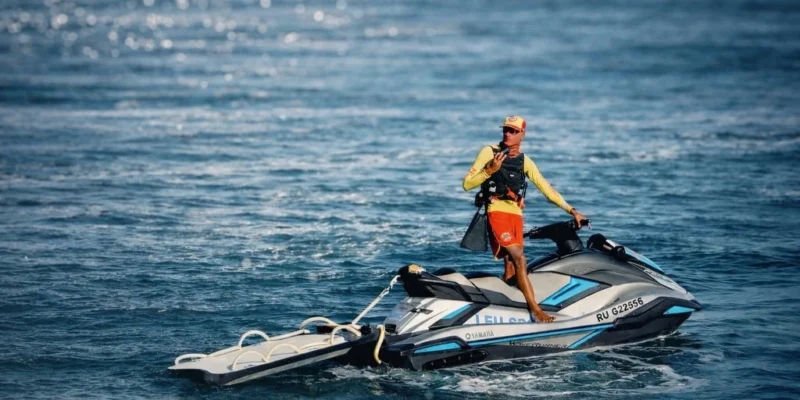
More InformationThe second grant goes to Réseau d’Éducation et de Sauvetage pour la Sécurité des Activités Côtières, founded in 2025, or RESSAC for short. The association continues the programs “Vigies Requins Renforcées” of the Réunion Surf League and “Water Patrol” of Leu Tropical Surf Team and has expanded its area of operation to include safety, rescue and support of all coastal users within the 300-meter zone.
For 2025, the meeting documents show 116 operations in L’Étang-Salé and 117 operations in Saint-Leu. Nearly 300 users were monitored on each of the days of operation. In addition, there were 110 assistance and rescue operations. How such a patrol reacts to a shark sighting was demonstrated on August 9: After a bull shark report at Étang-Salé, the surf spot was evacuated as a precaution; no one was injured.
Two Different Tasks Under One Safety Goal
The two funding programs should not be confused. RESSAC works directly on the coast with monitoring, warning, assistance, and rescue. Centre Sécurité Requin combines shark risk management measures and research, including, until now, preventive fishing. Together, the programs form different levels of the safety strategy on the west and south coasts of the island in the Indian Ocean.
The decision ensures the financial viability of this structure for 2026, but does not yet answer the most controversial strategic question. Whether and in what form preventive fishing will continue after the announced consultation with the government remains to be seen. Crucially, the further debate will depend on whether it is conducted with transparent data on catches, species, research findings, effectiveness, and ecological consequences.
On the new administrative appeal: Shark conservationists demand tighter limits on shark killing off Réunion.