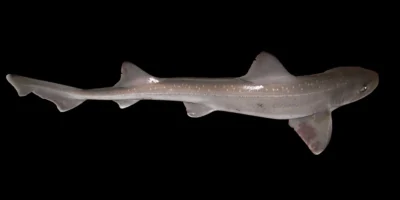
Sharks are far from rare off the Dutch coast. Around Neeltje Jans in Zeeland, researchers encounter numerous starry smooth-hounds in summer—including growing numbers of juveniles. During Sharkatag 2026, selected sharks were caught, measured, tagged and immediately released.
A report from NOS Jeugdjournaal followed the fieldwork. Shark researcher Niels Brevé explains why the smallest sharks and large females are particularly important to the project.
A small North Sea shark—not a tropical predator
The report features the starry smooth-hound (Mustelus asterias). Its Dutch name, gevlekte gladde haai, refers to the pale spots on its back. The species lives near the seabed over the Northeast Atlantic continental shelf and occurs regularly in the southern North Sea.
These smooth-hounds pose no danger to swimmers or divers. Their body plan is unmistakably shark-like, but their small, flattened teeth are adapted to benthic prey such as crabs and other invertebrates—not large prey animals.
Catch, measure, tag, release
The sharks are caught using small baited hooks. On board, the teams record each shark’s sex and length, take photographs and decide whether it should be tagged. The sharks are then returned to the water as quickly as possible. In the video, for example, a 68-centimetre shark is released without a tag because it falls outside this year’s target group.
In 2026, the focus is on juveniles under 50 centimetres and large sharks over one metre, many of which are adult females. These two groups can provide clues to where the sharks give birth and which areas females visit for pupping.
It is important to distinguish among tag types. A simple external Floy tag does not continuously transmit a GPS position: it carries an identifier and yields new location data only if a shark is later recaptured and reported. Electronic or satellite transmitters, by contrast, can record substantially more movement data. The project information therefore distinguishes between external tags and electronic transmitters.
More than 5,000 sharks tagged in 15 years
The programme has been running for about 15 years. According to the NOS report, more than 5,000 sharks have now been tagged. Such long-term data are particularly valuable because recapture records may reveal only months or years later which migration routes the sharks use and whether they return to known summering areas.
The data collected so far reveal a sex-specific migration pattern. After summer, many adult females leave Zeeland waters and travel south, sometimes as far as the Bay of Biscay or northern Spain. Many males, by contrast, migrate north towards Scotland and Norway. In spring, numerous sharks return to the Zeeuwse Voordelta.
Why juveniles matter so much
Starry smooth-hounds reproduce slowly. In the NOS report, Brevé mentions about two to ten pups per female per year. This is a rough annualised summary, not evidence that every female gives birth each year. A study in British waters recorded 4–20 embryos per pregnant female, while research in the Northeast Atlantic indicates an approximately biennial reproductive cycle. Such low reproductive output means populations can replace losses from targeted fishing or bycatch only slowly, making it especially important to identify and protect shallow coastal pupping and nursery areas.
The Sportvisunie describes the Voordelta as an important nursery area for the starry smooth-hound, the tope shark and the common stingray. Based on several datasets, the area has also been delineated as an Important Shark and Ray Area (ISRA). This scientific designation identifies important habitat but does not automatically confer legally binding protection.
Are warmer seas causing the rise?
The NOS report cites warmer seawater as one possible reason for more frequent sightings off Zeeland. Temperature does influence when smooth-hounds use shallow coastal waters. The short report cannot, however, establish what proportion of the observed increase is directly attributable to climate change.
Fishing effort, more targeted surveys, improved reporting systems and changing environmental conditions also affect how many sharks are recorded. More observed juveniles are therefore an encouraging signal, but they do not constitute a full population census or, on their own, prove any particular cause.
Movement data must lead to protection
Tagging does more than show where individual sharks travel. It can reveal which bays, estuaries and migration corridors are especially important at particular times of year. This evidence can support targeted measures, such as spatial protection for nursery areas, improved handling of bycatch or requirements to release captured sharks alive.
The welcome return of starry smooth-hounds off Zeeland is therefore no reason to consider the species secure. Precisely because these sharks reproduce slowly and undertake long cross-border migrations, they need reliable data and coordinated conservation measures. The central message of the footage is not that people should fear North Sea sharks, but that their nursery areas deserve attention.