


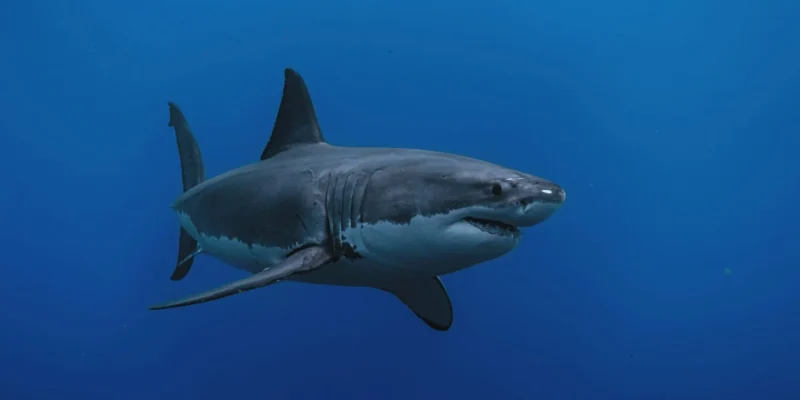
What does the world look like with a camera sitting directly on a young white shark? A new study in Frontiers in Marine Science uses exactly this perspective. Researchers attached cameras and accelerometers to juvenile white sharks before New South Wales, allowing them to see behavior that is easily invisible on the surface or in normal motion data.
The work A white shark’s view: insights into the behaviour of a marine predator was published on July 8, 2026 Frontiers in Marine Science.
Camera instead of guesswork
white sharks are often studied via satellite and acoustic data. Such data is valuable, but it doesn’t always show what an animal is doing. A similar diving profile can mean hunting, relocation, exploration, or a response to other animals. Animal-borne cameras close this gap because they combine motion, depth, acceleration and a direct view of the environment.
In the study, camera packages were attached to 13 juvenile white sharks caught and released between Evans Head and Port Macquarie on the coast of New South Wales. The animals were 174 to 283 centimeters long. The cameras were temporarily attached to the first dorsal fin and came off after a few days so that they could be recovered on the surface.
Important for classification: The researchers did not simply evaluate the first minutes after the catch. In most operations, continuous recording only began 24 hours after release in order to minimize acute capture and recovery effects as much as possible. The data was then coded second by second: position in the water column, swimming behavior, bottom type and encounters with other species.
68.5 hours from the perspective of juvenile white sharks
In the end, 68.5 hours of video material from eleven sharks were usable. Seven animals with continuous recordings showed a surprisingly close-to-the-bottom picture: 50.1 percent of the time they swam along the sea floor, 34.5 percent near the surface and only 9.2 percent in the free water column.
When the soil was visible, sandy, less complex habitats dominated. Sand accounted for 89 percent of the observed land use, reef areas 9 percent, and kelp only 2.1 percent. The average depth was around 51 meters; the deepest documented value was 115 meters.
Hunting bursts were rare
The cameras recorded 20 short burst events, i.e. moments with significantly increased tail beat and speed. These events lasted only 5 to 54 seconds and accounted for 0.12 percent of the total observation time. None of the events ended with an observed successful capture of prey.
In only three of these 20 burst events was the possible prey visible in the recordings. A marlin, an event with moray eels and octopus and a dolphin are mentioned. Particularly exciting: 16 of the 20 events began while the shark was swimming on the ocean floor; ten ran horizontally along the floor.
This differs from the classic image of the white shark, which shoots vertically at seals on the surface from below. The study suggests that juvenile white sharks also use ground-level, horizontal movements in this region, often examining potential prey rather than immediately attacking.
Lots of encounters, little attack
Potential prey animals appeared 85 times in the videos. These included bony fish such as trevally and marlin, rays, stingrays, smaller sharks, an octopus and even other white sharks. In most cases, the shark and potential prey showed little interest or barely visible reaction.
An white shark circled closely around an oarfish three times without eating it. Another showed striking interest in scattered bony remains of teleost fish for 14 minutes. Such sequences are precisely the value of camera recordings: they show not only where a shark is, but also when contact is not a hunt.
Companion fish in the camera image
The study also documents many encounters with small companion fish. In seven white sharks, a single guiding fish was observed for a total of 17 hours. This fish often sat or swam directly above or in front of the shark’s head. Yellowtail scads (Atule mate) and pilot fish (Naucrates ductor).
Groups of small fish also accompanied the sharks: such groups were observed for a total of 13.5 hours across eight white sharkss. Fish rubbed themselves on the sharks’ heads four times, possibly to get rid of parasites. In four other cases, sharks turned abruptly and accelerated toward fish swimming behind them.
Why this matters for shark protection
This type of research is particularly relevant for New South Wales because white sharks occurs in coastal habitats where people also swim, surf and fish. The better one understands when young sharks are using the bottom, when they are just exploring, and when real hunting attempts are taking place, the more precisely observation and management data can be interpreted.
The work is not a simple all-clear or a new narrative of danger. Rather, it shows how selective and situation-dependent behavior is. An white shark that sees another animal will not automatically attack. A quick movement impulse is not automatically a successful attack. And a sandy seafloor may be more important to juvenile white sharks than one would think from the surface.
The real win: context
The strongest finding therefore lies less in a single spectacular moment than in the context. 68.5 hours of camera work primarily show everyday life: swimming on the bottom, transitions between depth and surface, short examinations, accompanying fish and many encounters without attacks. It is precisely this everyday life that is often missing when white sharks is only noticed through individual sightings or headlines.
For Haitauchen, this is a nice, sober change of perspective: the great white shark is not just a symbolic animal for power and risk. From his own camera perspective, he becomes a young predator who uses sandy soils, probing, dodging, accelerating, being accompanied, and rarely actually hunting. Such details make shark protection no less urgent, but much more precise.