


Starry smooth-hound - Mustelus asterias

Body structure, features & anatomy
The starry smooth-hound Mustelus asterias is a demersal shark in the family Triakidae. WoRMS lists this scientific name as a valid species name. On Shark Diving, it is classified within the Selachii, the Galeomorphi, the Carcharhiniformes and the genus Mustelus.
The English common name starry smooth-hound refers to the many small white spots on its grey to grey-brown back. The underside is noticeably paler. In some individuals the spots are conspicuous, while in others they are faint or barely visible; the pattern alone is therefore not always sufficient for reliable species identification.
Identifying features
The body is elongated and moderately robust, and the snout is short to moderately long and rounded. Two conspicuous spineless dorsal fins, large pectoral fins, an anal fin and a distinctly asymmetrical caudal fin follow the typical body plan of houndsharks. The eyes lie on the sides of the head; well-developed nasal flaps sit in front of the small mouth.
- Grey to grey-brown back with small light or white spots.
- Pale underside and a slender body adapted to swimming close to the seabed.
- Two dorsal fins without spines and one anal fin.
- Short, rounded snout and small, numerous teeth.
- In European waters, most individuals are well under 1.4 metres, although large sharks can reach approximately this length.
Teeth, size and identification pitfalls
The low, flattened teeth are adapted to grasping and crushing small, hard-shelled prey rather than slicing it. FishBase identifies crustaceans as the main prey and reports a maximum length of about 1.5 metres; in British waters, maximum lengths of around 1.4 metres are more commonly reported.
Farrell et al. (2009) show why Northeast Atlantic smooth-hounds were historically not always identified reliably to species level. The starry smooth-hound was also confused with the common smooth-hound Mustelus mustelus. Spots, proportions and teeth can assist identification, but are not conclusive in every case. For catch and sighting records in particular, identification to species level should be considered reliable only when multiple morphological characters—or genetic evidence—agree.
Distribution & habitat
The Catalog of Fishes records the starry smooth-hound from the Northeast Atlantic. Its northern range extends from Scotland and southern Norway via the North Sea, the United Kingdom, the Netherlands and France to Spain and Portugal. Along northwest Africa, the species occurs, among other places, in Morocco and further south.
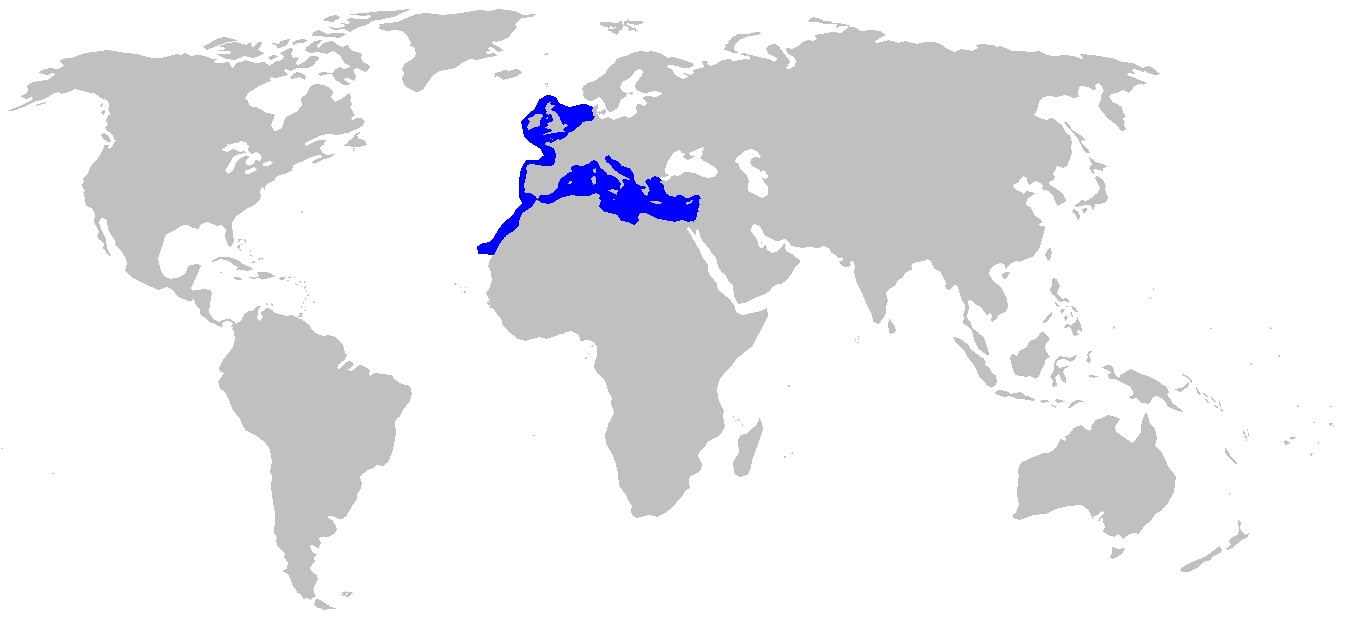
The range also includes island waters and continental-shelf waters in the eastern Atlantic and the Mediterranean; records also exist from the Black Sea. Occurrence varies markedly among regions, and older catch statistics often do not reliably separate the similar-looking Mustelus species.
Seabed, depth and coastal waters
The species lives near the seabed over the continental shelf. Sand, gravel and mixed substrates are typical from shallow water to depths of around 200 metres. Large bays, sandy coasts, outer estuaries and productive shelf areas are particularly important. Juveniles often use very shallow, sheltered waters.
Electronic-tagging data from Griffiths et al. (2020) recorded depths of up to 118 metres and clear seasonal changes in six sharks with usable records. This small sample describes individual movements and does not define an absolute depth limit for the species. It is nevertheless consistent with the species’ association with the shallower shelf and shows that individuals may occupy deeper waters in winter and move closer to the coast in summer.
Seasonal migrations and pupping areas
A Dutch tagging study by Brevé et al. (2016) documented annual migration between summering grounds in the southern North Sea and wintering grounds in the English Channel and Bay of Biscay. Recaptures also indicate site fidelity: many sharks return to the same summer areas in subsequent years.
In the Oosterschelde, larger females were particularly common. The capture of 30 newborn pups measuring 32 centimetres or less confirmed the area’s importance as a seasonal pupping area. This supports its identification as a pupping ground; further data are needed to determine whether it meets all strict long-term criteria for a nursery area. Such shallow pupping and nursery habitats are spatially limited and therefore particularly relevant to conservation.
Brevé et al. (2020) confirmed spatial segregation by sex: in winter, more males were recorded in the northern North Sea and more females in the Bay of Biscay. Sheltered Dutch inlets were used almost exclusively by adult females in summer.
Life history, diet & reproduction
Starry smooth-hounds forage mainly on or just above the seabed. They may aggregate seasonally by size and sex, but remain active sharks of coastal and shelf waters, moving among feeding grounds, pupping and nursery areas, and overwintering grounds.
Diet
McCully Phillips et al. (2020) examined stomach contents from 640 sharks in the Northeast Atlantic. Crustaceans accounted for 98.8% of the index of relative importance (IRI). Hermit crabs and swimming crabs were particularly important; together, only a few crustacean groups accounted for most of the diet.
Larger smooth-hounds more often ate larger crab species, while smaller sharks consumed a different range of prey. Small fish and other benthic animals may occasionally also be eaten. The flattened teeth and small mouth suit a specialised predator of hard-shelled, bottom-dwelling prey.
Reproduction
The species is aplacentally viviparous: embryos develop inside the mother but are not nourished through a yolk-sac placenta. Instead, they rely on their yolk reserves until the fully developed pups are born alive.
A survey of British waters by McCully Phillips & Ellis (2015) estimated the lengths at which 50% of individuals were sexually mature at 70.4 centimetres for males and 81.9 centimetres for females. The females examined carried four to 20 embryos; full-term pups measured 20.5 to 32.9 centimetres. On average, larger females carried more and larger offspring.
Births were recorded in February in the western English Channel, but in June and July in the eastern English Channel and southern North Sea. These differences show that reproductive timing observed in one region should not be extrapolated to the species as a whole.
Reproductive cycle, maturity and age
Farrell et al. (2010) reported an approximately twelve-month gestation period in Atlantic sharks, followed by a reproductive resting period of about one year, implying a roughly biennial cycle. In this study, males matured at around four to five years and females at around six years.
The study by Farrell et al. (2010) recorded a maximum observed age of 13 years among wild-caught sharks; growth models suggest that females may live to around 18 years. The combination of late maturity, long gestation and a reproductive resting period limits how quickly a population can recover from losses.
Threats & conservation status
The IUCN Red List assesses Mustelus asterias globally as Near Threatened. The assessment was conducted in 2020 and published in 2021. The category indicates elevated extinction risk but is not itself a legally binding fisheries regulation.
According to the IUCN justification summarized by NatureScot, the species underwent an estimated global population reduction of 20–29% over three generations, or 39 years. The main cause is considered to be fishing mortality, especially in the Mediterranean and Black Sea.
Regional trends differ
The Northeast Atlantic presents a different picture from the global trend: ICES data indicate increasing occurrence in the North Sea, off western Scotland and in other parts of the region. A regional increase does not negate the global decline; it shows how fishing pressure, survey coverage and population trends vary among ocean regions.
Fisheries, bycatch and data gaps
Starry smooth-hounds are caught in bottom trawls, gillnets and longlines. Depending on the market, they may be landed, retained for bait or discarded. Many sharks in trawl catches are not yet sexually mature; post-capture survival depends strongly on the fishing gear and handling.
- Targeted fisheries and bycatch remove adult females and juveniles.
- The slow reproductive cycle—approximately biennial in some regions—delays recovery.
- Pupping and nursery areas in shallow bays and estuaries lie within intensively used coastal waters.
- Confusion with other smooth-hounds hampers species-specific catch statistics and population assessments.
- Regional increases may obscure local risks in other parts of the range.
Important measures include reliable species identification in catch statistics, reducing bycatch, carefully releasing viable sharks, and protecting pupping and nursery areas. At CoP20, the Parties adopted the inclusion of all Mustelus species in CITES Appendix II, effective 5 June 2027, as recorded in the official CITES notification. CITES regulates international trade; it does not replace fisheries management or habitat protection. Mustelus asterias is not currently included in the CMS species list or the OSPAR List of Threatened and/or Declining Species and Habitats. Effective conservation therefore still depends on regional fisheries management and habitat protection.
Starry smooth-hound & humans
The Belgian research institute ILVO classifies the starry smooth-hound as harmless to humans. The species forages mainly for crustaceans on or near the seabed and displays no behaviour that would make it a typical threat to swimmers, snorkellers or divers. Like any wild animal, it should not be harassed.
For divers, Mustelus asterias is not a large shark typically encountered at predictable aggregation sites. Encounters tend to be seasonal and incidental over sand or gravel or in shallow bays. Many important habitats are turbid and tidal and also serve as pupping and nursery areas, so calm behaviour matters more than obtaining a close-up photograph.
Respectful encounters
The general guidelines of Shark Trust also apply to this species: sharks should determine the distance and duration of an encounter. In shallow pupping areas, it is particularly important not to split up groups and to keep routes to deeper water clear.
- Approach slowly from the side, leaving escape routes to deeper water open.
- Do not touch, chase, encircle or flush sharks from the seabed.
- Observe groups of juveniles and large females in shallow bays from a generous distance.
- Do not feed or bait sharks for photographs; do not alter their natural movements.
- Check local exclusion zones, tides, visibility and boat traffic before entering the water.
Tagging studies and recaptures
The Dutch tagging study demonstrates the value of citizen science: more than 2,200 sharks were externally tagged in the Dutch Delta between 2011 and 2014. A subsequently reported recapture provides information on location, timing and growth; only the combined evidence from many such reports reveals migration patterns and site fidelity.
An external tag is not necessarily a GPS transmitter. Anyone who sees or catches a tagged smooth-hound should report the tag number, location, date, length and, if possible, clear photographs to the programme identified on the tag. Photographs of the flanks, dorsal markings, fins and head can assist species identification; individual white spots alone are not reliable evidence.
Fishing and careful handling
Scientific reviews describe the species as commercial bycatch and a popular target for recreational anglers. Mortality varies substantially by fishing method: it can be high in gillnets, whereas many sharks caught on longlines are initially retrieved in good condition. Reliable overall data on mortality after recreational catch-and-release are still lacking.
If release is intended and legally permitted, handling time should be kept short, air exposure minimised, the entire body supported and the shark released promptly. For divers, the best encounter remains a passive one: observe, keep your distance and let the shark determine how long it remains in view.
Profile
- First described:
- Max. size:
- Depth:
- Max. age:
- Max. weight:
- Water type:
- IUCN Status:
Taxonomy
- Kingdom:
- Phylum:
- Subphylum:
- Infraphylum:
- Parvphylum:
- Class:
- Subclass:
- Superorder:
- Order:
- Family:
- Genus:
Newsletter
Shark Alert in Your Inbox