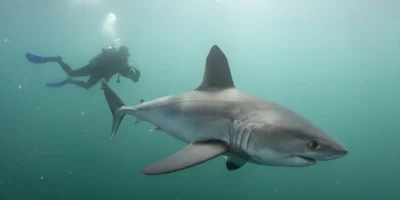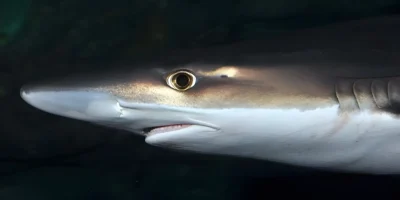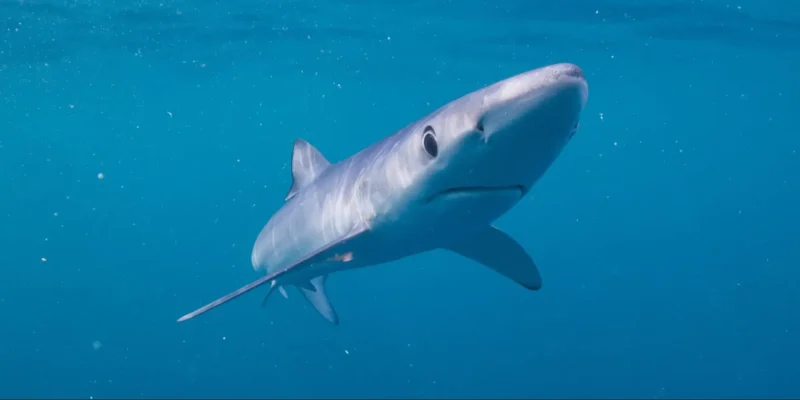
Scientists at the University of Exeter have been awarded £939,434 by Natural England for a new project to protect sharks in English waters. Running from July 2026 to March 2029, it will investigate the movements, breeding areas and conservation status of three species that remain poorly understood.
Three shark species in focus
The project will study the Blue shark (Prionace glauca), Porbeagle (Lamna nasus) and Tope shark (Galeorhinus galeus). All three occur in English waters. In Europe, the tope is assessed as Vulnerable and the porbeagle as Critically Endangered, while major gaps remain in knowledge of their distribution, abundance and important habitats.
The work is funded through Natural England’s Species Recovery Programme and led by Dr Matthew Witt and Dr Lucy Hawkes at the University of Exeter. Partners include the Angling Trust, the Marine Biological Association and the Pat Smith Database, bringing together tracking technology, marine biology and decades of observations from recreational fishing.
75 tags and ultrasound without blood sampling
Researchers plan to deploy 75 electronic tags, including long-duration satellite tags capable of tracking individual sharks for up to two years. The data should reveal migration routes, areas used repeatedly and how sharks respond after being caught and released by anglers.
The team will also use non-invasive ultrasound to identify pregnant females without taking blood. Combining those observations with tracking data could help locate potential pupping and nursery grounds more precisely.
Anglers’ knowledge becomes part of the evidence
The Angling Trust highlights the central role of sea anglers. Workshops and structured interviews are planned with at least 45 anglers at major hubs including Looe, Falmouth and Brightlingsea, collecting historical catch records, observations and local ecological knowledge.
This information will be combined with existing databases and new telemetry data to build the most comprehensive picture yet of how blue sharks, porbeagles and tope sharks use English waters. It should also show which catch records are most informative and where systematic surveys are still needed.
Updated Red Lists and better release practice
The findings will feed into updated England Red List assessments for all three species. The project will also develop best-practice guidance intended to improve survival after release. The funding announcement marks the start of a three-year programme; robust results on migration and nursery areas will only emerge as the research progresses.