


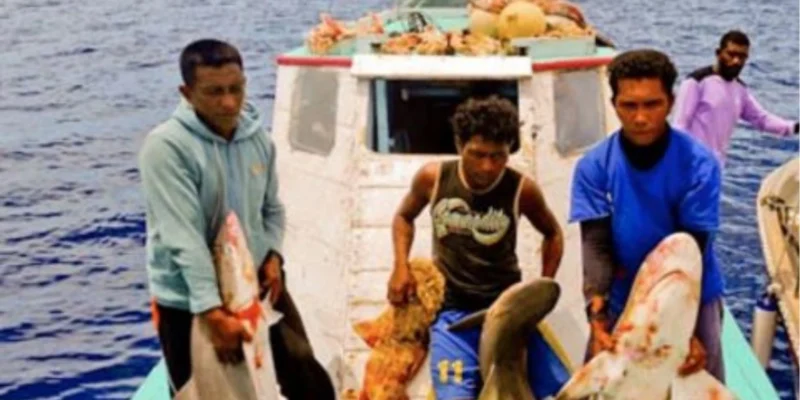
A new study on shark fishing in Muncar shows where protective measures could be particularly effective. The port on the east coast of Java is one of the most important transshipment points for shark catches in Indonesia. Using daily landing data, GPS records and conversations with fishermen, the research team investigated which species are caught, how large the animals are and when and with which fishing gear particularly high risks arise.
127 boats and two very different fisheries
The researchers recorded 127 boats operating from Muncar. 113 small vessels with less than five gross registered tons mainly used gill nets in the Bali Strait. They primarily targeted tuna, marlin and hairtails; sharks were economically valuable bycatch. Another 14 larger boats specialized in shark fishing with longlines and fished over longer distances in waters off East Java, Lombok, the Bali Sea and the Makassar Strait.
This separation is crucial for management. The small inshore fishery and the larger longline fishery affect sharks in different areas and life stages. A uniform rule for all boats would therefore probably ignore the actual risk patterns.
Every second shark recorded belonged to a threatened species
For 2023 and 2024, the study lists a total of 3,439 sharks from 51 species. 50 percent of the catches were of species that are classified as Vulnerable, Endangered or Critically Endangered on the IUCN Red List. 33 percent belonged to CITES-listed species. The five most frequently recorded species were silky sharks, scalloped hammerhead sharks, spinner sharks, blacktip reef sharks and pelagic thresher sharks. All five species are threatened and are listed on Appendix II of the Convention on International Trade in Endangered Species of Wild Fauna and Flora.
The length distribution sharpens the image. Particularly in silky sharks, spinner sharks, pelagic thresher sharks and blacktip reef sharks, small and immature animals dominated. For silky sharks and spinner sharks, the mean catch length decreased statistically significantly within the two years of the study. This indicates growth or recruitment overfishing: animals are taken before they reach their optimal size or have had a chance to reproduce.
Longlining and the month of May increase the risk of hammerhead sharks
There were clear differences between fishing gear for the critically endangered scalloped hammerhead shark. Gill nets caught fewer, but smaller and younger animals. Longlines, on the other hand, captured many subadult and adult hammerhead sharks. Males were typically caught before sexual maturity using either method of capture. As a result, fishing pressure affects several life stages of the same population.
Statistically, the probability of a hammerhead shark being caught was higher in May than in other months examined. The probability of catching hammerhead sharks was also significantly higher for larger boats than for smaller vessels. However, the authors warn against a hasty interpretation: Without spatially resolved data on catches per effort, it is not possible to distinguish with certainty whether there were more hammerhead sharks in May or whether fishing was simply more intensive.
Protection measures must be ecologically and socially viable
The study names minimum sizes, catch limits, seasonal closures and spatial protection measures as possible instruments. Longline fishing should be given priority because the few specialized boats caught a particularly large number of endangered sharks. A closure in May could make sense if further data confirms that this period coincides with hammerhead shark reproduction or aggregations. Blongas, an area designated as Important Shark and Ray Area, is also eligible for spatial protection measures.
According to the researchers, rules alone are not enough. Indonesia already has trade targets, quotas and recommended minimum sizes, but landing data suggests a gap between regulation and implementation. Regular unannounced inspections at ports and markets and better traceability could improve compliance.
At the same time, coastal communities depend economically on fishing. A complete ban on endangered species or the closure of a fishery would have significant short-term social consequences. The study therefore recommends developing measures together with fishermen and, if necessary, cushioning them by switching to other fisheries, buyback programs or alternative income. The data does not provide a ready-made solution, but it shows how protection can start where fishing risk and ecological vulnerability come together.