


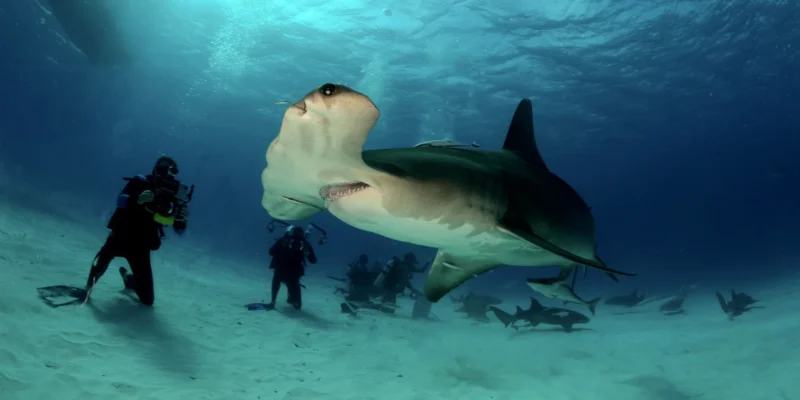
Most predators in the ocean slow their activity when sea temperatures change. Great hammerhead sharks (Sphyrna mokarran) are a remarkable exception. New research from Florida International University (FIU) shows that these impressive marine predators maintain their hunting performance across a surprisingly wide range of water temperatures between winter and summer months.
The study, published this week in the Journal of Experimental Biology, describes this phenomenon as “thermal persistence”. It found that great hammerhead sharks have an optimal water temperature of about 29.3 degrees Celsius (84.7 degrees Fahrenheit) for swimming, hunting and maintaining normal metabolic function. While the performance of most animals decreases with temperature changes, the decline in performance in hammerhead sharks is only slight.
“This tells us that great hammerhead sharks may cope better with climate change than other species,” said Yannis Papastamatiou, associate professor of biological sciences at FIU and a researcher at the Institute of Environment, who co-authored the study.
Adaptability with potential risks
For their study, scientists at FIU, in collaboration with researchers from the Georgia Aquarium, the Mote Marine Laboratory and other partners, used advanced biologging technology. This allowed them to track movement, acceleration, depth and water temperature of nine hammerhead sharks off the coasts of Florida and the Bahamas. From these data the team was able to produce the first ‘thermal performance curve’, showing how shark performance changes at different temperatures.
Despite their thermal flexibility, great hammerhead sharks were most frequently found in temperatures near their preferred 29.3 degrees Celsius. This suggests that, despite their adaptability, they still seek optimal conditions. ‘If ocean temperatures change, hammerheads could shift their range to remain within temperature ranges in which they function best,’ Papastamatiou said. ‘That could bring them into areas with higher fishing pressure.’
Great hammerhead sharks are listed as endangered. They are among the ocean’s most impressive predators and can travel thousands of kilometres, yet their populations have declined dramatically in recent decades. They are classified by the International Union for Conservation of Nature (IUCN) as ‘critically endangered’.
