


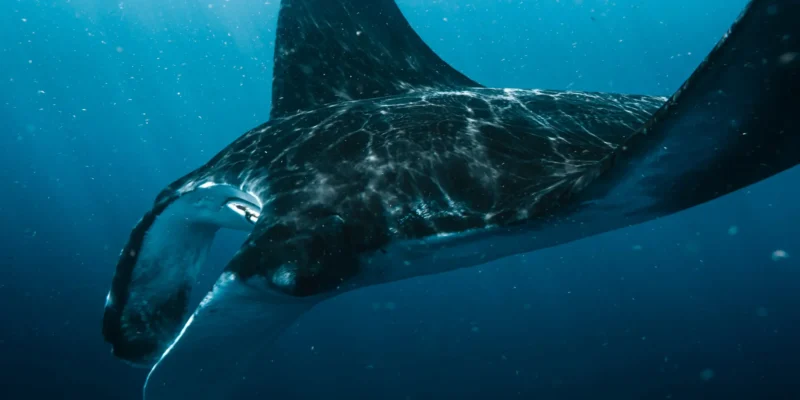
Galapagos sharks seem to have found an unusual way to deal with hard-to-reach itchy spots: they rub against oceanic manta rays. What sounds like a strange dive moment may be a useful clue to how large marine predators manage parasites.
Scientific American reports that the interactions were documented at dive sites around Mexico’s Revillagigedo Archipelago. Researchers observed Galapagos sharks rubbing body parts against the upper and lower surfaces of manta rays between December 2024 and January 2026.
The snout and gill region were especially conspicuous. Those are areas where external parasites such as sea lice often attach to sharks. The explanation is simple and plausible: the rough skin of a manta ray can work like a living scratching surface.
Eight Documented Encounters
The behavior is described in two scientific papers. A note in Marine Biodiversity documents Galapagos sharks chafing on oceanic manta rays in Revillagigedo National Park and presents it as the first formal description of this interaction for the species.
A second paper in Environmental Biology of Fishes adds further video observations from the same archipelago. Together, the reports describe eight encounters, enough to show a repeated pattern rather than a single odd accident.
What It Means for Mantas
For manta rays, the interaction is not necessarily neutral. The studies describe different reactions depending on shark size. Juvenile sharks caused milder responses, while larger adults prompted stronger evasive movements, including backward rolls and attempts to move away.
That matters because a Galapagos shark is not a cleaner fish. Even if the rubbing is not an attack, a large predator approaching a manta at close range can still create stress. The benefit for the shark may therefore come with a cost for the manta.
When Cleaning Stations Are Not Enough
Many fish and sharks use cleaning stations where smaller fish remove parasites. But a cleaning station cannot always solve every problem. A broad, rough manta surface may help a shark reach body areas that are difficult to clean otherwise, especially around the head and gills.
Similar scratching behavior has been recorded in other contexts, including sharks rubbing on sand, whale sharks or other large animals. The new point here is the specific combination of Galapagos sharks and oceanic manta rays in Revillagigedo.
Why Revillagigedo Matters
Revillagigedo is a large marine protected area in the tropical eastern Pacific and a hotspot for big pelagic animals. Sharks, manta rays, tunas, dolphins and other wide-ranging species meet there in unusually visible numbers.
That protection helps researchers see behavior that would otherwise remain hidden. Large, well-managed marine spaces do not only protect animals; they also create the conditions in which rare interactions can be observed, filmed and understood.
For divers, the story is a reminder that familiar species still have surprises left. A Galapagos shark is not just a silhouette in blue water, and a manta is not just a gentle giant. Both belong to a complex network of cleaning, parasites, stress and protected habitat.
