


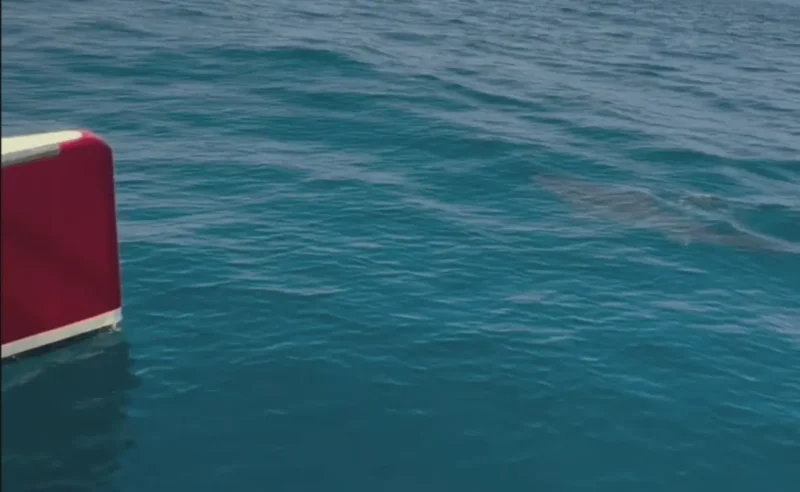
A three to four meter long shark caused an extraordinary moment off the Portuguese Atlantic coast on July 23, 2026. The animal swam near the surface and moved calmly around a tour boat for a short time. The encounter occurred between São Martinho do Porto and Nazaré, approximately two nautical miles offshore.
According to Portuguese broadcaster Renascença, the boat was on a dolphin-watching trip. Ocean Adventures later shared the video on social media. The footage mainly shows the animal’s size and steady swimming, but it does not allow a reliable species identification.
Calm encounter with no apparent threat
According to Ocean Adventures, the shark approached the boat and only swam near it for a short time. The people on board never felt threatened. The animal appeared calm and curious before disappearing back into deeper water.
oe24 picked up on the encounter on August 1st and described it as a rare sighting near the well-known surf spot Nazaré. However, no aggressive behavior can be inferred from the short approach: a shark can examine a boat out of curiosity, follow a scent trail or simply pass by on its route.
Was it really a great white shark?
Nuno Santos of Ocean Adventures considered a great white shark possible because the animal appeared to have a pale belly. This has not been confirmed by specialists. A pale underside occurs in many shark species and is not enough on its own to identify a great white shark reliably.
For a reliable identification, several well-resolved views would be necessary. Experts pay attention to, among other things, body shape, snout, position and shape of the fins, coloring, tail stalk and swimming style. Perspective, reflections, and the surface of the water can easily distort these features in a short cell phone video.
For now, the accurate description is simply a large, unidentified shark. A great white remains a hypothesis, not an established identification. Without a direct scale, the estimated length of three to four metres should also be treated as approximate.
One sighting does not show a population trend
A single animal off Nazaré proves neither an increase in large sharks off Portugal nor a new threat to swimmers or surfers. The observation took place around two nautical miles off the coast and only lasted a short time. Without systematic sighting, catch or telemetry data, no trend can be derived.
The word “rare” also needs careful classification. Rarely filmed does not necessarily mean that sharks are biologically exceptional in this area of the ocean. Large parts of the Atlantic are only observed selectively. More tour boats and omnipresent cameras also increase the chance of even documenting short encounters.
How to respond to a sighting from a boat
According to their own statements, the crew reacted calmly – which is exactly what makes sense in a sighting like this. A boat should keep its distance, not cut off the swimming path and neither pursue nor surround the shark. Feeding or baiting only for better recordings would unnecessarily influence the animal’s behavior.
Photos and videos can still be valuable if they are created without disruption. Photos from multiple angles as well as information about the date, time, exact position, estimated length and behavior are helpful. Such information facilitates later review by experts and turns a viral scene into a useful sighting data set.
A spectacular moment, viewed in context
The video from Nazaré shows an impressive, apparently peaceful encounter with a large wild animal. Precisely because such images trigger strong reactions, the separation between observation and interpretation is important: the location, approximate size and calm behavior are certain. It remains unclear which species of shark was circling the boat.
When it comes to dealing with the report, this means neither trivialization nor alarm. Sharks belong to the Atlantic Ocean off Portugal. Anyone who encounters them at sea should keep their distance, not harass the animal and clearly mark uncertain species identification as a guess.