


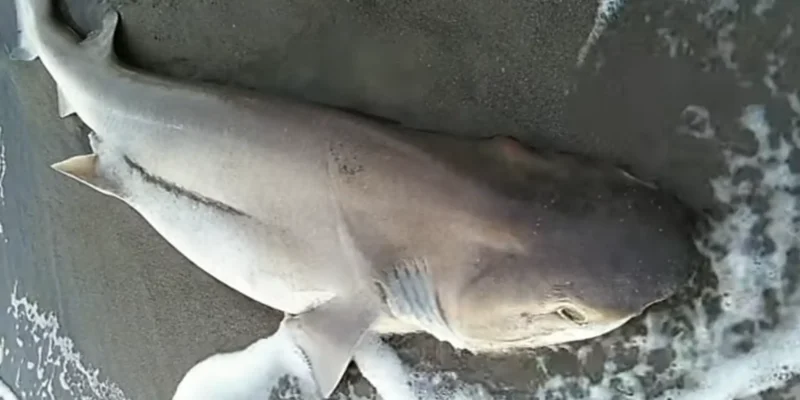
A large bluntnose sixgill shark has been recovered dead off the coast of Follonica in southern southern Tuscany. After the animal was found off the Spiaggia del Tony’s, it was taken to the port of Scarlino, where experts carried out the first scientific examination.
The Italian local media MaremmaOggi reported that it was a female specimen of Hexanchus griseus approximately 4.5 meters long. The dissection was performed by Primo Micarelli from Centro Studi Squali in Massa Marittima; Letizia Marsili from Universität Siena and the team from the MagiaMare laboratory were also involved.
No apparent cause of death
According to Micarelli, after the initial investigation there was no clear external explanation for the death. The animal was recovered almost intact, had only been lying dead in the water for about 24 hours and, according to the report, did not yet show any normal signs of advanced decomposition.
It is precisely this initial situation that makes the find scientifically interesting. If neither injuries nor an immediately recognizable external trigger are visible, tissue samples, laboratory analyzes and the condition of internal organs must clarify whether illness, age, environmental factors or other causes may have played a role.
Samples go to several laboratories
The collected biological material will now be examined in laboratories at Universität Siena, Arpat and Istituto Zooprofilattico. Only these analyzes can show whether the discovery provides information about the animal’s health, nutrition, stress or possible causes of death beyond the individual case.
For a classification it is important: The previous findings are preliminary. From the first section it does not automatically follow that there was no cause, but only that it was not externally and immediately recognizable. Especially with large deep-water sharks, the actual explanation can only become apparent after laboratory work.
A shark from the depths
The bluntnose sixgill shark is not your typical coastal or bathing zone shark. Micarelli classifies the species as a deep-water inhabitant that usually lives at depths of several hundred meters and only rarely ascends to significantly shallower areas. It therefore remains unusual for such a large animal to come close to the coast.
At the same time, the expert emphasized to MaremmaOggi that the species does not cause concern for bathers. The animal was recovered dead, and the bluntnose sixgill shark is not a common companion of beaches or shallow bays.
not the first find in the region
For Micarelli, such a find on the Maremma coast is not entirely without background. In 2016, a male bluntnose sixgill shark almost three meters long was recovered from Marina di Grosseto; some of his teeth are now in the Shark Museum of Massa Marittima.
In such cases, it remains difficult to explain why individual animals make it from the depths to near the coast. This is precisely why documented finds are important: they provide rare data about a species that occurs in the Mediterranean but is only occasionally seen or recovered by humans.
Why the case is relevant to shark diving
For divers, the case is less a story of encounters than a look into the hidden shark world below the usual sport depths. bluntnose sixgill sharks show that the Mediterranean is not only made up of visible coastal species, but is also associated with deep-dwelling sharks that only rarely come to the surface of public awareness.
The discovery before Follonica is therefore no reason for dramatization, but a good reason for detailed research. If laboratory analyzes reveal more about the cause, state of health or last phase of life of the animal, an eye-catching beach discovery can become a valuable data set on the biology of large deep-water sharks in the Mediterranean.
