


Bluntnose sixgill shark - Hexanchus griseus
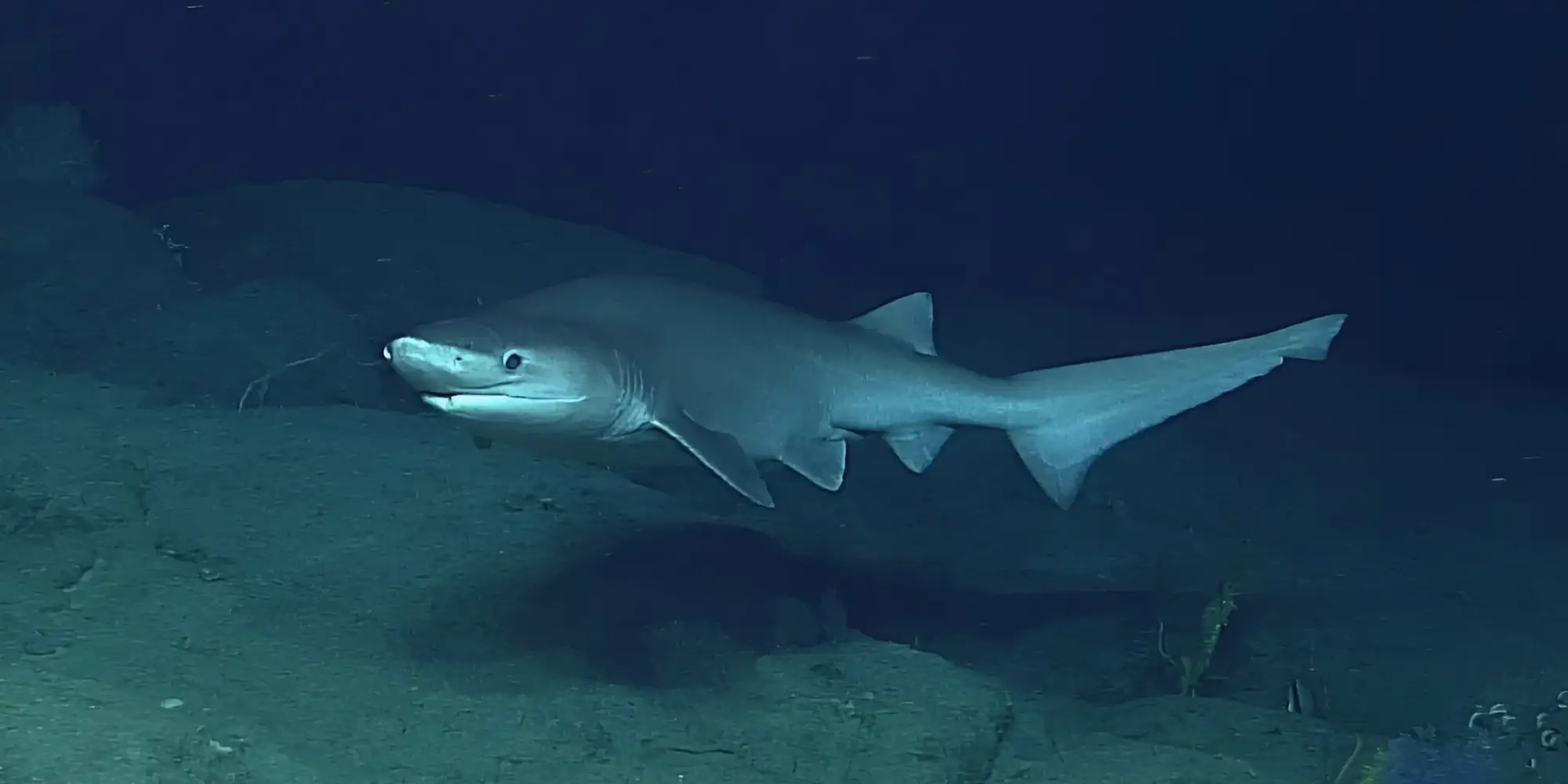
Body structure, features & anatomy
The bluntnose sixgill shark Hexanchus griseus is one of the largest living cow sharks.
WoRMS treats the name as valid; on Haitauchen it sits within Selachii, Squalomorphi, Hexanchiformes, Hexanchidae and the genus Hexanchus. FishBase describes a heavy, broad-headed shark with a ventral mouth, comb-like lower teeth, a grey to brown back, pale underside, light fin edges and greenish eyes in life.
Six gill slits and one dorsal fin
Its clearest field mark is the six long gill slits on each side. Most familiar sharks have five. The shark also has a single dorsal fin set far back near the tail base, a broad blunt head, a short rounded snout and a powerful spindle-shaped body.
Teeth and identification
The upper teeth grip while the broad lower teeth form a cutting edge. Adults can be well over three metres long, and exceptional maximum sizes close to six metres are reported. The smaller bigeye sixgill shark is slimmer, has relatively larger eyes and remains much smaller.
Distribution & habitat
The bluntnose sixgill shark is worldwide but patchily distributed.
Shark-References summarizes the species as tropical to temperate and circumglobal: in the western and eastern Atlantic Ocean, the Indian Ocean, the western Pacific Ocean from East Asia to New Zealand and Hawaii, and the eastern Pacific from Alaska and the Aleutians to Baja California and Chile.
Depth, temperature and daily movement
This wide range does not mean the species is common everywhere. It is tied to outer shelves, steep slopes, deep-water access, island slopes, seamounts and upper continental slopes, and it is recorded in the Mediterranean as a large but rarely seen deep-water shark.
The documented depth range extends from very shallow water to roughly 2,500 metres. Adults are usually associated with deeper, cooler water, while juveniles may occur closer to shore where deep slopes, bays or fjords connect to shallow nursery areas.
Life history, diet & reproduction
Bluntnose sixgill sharks are large opportunistic predators and scavengers of deep slopes and bottom habitats.
They often rest or patrol near the seafloor, but can make vertical movements and appear higher in the water column or nearer the surface at night.
Broad prey spectrum
Mediterranean Marine Science documented a mature male from 550 to 730 metres in the Gulf of Valencia whose stomach contained molecularly identified remains of a striped dolphin calf. Such records fit a species that hunts actively but can also use carcasses and fishery waste.
Reproduction and young
The diet includes bony fishes, rays, other sharks, chimaeras, cephalopods, crustaceans, carrion and larger marine animals. The species is live-bearing, with exceptionally large litters reported in summaries, and young appear to use shallower coastal or shelf areas as nurseries.
Threats & conservation status
IUCN Red List lists the bluntnose sixgill shark as Near Threatened globally.
fish.gov.au Shark Report describes the species as uncommon but monitored in Australia, where its regional status is less concerning than the global picture. The same report notes that it can occur as bycatch in several gears and would not tolerate heavy targeted exploitation.
Main pressures
Main pressures include longlines, handlines, gillnets, trammel nets, traps and trawls; regional use of meat, liver oil, fishmeal and sport fishing; slow replacement of large adults; limited data from deep habitats; and shallow nursery areas that may overlap with busy coasts.
Protection depends on species-level catch records, careful release, bycatch reduction and attention to local populations rather than assuming that a wide global range is enough protection.
Bluntnose sixgill shark & humans
The bluntnose sixgill shark is not a typical beach or reef shark.
Florida Museum describes it as not considered dangerous to people unless provoked. At the same time, it is a large, powerful shark and should never be touched, crowded, fed or underestimated around fishing or bait.
Encounters while diving
Diving encounters are uncommon and usually linked to deep-water access, fjords, slopes, kelp regions, night conditions or special observation methods. Keep distance, leave an escape route to deeper water and avoid baited or fishery-waste situations.
For Haitauchen, Hexanchus griseus shows a different side of shark encounters: less predictable than reef diving, often brief, but biologically striking because it opens a window into deep-water shark life.
Profile
- First described:
- Max. size:
- Depth:
- Max. age:
- Max. weight:
- Water type:
- IUCN Status:
Taxonomy
- Kingdom:
- Phylum:
- Subphylum:
- Infraphylum:
- Parvphylum:
- Class:
- Subclass:
- Superorder:
- Order:
- Family:
- Genus:
News

Newsletter
Shark Alert in Your Inbox