


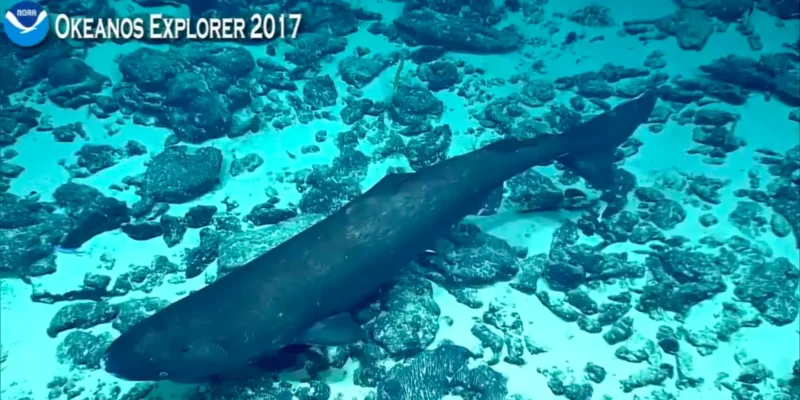
As part of an observation experiment, researchers sank the carcass of a cow in the South China Sea. At a depth of 1,629 metres, they documented eight Pacific sleeper sharks (family Somniosidae) feeding for the first time – an extraordinary insight into the behaviour and distribution of these hard-to-observe deep-sea inhabitants.
First record in the region
The footage was taken southeast of Hainan Island in the northern part of the South China Sea. According to lead researcher Han Tian, the discovery marks the first documented record of a Pacific sleeper shark in this region and suggests a southwestern expansion of its known distribution range.
“This result is the first registered case of a Pacific sleeper shark in the South China Sea and suggests an extension of its range to the southwest.” – Han Tian
Hierarchies at the carcass
The video analysis showed clear differences in feeding behaviour: Larger animals attacked the carcass directly and energetically, while smaller ones approached more cautiously. Additionally, the sharks formed a sort of order that followed a hierarchical organisation – similar to patterns seen in shark gatherings around floating whale carcasses. The researchers also observed a separation by size and sex.
Associated deep-sea fauna
Besides the sharks, the team recorded other deep-sea organisms: including copepods, which appeared on the sharks’ heads and the cow carcass, as well as a snailfish and colourful amphipods. These findings paint a broader picture of the food web in the deep sea.
Why the discovery matters
Sleeper sharks have historically been documented mainly in the North Pacific – from Japan and the Bering Sea to Alaska and California. The footage now obtained is among the first to show these sharks in the South China Sea. The discovery not only expands knowledge of their distribution but also raises questions about the ecological and environmental factors that drive movements and behaviour in the deep sea.
“This discovery expands our understanding of their distribution and raises questions about environmental and ecological factors driving these changes.” – Han Tian