


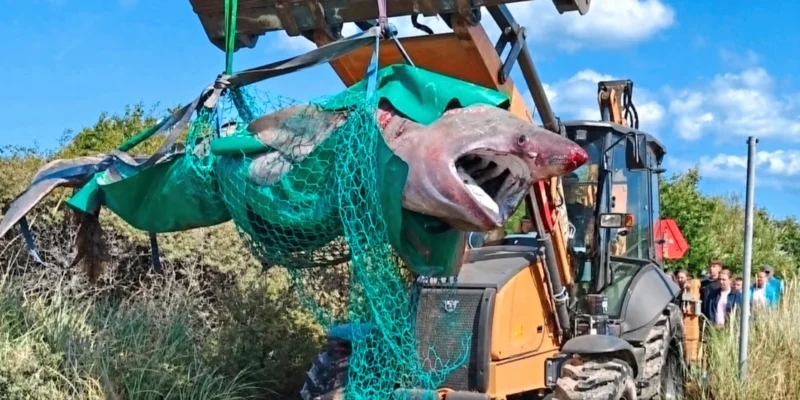
A 4.70 meter long Basking shark (Cetorhinus maximus) stranded at Ålbæk in North Jutland on August 8, 2026. As WELT reports, the animal had previously been observed in shallow coastal water for several days. When it lay dead on the beach, it was recovered and examined at Nordsøen Oceanarium.
The shark weighed around 500 kilograms and, according to experts’ estimates, was around 10 to 15 years old. For a species that can reach a length of around ten meters, it was still a comparatively young animal.
The official video of Nordsøen Oceanarium summarizes the section from August 12th. A longer broadcast was also published as Facebook live stream.
Initial investigation does not provide a clear cause of death
Experts from the State Natural History Museum of Denmark, the Kattegat Center, the Museum Sønderjylland and Nordsøen Oceanarium took part in the study. According to the initial findings, the Basking shark had no serious external injuries.
Starvation also seems unlikely so far: there was fresh leftover food in the stomach. The parasites found were also not considered an obvious cause of death. This leaves the crucial question about the section open.
Tissue samples as well as the brain and spine will be further examined. Additional CT images are intended to make possible changes visible that were not apparent during the external examination or autopsy. Only these analyzes can show whether the cause of death can still be determined.
Ålbæk is located in the transition area to the Baltic Sea
In headlines the discovery is attributed to the Baltic Sea. Geographically, however, Ålbæk is located on northern Kattegat. This transitional body of water connects the North Sea and the Baltic Sea. The more precise classification is therefore: The Basking shark was stranded in the Danish transition area to the Baltic Sea, not in the brackish water basin further east.
Basking sharke live primarily in cool to temperate marine areas. In the northeast Atlantic they are observed off Great Britain, Ireland, Norway and Iceland, among others. They follow plankton-rich water masses and can cover long distances.
According to the information provided by WELT, only approximately ten Basking sharke have been detected in Danish waters since 2000. The find is therefore rare, even if the Kattegat is basically on the edge of the known distribution area.
A large but harmless plankton eater
The Basking shark is the second largest species of fish alive today after the Whale shark. Its wide-open mouth looks impressive, but is not used to hunt large prey: the animal swims through water rich in plankton and filters out small organisms using its gill traps. The species is considered harmless to humans.
It is precisely the rarity of such finds that makes the samples taken valuable. Even if the immediate cause of death can no longer be reconstructed, studies of age, diet, parasites and tissue can provide clues about the state of health and the use of Danish waters.
