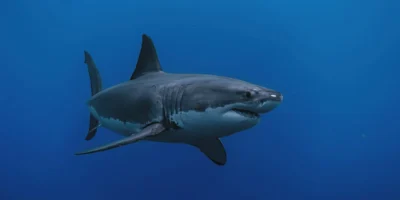
California is temporarily tightening the rules for fishing for large sharks near beaches. At its June 17-18, 2026 meeting, the California Fish and Game Commission adopted emergency regulations intended to protect white sharks and reduce risky situations between hooked sharks and people in the water.
The California Department of Fish and Wildlife announced the decision on June 25, 2026. The trigger is not a single attack, but an expected shift in nearshore habitat: warmer El Niño conditions can keep young white sharks farther north and in California shallow-water areas for longer.
Which gear is affected
The new rules focus on equipment commonly used to catch large sharks. Hooks larger than 1.5 inches in maximum inside measurement, as well as wire, metallic lines and metallic leaders, are prohibited for recreational fishing from shore and within 1,000 yards of shore.
The area is clearly defined: from Pigeon Point in San Mateo County south to the U.S.-Mexico border. Shore fishing includes not only beaches, but also banks, piers, jetties, breakwaters, docks and other structures connected to land.
This is not a blanket fishing ban and not a general closure of the coast. The commission is targeting the place where heavy gear, large sharks and many ocean users are most likely to overlap: shallow, accessible coastal zones.
Why hooked sharks create a separate risk
A hooked shark behaves differently from a free-swimming shark. It is under stress, fighting line and hook, may turn unpredictably and is often pulled close to people, piers or surf. That is the situation California wants to reduce.
The logic fits what the Haitauchen article Sharks on the hook: the dark side of catch and release describes more broadly: a shark catch does not automatically become harmless because the animal is later released. The fight, hook injuries and handling can be dangerous for the shark itself; at the same time, the risk for people rises when a powerful animal has to be controlled or unhooked at the shoreline.
How quickly that can become an actual injury was shown recently in Georgia, where a teenager was bitten while unhooking a captured shark. That incident was not a classic swimming bite, but a fishing contact. That makes it a useful comparison for the California rules: the problem is not a shark deliberately seeking bathers, but a captured shark in immediate human proximity.
A conservation rule and a safety rule
For white sharks, the measure matters in two ways. California nearshore habitats are important areas for juveniles, which feed and grow in warmer, shallow water. If these young sharks are hooked from shore with heavy gear, injuries, exhaustion and avoidable deaths can follow.
At the same time, the rule takes the human side seriously. A large shark attached to a wire rig in the surf can endanger swimmers, surfers, lifeguards, anglers and bystanders. In this case, animal protection and public safety are not separate issues; they are directly connected.
Temporary, with an option to extend
After filing with the secretary of state, the emergency rules initially run for 180 days. The commission may extend them up to two times for 90 days each. If the restrictions prove effective, they could later move into a regular rulemaking process.
The key question will be whether the rules actually reduce risky shark-fishing practices near beaches without burdening other coastal users unnecessarily. The precision is the strongest point: not every fishing rod is treated as a problem, only gear designed for large sharks that can create dangerous situations in swimming and surfing areas.
A sober step away from conflict
California’s decision shows what practical shark protection can look like when it does not stop at symbolism. White sharks are not treated as a threat image, but as protected wildlife whose behavior can overlap with warm nearshore conditions. People are not kept out of the ocean, but risky fishing methods near busy coastlines are limited.
For swimmers, surfers and divers, the main takeaway remains: more young white sharks near shore does not automatically mean more attacks. The critical point is where people actively hook sharks, pull them close and put them under stress. That is exactly where California is now acting.