


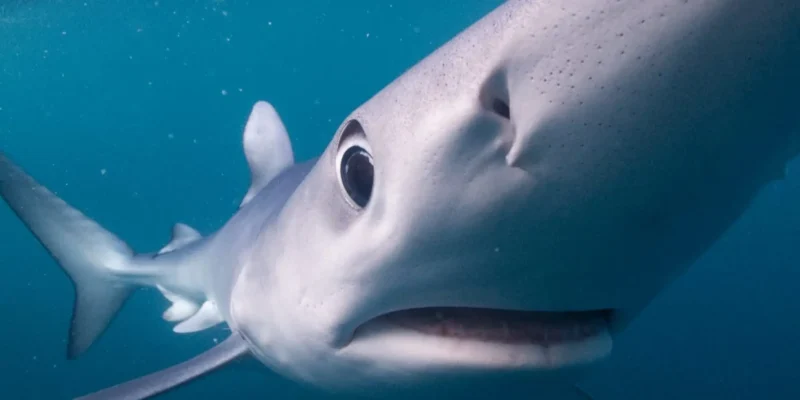
Blue sharks are among the most common pelagic sharks in bycatch of longline fisheries. For the Mediterranean population, this apparent frequency is deceptive: it is considered critically endangered, and any additional loss could be relevant for a slow-growing shark species. A new study from the southern Adriatic now provides important data about what happens after release.
The work Resilience in the line: insights on post-release survival from long-term monitoring and satellite tagging of blue sharks (Prionace glauca) in the Southern Adriatic Sea is in Biological Conservation published and assigned to volume 321, article 111939. The DOI is 10.1016/j.biocon.2026.111939. The authors are Pierluigi Carbonara, Andrea Bellodi, Giulia Prato, Simone Niedermüller, Alessandro Buzzi, Cosmidano Neglia, Lola Toomey, Massimiliano Bottaro, Maria Cristina Follesa and Walter Zupa.
Five years of fishing and tagging data
The study combines several data sources from 2019 to 2024: onboard observations, checks at landing sites, fisherman’s logbooks and satellite telemetry. This means it goes beyond pure catch statistics. It not only asks how often blue sharks appear in the swordfish longline fishery, but also which animals actually live on after being released.
A total of 45 blue sharks were equipped with pop-up satellite tags. These transmitters can later emerge and transmit data, allowing movement patterns and tagging behavior to determine whether an animal survived release. This is particularly valuable for the southern Adriatic, where little integrated data on bycatch and post-release survival has been available there.
77 percent survived after release
The central result initially sounds cautiously optimistic: the estimated survival rate after release was 77 percent. Most deaths occurred in the first four days. It is precisely this period of time that is important in bycatch studies because a shark may appear alive when released, but later die from capture stress, injuries or exhaustion.
The researchers also linked the capture status and telemetry data. This resulted in an estimate that about 68 percent of blue sharks caught accidentally could survive if they were released quickly. This is not an all-clear, but it is a strong argument for releasing live animals consistently and as gently as possible.
Leash time, condition and body size count
The chances of survival were not randomly distributed. The condition during retrieval and body size had a clear influence: adult animals were apparently more resilient than smaller or more heavily stressed individuals. This fits with other bycatch studies in which capture stress, injuries and handling directly determine whether a shark released alive really has a chance.
A Random-Forest-Modell identified soak time, i.e. the length of time the hooks remain in the water, as the most important factor in fishing condition. This was followed by environmental variables such as sea surface temperature, Chlorophyll-a and dissolved oxygen. This is practical for management because leash time and handling are more changeable than the environmental conditions themselves.
Why fewer landings can be a good sign
Catch rates remained stable in the study, while landings declined after 2021. The authors interpret this as an indication of greater compliance with discard or non-landing rules and of increased awareness among fishermen. What is crucial, however, is that a rule only protects if the animals survive after being released.
This is exactly where the strength of the work lies. It shows that no-landing rules and release are not just administrative terms. They must be combined with real fishing conditions, short deck procedures, appropriate equipment and cooperation with the fishery. Otherwise mortality just shifts from landing to the invisible period after release.
What this means for blue sharks in the Mediterranean
Blue sharks are important predators in the open sea and are classified as apex mesopredators in the study. They are under particular pressure in the Mediterranean because the population is critically endangered and longline fishery regularly overlaps with their habitat. Any improvement in bycatch management can therefore make a measurable difference.
The message is not that bycatch will become unproblematic once sharks return to the water. The message is more precise: if fishing gear stays in the water for a shorter time, if live sharks are released more quickly and calmly, and if fishermen are actively involved in monitoring and feedback, the chance that release actually means protection increases.
A sober glimmer of hope
The study is also interesting for Haitauchen because it closes the gap between sighting and protection. A blue shark that appears elegant and powerful on the surface can find itself in a completely different situation in just a few hours while fishing. Whether he survives depends on details that rarely appear in headlines: hooks, soak time, oxygen, temperature, handling and decisions on board.
The finding of 77 percent survival is therefore neither a reason for complacency nor resignation. It shows that many blue sharks are robust enough to survive release if conditions are right. At the same time, the around 23 percent mortality remains a clear mandate: bycatch must be further reduced, and every release must be designed in such a way that it actually represents a second chance for the shark.
