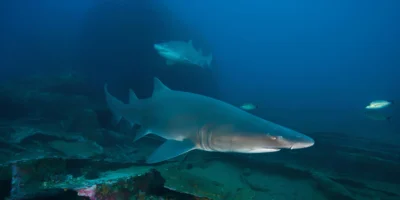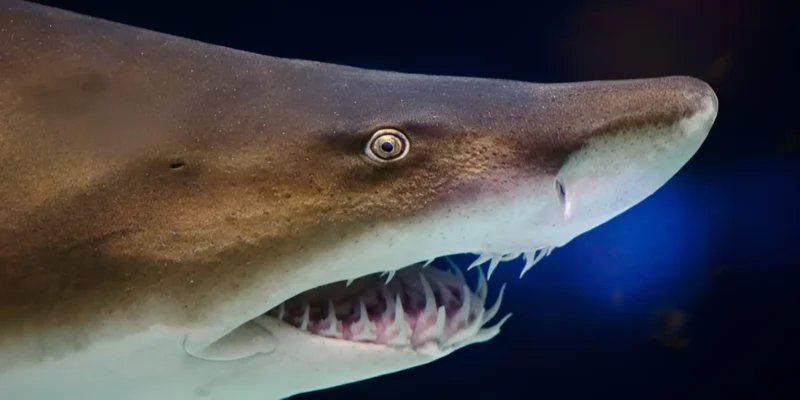
Sand tiger sharks are impressive ambassadors in display aquariums: large, calm-looking, easily recognizable to visitors. It is precisely this visibility that makes them a difficult case for shark protection. A new review in Frontiers in Conservation Science asks whether the removal of protected sand tiger sharks from Delaware Bay for the international aquarium trade is compatible with conservation and management goals.
The work Reconciling conservation and management objectives with the international aquarium trade of the globally critically endangered Sand Tiger Shark was published on May 26, 2026 and bears the DOI 10.3389/fcosc.2026.1797608. The authors Aaron B. Carlisle, Dewayne A. Fox, Edward Hale and Bradley M. Wetherbee do not argue against aquariums across the board. But you ask a specific question: What evidence and what considerations are needed when a globally critically endangered species is taken out of the wild for commercial exhibitions?
Why Delaware Bay is in focus
Delaware Bay is more than just any stretch of coast for sand tiger sharks in Northwest Atlantic. The bay is designated Habitat Area of Particular Concern and is therefore considered a particularly important habitat within US fisheries management. There, of all places, the authors describe a growing collection by private collecting companies that sell animals to aquariums abroad.
According to the review, sand tiger sharks from this catch go to regions such as Asia, the Middle East and Europe. This is tricky because sand tiger sharks were historically present in some of these regions, but are now considered disappeared or severely depleted. Live animals from Delaware Bay can therefore appear there as replacements for local populations without automatically contributing to their protection.
Critically threatened globally, assessed as uncertain regionally
The global situation of the species is clear enough to warrant caution. The IUCN carries the sand tiger shark, Carcharias taurus, considered critically endangered. The review points to a global decline of more than 80 percent over 74 years, i.e. around three generations. Sand tiger sharks have an extremely slow life history: a female gives birth to only two young in a two- to three-year reproductive cycle.
For the Northwest Atlantic the situation is more complicated. The population is considered one of the less threatened subpopulations due to US management measures; Older decline estimates may have been too high, and some data suggests stabilization or recovery. But this is exactly where the problem lies: a formal current inventory assessment and reliable trend data are missing. This leaves it unclear how much additional extraction the population can bear.
Aquariums are not automatically the problem
The authors expressly acknowledge that Aquariums can play a role in education, research and public perception. Large sharks in public areas make animals visible that many people otherwise only know from films or headlines. Done well, communication can reduce fear, explain conservation issues and enable research on live animals.
At the same time, keeping large, long-lived cartilaginous fish is not an easy replacement for wild populations. Breeding of sand tiger sharks is possible, but rare and slow. The review cites the birth of the sand tiger shark Rip in 2022 in the Ripley’s Aquarium of Myrtle Beach as an important achievement. But it also shows why breeding can hardly meet global demand in the short term: even under good conditions, only two young animals can be expected per mature female per cycle lasting several years.
Catching wild animals for profit requires a higher standard
The authors are particularly critical of the combination of protection status, commercial trade and lack of impact testing. In the USA, the sand tiger shark is a banned species in federal waters and is also listed as a Species of Concern. If animals are nevertheless taken from an important habitat and sold internationally, the review believes that a general reference to education is not enough.
The point is not whether a single aquarium can attract visitors to sharks. The point is whether the actual removal provides measurably more protection than it biologically costs. To achieve this, benefits, risks, cash flows and management consequences would have to be examined transparently. Particularly with slow-growing species, a small additional pressure can be relevant if the population is not properly assessed.
What the authors demand
The review first calls for a solid inventory basis. Without a current assessment of the Northwest Atlantic population, it cannot be reliably said whether withdrawals from Delaware Bay are sustainable. This includes data on population trends, reproduction, mortality, catch numbers, export routes and the role of the bay as a habitat.
Second, organizations that benefit from the extraction should take on more responsibility. The authors propose, among other things, fees per collecting permit or per animal removed, which could flow directly into management and species protection. A greater expansion of serious breeding programs is also mentioned, but without glossing over the slow biology of the species.
Thirdly, the review brings international regulation into play. A CITES listing for sand tiger sharks could help make cross-border trade more transparent and controllable. For a species that is critically endangered globally and is traded internationally as a living specimen, this would not be a radical idea, but rather an obvious level of security.
Why this is relevant to shark protection
For divers, sand tiger sharks are often positive encounters: visible, calm, photogenic and, on some coasts, an important part of the marine nature experience. That’s exactly why the species is well suited to getting people interested in sharks. But this strength must not become a shortcut. A live shark in a tank does not automatically make a conservation contribution just because it is impressive.
Protection only arises when the origin is clarified, when wild populations are not put under additional strain and when money, research and public attention flow back into concrete measures. The review reminds us that aquariums are not outside of this equation. Anyone who generates attention and income from a critically endangered species must be able to show that the outcome is positive for the species itself.
A conflict that won’t go away on its own
The authors also mention a new holding facility in Lewes, Delaware, as an indication of longer-term investment in collection and interim storage in the region. The question is therefore not theoretical. Unless a clear assessment and narrower framework follows, an international market can continue to grow while the scientific basis lags behind.
For Haitauchen, the most important lesson is sober: aquariums can be valuable partners in shark conservation, but wild capture from uncertainly assessed stocks requires a high standard of evidence. For sand tiger sharks from Delaware Bay, this means: first inventory data, transparency and real conservation funding, then the question of whether individual removals can even be justified.