


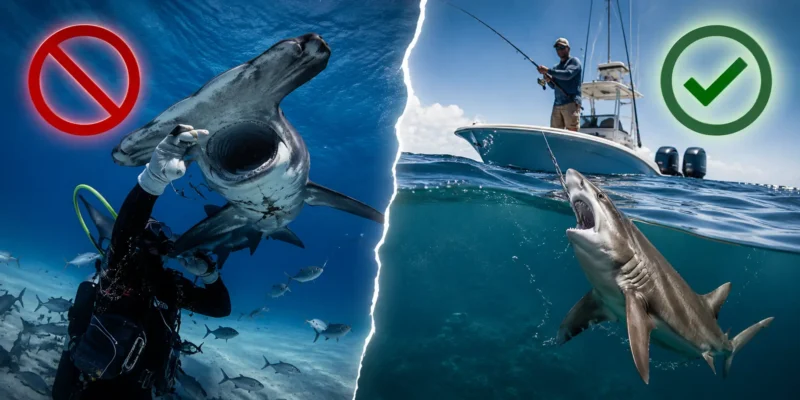
The US U.S. House of Representatives passed the Florida Safe Seas Act on June 2, 2026. The bill, H.R. 3831, seeks to ban feeding of sharks in the Exclusive Economic Zone off Florida. This would close a regulatory gap between Florida’s coastal waters and federal waters further out.
The Message from MP Daniel Webster describes the move as a measure for responsible use, marine conservation and safety of bathers, anglers, boaters and visitors. Webster had introduced the bipartisan bill; However, after the vote in the House, the bill is not yet valid federal law.
The official one House-enlarged bill text at GovInfo is noticeably short: H.R. 3831 amends Section 317 of Magnuson-Stevens Fishery Conservation and Management Act so that the existing shark feeding ban applies not only to Hawaii, but also to Florida. The text explicitly states that the U.S. House of Representatives passed the bill on June 2, 2026.
What exactly should be banned
At its core, it’s about a simple demarcation: Anyone who specifically attracts sharks with food changes their behavior and brings people and wild animals closer together than would be necessary in a normal encounter context. Florida already prohibits this practice in its own waters, according to the Webster Notice. The new federal rule would expand the area off Florida’s coast where shark feeding is not allowed.
The difference is important for divers. Many legal and responsible shark encounters operate without hand feeding or targeted conditioning. A shark feeding ban is not directed against every shark observation, every research tour or every encounter in the water, but rather against intentional feeding as an attraction or lure in the surveyed area.
Why Florida is in focus
Florida is one of the most visible shark hotspots in the United States. The Atlantic Coast, Keys and Gulf Coast combine swimming beaches, sport fishing, boat tourism, diving and natural habitats for many shark species. This means that two realities come together: sharks belong ecologically in these waters, and at the same time a lot of people use the same coastal areas.
This is precisely why the political message of the draft is stronger than the brief legal text. The rule is intended to prevent providers or individuals from deliberately habituating sharks to people, boats or swimming areas. Such habituation can be risky for animals because they are more likely to find themselves in conflict situations, and it can be problematic for humans when expectations arise about seemingly controllable wildlife contacts.
Safety without the anti-shark narrative
It is easy to misread the draft if you only understand it as a security law. Sharks are not a nuisance off Florida, but part of the sea. The crucial question is not how to remove sharks from the water, but how to reduce avoidable risk situations without demonizing wildlife.
A feeding ban fits exactly into this logic. It does not attempt to fundamentally prevent encounters with sharks. It takes out of the system a concrete human action that can attract animals, change behavior and give tourism a false sense of control.
What reputable providers should consider
- No hand feeding: Encounters should not depend on sharks being actively fed to humans.
- Clear briefings: Guests must know that sharks are wild animals and distance, calm and group discipline are more important than closeness.
- No fish remains in the water: Cleanup sites, bait, chumming, and trash can attract sharks into situations that do not lend themselves to controlled observation.
- Transparent communication: Tours should explain whether and how animals will be attracted, rather than selling wildlife contact as a guaranteed experience.
This transparency is particularly important for diving and snorkeling offers. A guest can only make responsible decisions if it is clear whether an encounter is based on natural behavior, known seasonal presence or active feeding. The line between respectful observation and problematic conditioning should not disappear in the small print.
No law yet
What is important is the current status: On June 2, 2026, the U.S. House of Representatives passed H.R. 3831. This means that the Florida Safe Seas Act is one step further, but not yet automatically federal law. Further steps in the legislative process are crucial for the actual legal situation.
The draft is still relevant to the shark protection debate. It shows that shark feeding is not just treated as a tourist practice, but as a wildlife management and safety issue. This is a sober position: Sharks should remain in Florida waters, but people should not force them into unnecessary proximity by feeding them.
If the rule ultimately becomes federal law, it would primarily be a signal of consistent standards along the Florida coast. Good shark encounters don’t require show feeding. They need distance, clean processes, honest communication and respect for animals that should not be trained for the next thrill.