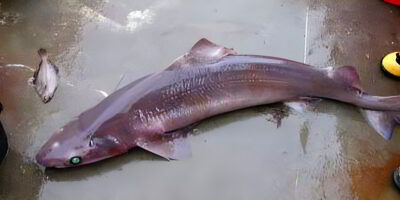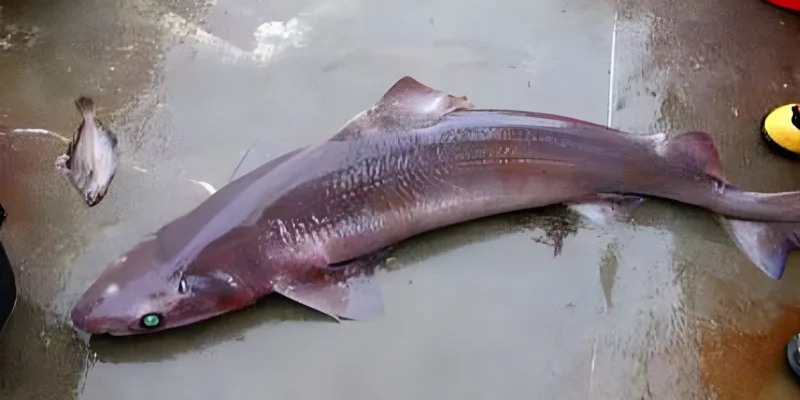
A new project of the Save Our Seas Foundation A standardized national monitoring for gulper sharks is to be implemented for the first time Maldives build up. The project, led by Sara Scroglieri, aims to clarify which species of the deep-sea shark family Centrophoridae occur in the archipelago, where they live and how often they occur as bycatch. To date, there is a lack of systematic data even for these fundamental questions.
The timing is politically and biologically explosive. The Maldivian gulper shark fishery collapsed after only around two decades. After a nationwide ban on shark fishing in 2010, the animals were protected for almost 15 years. However, since November 2025, gulper sharks has been allowed to be targeted for fishing again. Monitoring does not begin in an untouched protection zone, but rather during a new usage experiment.
From the liver oil boom to the inventory collapse
Targeted deep-sea fishing developed in the 1980s. What was in demand was not primarily meat or fins, but rather the animals’ large, squalene-rich livers. The oil was exported and used, among other things, for industrial products. Within about 20 years, export volumes fell to very low levels – a classic warning signal for the overexploitation of slow-growing deep-sea species.
gulper sharks are particularly ill-equipped to handle high fishing pressure. They grow slowly, reach sexual maturity late and only produce a few young. If many adults are removed, a population can react much more slowly than with more productive bony fish. Fifteen years without targeted fishing sounds long, but it does not necessarily mean a complete recovery for such life cycles.
The protection status changed in 2025
The project description cites the Maldives as a rare opportunity to study recovery under complete protection. This initial situation has now changed. Like Haitauchen about the Reopening already announced in August 2025 reported, the government partially lifted the blanket protection rule for this group of sharks.
After Fisheries regulations published at the end of October 2025 The gulper shark fishery can be operated again under a management plan and with special licenses. Other Shark species remain protected. The regulation makes reliable population data even more urgent: Without a baseline, it is impossible to show how much the populations have recovered since 2010, nor whether new catches would be sustainable in the long term.
Fishing knowledge, genetics and bycatch data
The program therefore does not rely on a single method. Local ecological knowledge from fishermen and island communities will be linked to genetic samples and fishing data. Data sets on species diversity, distribution, relative abundance and bycatch rates are planned. Genetics are particularly important because the exact species composition of the Maldivian gulper sharks has not yet been conclusively clarified.
In addition, the first bilingual identification guide for the deep-sea sharks Maldives is to be created – in English and Dhivehi and developed together with the groups involved. Better species identification on board is more than just educational work: catch and bycatch statistics are only useful if similar-looking species can be reliably distinguished.
The project also wants to involve fishermen in monitoring and handling bycatch as carefully as possible. Their observations can reveal historical fishing sites, seasonal patterns and changes that would be difficult to capture in short scientific expeditions. At the same time, such information must be compared with standardized, fishing-independent methods.
An inventory is not yet proof of recovery
The new program can fill a critical gap, but its first data set will first describe the current situation. A robust recovery trend requires repeated surveys, clearly defined reference values and rules for when fishing should be restricted or closed. Catch numbers alone can be misleading because fishing gear can be used specifically in the last concentration areas.
A technical classification in Aquatic Conservation of July 2026 also emphasizes that although environmental DNA can detect the presence of species, it does not, on its own, reliably measure abundance, population structure or recovery. The method can complement cameras, genetic analyses, fishing data and species-specific stock assessments, not replace them.
A test case for deep-sea shark protection
The Maldives will therefore become an internationally important test case Indian Ocean: Can extremely slow-reproducing deep-sea sharks return after a collapse – and can a reopened fishery be monitored to prevent a second collapse? The new monitoring does not yet provide an answer to this. For the first time, however, it creates the basis for testing political claims about recovery and sustainability against measurable data.