


Gulper shark - Centrophorus granulosus

Body structure, features & anatomy
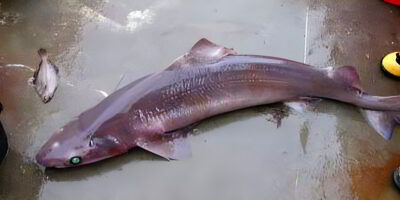
The gulper shark has a moderately strong, elongated body with a broad head and a short to moderately long, rounded snout. The upper side is uniformly brown, gray-brown or dark gray, the underside is slightly lighter. The dark lining of the mouth can also be noticed during identification.
According to the description of Fishes of Australia The species has two dorsal fins with strong spines. The first dorsal fin is higher than the second; their base is long and their free hind end extended. As is typical for dogfish sharks, an anal fin is missing.
Teeth and rough skin
The teeth of both jaws each have a main tip, but differ significantly in size. At the top there are smaller, more upright to slightly inclined teeth. The lower teeth are significantly larger, set at a steep angle and together form a cutting edge.
In adult animals, the cutaneous teeth are close together. Their flat, rounded to teardrop-shaped crowns create the grainy surface on which the species name granulosus alludes. Young animals have more erect, three-pointed cutaneous teeth.
Size and gender differences
Females are significantly larger than males. The maximum recorded total length is approximately 176 centimeters; large males reach about 124 centimeters. The long, extended rear edges of the pectoral fins and the robust head also help to distinguish it from smaller species in the family.
The current taxonomy in WoRMS leads Centrophorus acus and Centrophorus niaukang as synonyms. Older photos, catch reports and population data under these names may therefore relate to the same species; In the case of historical information, it is still important to re-examine the provision.
Distribution & habitat
The gulper shark is spotty in the Atlantic as well as in Indian Ocean and in the West Pacific spread. There are, among other things, well-documented deposits Portugal, South Africa and Australia. The species has not been recorded in the eastern Pacific.
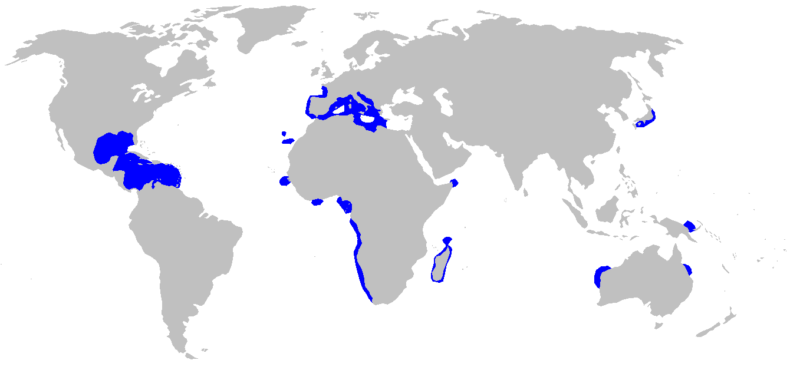
Outer continental shelves, continental slopes and the slopes of oceanic islands are inhabited. The shark usually swims close to the bottom or in the water column near the bottom. Evidence ranges from approximately 50 to 1,500 meters deep, with the focus in many places being between 300 and 1,100 meters.
Cool deep slopes instead of flat coasts
The wide horizontal distribution should not be confused with a uniformly populated area. Suitable depths, temperature, food availability and the structure of the slopes limit their occurrence to separate habitats. Within a region, genders and maturation stages may also use different depths.
The inventory valuation of OSPAR expressly points out identification difficulties for the northeast Atlantic. Previous landings combined several gulper sharkspecies under one name. Also historical reports from the Mediterranean may partly affect the similar small gulper shark.
Distribution remains incompletely known
Deep sea surveys are spatially unevenly distributed and many catches are only reported as Centrophorus sp. reported. Maps therefore show confirmed areas of discovery rather than a closed distribution area. New morphological and genetic tests may change individual marginal deposits in the future.
Life history, diet & reproduction
gulper sharks live mainly alone and look for food on the ground and in the water column above. Their large lower teeth cut prey while the smaller upper teeth hold them in place. The nutrient-poor deep sea promotes an energy-saving lifestyle.
FishBase primarily mentions bony fish such as hake, lanternfish, cod and grenadier fish as prey. There are also squid and crustaceans. The food thus connects organisms from the sea floor with prey from the mesopelagic water column.
Live birth with few young
The species is aplacental viviparous. The embryos develop in the uterus without a connection to the placenta and are nourished primarily by a large supply of yolk. Litters examined included one to seven young; four to six embryos were often found.
One Study in Deep Sea Research Part II determined an average of 5.3 embryos and sizes at sexual maturity of around 111 centimeters for males and 143 centimeters for females. The work also documented more blood-supplied uterine structures during development without detecting a placenta.
Late maturity and long generations
Females are estimated to reach maturity at around 16.5 years. The highest documented age is approximately 39 years and the generation length is 27.75 years. This slow life history explains why even limited additional mortality can lead to significant population losses over decades.
Threats & conservation status
The IUCN Red List has rated the gulper shark globally as a since the 2024 reassessment highly endangered (Endangered, criterion A2bd). Over three generations or around 83 years, a decline of 50 to 79 percent is assumed.
Deep sea fishing strikes a slow pace
The species is caught using groundwater and midwater trawls, deep-sea longlines, gillnets and gillnets. It can be a target species or come on board as bycatch. The pressure is particularly strong because late sexual maturity, long generations and small litters prevent rapid recovery.
- Liver oil: Deep sea gulper sharks are targeted for their squalene-rich oil.
- Bycatch: Animals from great depths often do not survive capture, changes in pressure and long periods of handling.
- Incorrect determinations: Combined catch reports obscure species-specific declines.
- Unregulated fisheries: In parts of the distribution area there are no catch limits or reliable controls.
Protection and international trade
In the Northeast Atlantic, there are bans or severe restrictions on targeted fishing and landings of several deep-sea sharks. Such rules reduce pressure regionally but do not protect populations in areas where deep-sea fishing remains intensive or poorly recorded.
At the CITES Conference of the Parties 2025, according to the published CoP20 result the entire family of gulper sharks is included in Appendix II. Due to the agreed transition period, the listing will not come into force until June 5, 2027. From then on, international trade must be legal and compatible with the continued existence of stocks.
Gulper shark & humans
The gulper shark does not pose any relevant danger to swimmers and recreational divers. Its habitat is almost always well below normal diving depths, and there is no evidence of aggressive behavior towards humans. Direct encounters mainly occur during deep-sea research or fishing.
Encounters mostly on board
The photo used as the cover image shows a dead specimen on the deck of a research vessel. Such photos are important for identification and documentation, but should not be confused with a natural underwater encounter. Live animals should not be touched because of their dorsal fin spines and sharp teeth.
Liver oil, meat and fins
The most important contact with people is economic. Liver oil contains squalene and is used, among other things, for cosmetics, nutritional supplements and industrial applications. Meat and fins are also used regionally; however, some of the catches are discarded.
The official CITES proposal describes gulper shark fisheries as a typical boom-and-bust pattern: high prices encourage rapid development until local catches plummet. Products of different types can then hardly be distinguished from one another, which makes traceability and control difficult.
The species can hardly be observed in a planned manner for diving tourism. Rather, their value lies as part of little-explored deep-sea ecosystems and as an example of how invisibly overfishing can occur at great depths. Scientific catch data, correct species identification and a transparent supply chain are therefore crucial.
Profile
- First described:
- Max. size:
- Depth:
- Max. age:
- Max. weight:
- Water type:
- IUCN Status:
Taxonomy
- Kingdom:
- Phylum:
- Subphylum:
- Infraphylum:
- Parvphylum:
- Class:
- Subclass:
- Superorder:
- Order:
- Family:
- Genus:
News
Newsletter
Shark Alert in Your Inbox