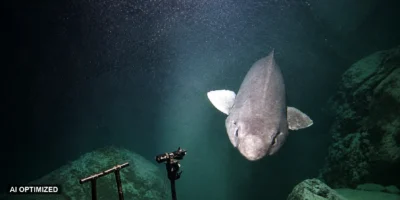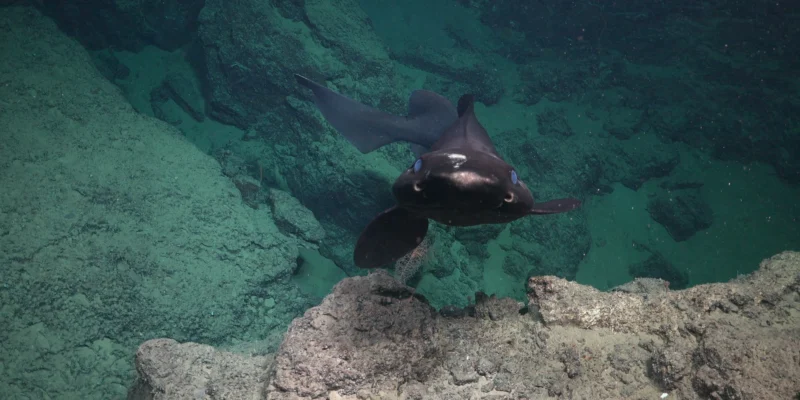
The first Caribbean-led deep-sea expedition off Trinidad and Tobago has documented 25 active cold seeps, 20 possibly new species and numerous new country records. The team from Trinidad and Tobago mapped more than 11,335 square kilometers of seafloor in the Caribbean Sea in July 2026 with the research vessel Falkor (too). Among the animals filmed was a False catshark (Pseudotriakis microdon) at a depth of 1,086 meters.
The month-long trip was, according to Schmidt Ocean Institute, the island nation’s first locally-led and most comprehensive deep-sea exploration to date. About 13 percent of the previously unmapped seabed in the national territory has been newly surveyed. The remotely operated submersible vehicle SuBastian provided images, collected samples and helped verify evidence from sonar data directly at the bottom.
219 bubble streams led to 25 cold seeps
The team detected 219 bubble streams in the map data. Such emissions may indicate cold seeps, in English cold seeps. Methane and hydrogen sulphide, among other things, escape from the sediment there. The name doesn’t necessarily mean that the water is particularly cold; it separates these slow releases from hot hydrothermal vents.
SuBastian visually confirmed 25 of these habitats. The largest area discovered was about half an acre, or about 0.2 hectares, and was densely populated with mussels and tubeworms. The basis of the food web is chemosynthetic bacteria: They obtain energy from chemical compounds instead of sunlight and thus supply communities far below the light-rich zone.
20 possible new species – but no formal descriptions yet
The at least 20 suspected new species include an octopus of the genus Graneledone, corals, carnivorous sponges and squat lobsters. Three finds could even represent previously unknown genera. The octopus had already been observed in 2014, but at that time images and samples were not sufficient for confirmation.
The phrase “possibly new” is crucial. Only by comparing body characteristics, genetics and museum material can it be determined whether a species has actually not yet been scientifically described. The expedition therefore reports candidates, not formally described new species.
In addition to the False catshark, the team saw chimeras, so-called ghost sharks, as well as a black swallower with a severely stretched stomach and the carcass of a manta ray at a depth of 1,025 meters. A leucistic specimen of the same species was documented in 2025 in the Azores. The current observation is a new record from this expedition, not another report on leucism.
At least 54 species had never before been recorded in Trinidad and Tobago’s waters. In addition to chimeras, these also include bone-eating Osedax worms, which are colloquially known as zombie worms. However, a new country record is not the same as a new species: the animal may have long been known elsewhere and now be documented for the first time in this sea area.
More than 700 samples remain in the country
The team collected over 700 specimens. They are kept in the Zoological Museum of the University of the West Indies in St. Augustine and are intended to increase its deep-sea collection approximately twelvefold. This means that important comparison objects remain in Trinidad and Tobago and are available there for taxonomic and ecological research.
In addition, researchers collected water and sponge samples for environmental DNA. Organisms leave genetic traces in water; filter feeders such as glass sponges can accumulate these signals from large amounts of water. Such data complements video and specimen sampling, but does not replace the formal investigation of possible new species.
A “frozen zoo” for Caribbean deep-sea species
A new antifreeze for living tissue was also tested. It is intended to protect cells from damage when frozen, which can occur with direct freezing or liquid nitrogen. Tissue from more than 86 species of deep-dwelling sponges, corals and sea cucumbers has been cryopreserved. This creates a reference collection that can be used to examine future changes in ecosystems.
With DORIS, the expedition also tested an experimental, comparatively inexpensive camera and imaging system. The device is developed by Ocean Discovery League and Blue Robotics. If such systems prove successful, research institutions with smaller budgets could also collect their own deep-sea data more regularly.
A huge unknown zone – and yet human traces
A report by Discover Wildlife highlights that less than 0.001 percent of the country’s deep sea area has been explored. At the same time, 93 percent of the national territory lies below the usual limits for recreational diving. The new maps therefore cover a large, ecologically important zone that is rarely seen directly by people.
It is still not completely untouched. SuBastian also filmed human waste on the seabed. The find does not yet provide a quantitative waste balance, but shows that even very deep and previously unvisited places are associated with human inputs.
Data for protected areas and local decisions
The maps, species lists and biological samples are intended to be incorporated into the marine spatial planning of Trinidad and Tobago. Cold seeps are spatially limited and at the same time highly specialized habitats. Their exact location is therefore important when assessing fisheries, resource use, cable routes or future marine protected areas.
It’s not just the number of finds that is special, but also who led the expedition. Scientific leadership was provided by Trinidad and Tobago marine biologist Diva Amon; A large part of the team came from the island nation. Samples, skills and data should not only be collected from outside, but should also be permanently anchored in the region. Analyses on land now show whether the 20 candidates actually become new species.