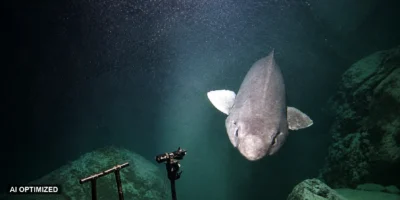
Researchers off the Azores filmed an unusually pale shark using a BRUV system (Baited Remote Underwater Video): a leucistic False Catshark (Pseudotriakis microdon). The baited camera, stocked with salted, chopped sardines, recorded for around nine hours. In a roughly 30-second clip, an almost white animal passed by the edge of the frame – a scientifically groundbreaking discovery.
Leucism instead of albinism
The False Catshark is a large deep-sea predator with a patchy, global distribution and is normally dark brown to blackish in colour. The observed specimen exhibits leucism: a genetically determined, partial reduction in skin pigmentation with normal eye colour. This distinguishes it from true albinism, which involves complete pigment loss, including in the eyes.
Leucistic animals appear white or pale but retain normal eye colour, unlike albinos.
Rare condition, healthy animal
Pigment disorders such as albinism or leucism are rare in cartilaginous fish. It is often assumed that the light colouration could impair hunting and camouflage. However, in this case, the shark appeared healthy: its distinctly rounded belly suggests it had recently eaten or was pregnant. In great depths, many fish are naturally pale; additional disadvantages are therefore unlikely.
Deep-sea context and study
The discovery was made in October off the Azores at over 1,200 metres depth. The archipelago lies about 900 miles west of the Portuguese mainland. The results were published on 6 August in the journal Marine Biodiversity; contributors included Diana Catarino, Eva Giacomello, Pau Robles, and Laurence Fauconnet.