


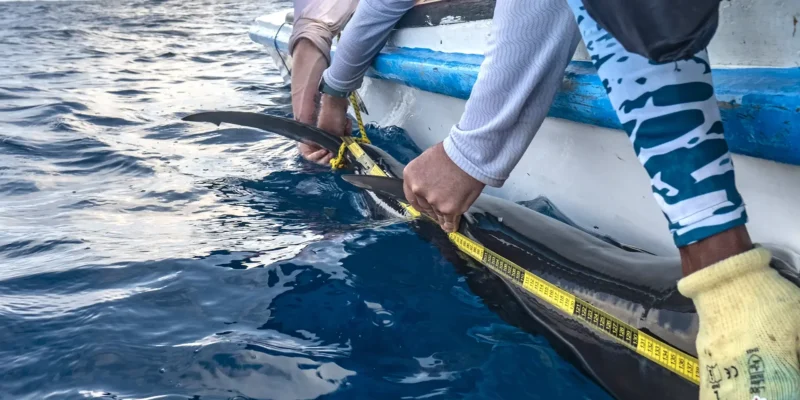
A new study in Scientific Reports reconstructs the life history of the smooth hammerhead shark from its vertebrae. The key finding is that early juveniles carry stronger coastal signatures. From about 2.5 years of age, the habitat and dietary signals become progressively more oceanic, continuing into adulthood.
The study examined the endangered smooth hammerhead (Sphyrna zygaena) in the Atlantic Ocean. The researchers analysed stable isotopes of carbon, nitrogen and sulfur in successive vertebral growth layers. This produced a chronological series of chemical signals for each shark, from the vertebral centre representing early life to layers formed later.
Vertebrae record more than age
Stable isotopes are different versions of a chemical element. Their relationship varies between food webs and habitats. If the material is incorporated into a vertebra as it grows, some of this ecological information is retained. Unlike a satellite mark, the method does not provide an exact route. Rather, it shows which food and which environmental conditions have entered the tissue over a long period of time.
The combination of the three elements broadens the view: Carbon and nitrogen isotopes can reveal differences between food sources, habitats and positions in the food web. Sulfur complements these signals and helped particularly clearly in the new analysis to distinguish coastal phases from more oceanic phases. According to the research team, this is the first analysis of sulfur isotopes in the vertebrae of sharks and rays.
The shift does not begin at the same time in every shark
The overall pattern was consistent across the dataset, but the trajectories of individual sharks were not identical. Isotopic variation was greatest among juveniles and females. The authors suggest two possible explanations: the sharks may use nurseries with different isotopic signatures, or they may partition their ecological niches differently. The data do not directly establish either explanation.
Regional nurseries of the smooth hammerhead remain poorly understood, as recent research into a possible nursery off the Galápagos also showed. The two studies concern different regions and methods, but together they underline how little is known about the way this highly migratory species uses space during its early years.
Why this matters for conservation
A shark that uses different spaces and food webs as a juvenile than in adulthood cannot be protected by measures in a single habitat alone. Coastal areas may be important for early life stages, while older animals increasingly depend on oceanic ecosystems and transboundary fisheries management. In the team’s opinion, it is precisely these differences between the life stages that should be incorporated more into protection concepts for mobile marine species.
The study does not identify specific nurseries or migration corridors. The sampled sharks also came from the Atlantic, so the findings cannot automatically be applied to every population worldwide. Instead, the chemical life histories provide new clues about when an ecological shift occurs and which life stages future research should examine separately.
The publisher currently provides an early, peer-reviewed and citable version that may still undergo editorial revision before the final version. The publicly available summary does not state the number of sharks examined or the precise catch or sampling locations; those details should only be added from the complete version.