


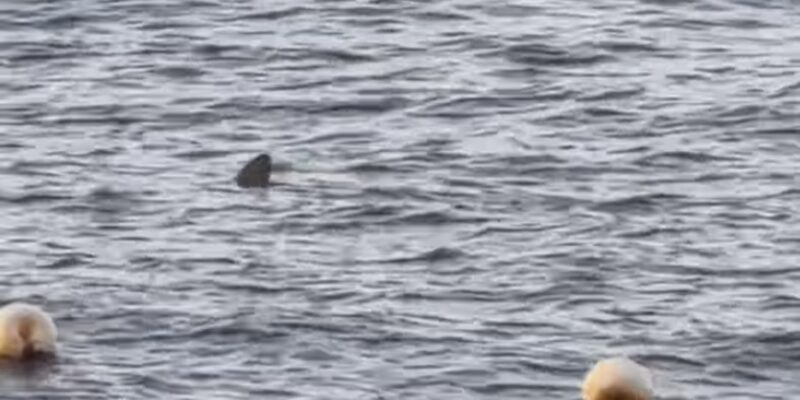
A shark was filmed close to the surface off Radazul, Tenerife, on the morning of Saturday, 8 August 2026, shortly before a freediving competition. Its dorsal fin was visible near the designated dive area. There was no incident involving competitors or swimmers.
Atlántico Hoy reports that the sighting occurred at around 8 a.m., just minutes before the 2026 Canary Islands Outdoor Freediving Championship. The footage was shared through the Instagram account @gastonanfibio. Despite the unexpected encounter, the competition subsequently began and, according to the report, proceeded as normal.
What the footage actually shows
The video shows a single dorsal fin moving calmly through the water just below the surface. Other body features needed for identification are not clear enough in the published footage. The report also gives no reliable estimate of the animal’s length.
The only defensible identification is therefore a shark; the species seen off Radazul remains unknown. The shape and size of a visible fin alone are rarely sufficient for a reliable identification. Perspective, distance, waves and the part of the body hidden below the surface can all substantially alter its appearance.
Careful wording is equally important when describing the animal’s behaviour. Its calm movement at the surface and the absence of any incident are documented. This does not indicate an attempt to approach people or any particular danger. The animal was simply observed briefly near a busy stretch of coast.
Why the sighting is not a beach alarm
Sharks are a natural part of the wildlife of the Atlantic Ocean around the Canary Islands. Seeing one close to shore attracts attention, but it is not automatically unusual from a biological perspective. A single sighting also tells us nothing about whether more sharks than usual are currently present off Tenerife.
Assessing a population trend would require comparable observations over a longer period: confirmed species, precise location, time, water depth, duration and repeated sightings. A short social-media clip can be useful evidence, but it cannot replace such a dataset.
Nor does the shark’s proximity to a freediving competition prove that it was reacting to the event. The timing makes the scene noteworthy, but it does not explain why the animal was at the surface or how long it had already been in the bay.
Staying calm remains the right response
Anyone who encounters a shark while swimming, snorkelling or freediving should keep their distance and avoid chasing, touching or surrounding it for photographs. Movements should remain controlled, and instructions from event officials, safety divers or rescue personnel take priority.
Surface safety is already central to an organised freediving competition. A sighting should be reported to those responsible so they can assess the animal’s position, direction of travel and distance from the dive area. Whether an event needs to be paused can only be decided from the specific circumstances on site.
A valuable observation—without speculation
For any later expert assessment, the original video is more valuable than compressed copies on social media. Ideally, the unaltered recording should be saved together with the date, time, the most precise position possible and the duration of the observation. Additional angles could reveal further features and make a species identification possible.
The Radazul sighting therefore remains an unusual but uneventful encounter. The location, the timing shortly before the competition and the visible dorsal fin are established. Everything else—especially the species, size and reason for the animal’s presence—should remain open until better footage or an expert identification becomes available.