


This article was published on 18 September 2026 and updated on 25 October 2026.
Timeline – latest updates first
Update of 25 October 2026
The dusky shark Bukang-i was spotted near Busan’s international passenger terminal on 24 and 25 October. According to YTN, the new location is about two kilometres from its former position by the park waterway. The shark is now swimming in deeper harbour water; a return to the open sea has still not been confirmed.
Observers reported normal swimming speed and balance. No new external injuries were noted, according to the report. Researchers interpret the wider range of movement as adaptation to the new surroundings. These observations describe its current condition; they do not establish that its previously reported injuries have fully healed.
There is also new information about the oil slick of 23 October. YTN reports that the coast guard identified an oil tanker as the source: 87 litres reportedly leaked from an oil transfer hose, and the incident was not reported. Those involved are under investigation. Whether the spill affected Bukang-i’s behaviour remains unknown; harm to the shark from the oil has not been established.
Update of 23 October 2026
Bukang-i was guided out of the canal at North Port Waterfront Park on 21 October but returned behind the first barrier that night. According to KBS, further nets prevented her from reaching the inner canal. On 22 October, authorities removed the outer barrier, reinforced the inner one and left a clear route to the sea. Rather than another forced guiding operation, they now intend to wait for the shark to move on by herself.
On 23 October, the dusky shark had not been sighted since the morning. SBS reports that she had previously been swimming outside the canal and spending longer submerged. Experts interpret this as possible adaptation to deeper water. It does not confirm that Bukang-i has left the harbour for good.
That same day, the coast guard reported an oil slick near the park and began containment and cleanup. Whether the spill affected the shark’s behaviour is unclear. The timing alone establishes neither harm to the animal nor a link to her absence.
Update of 21 October 2026
A third attempt began in Busan on 21 October to guide the shark Bukang-i from the artificial canal at North Port Waterfront Park to the open sea. Authorities are again using a net and water jets. The reports reviewed so far do not confirm that the attempt succeeded.
According to Yonhap, a net attached to a floating platform is intended to guide the shark towards the canal exit, while a second boat uses water jets. An additional barrier is meant to stop Bukang-i from returning to the inner canal as she did during the previous attempt. Kyunghyang Shinmun also reported that the operation had begun.
Update of 19 October 2026
Damage to the tip of Bukang-i’s right pectoral fin was identified on 18 October. According to Yonhap, citing the National Institute of Fisheries Science (NIFS), no bleeding was observed. The institute does not currently consider the injury a threat to her health.
NIFS believes friction against the canal wall caused the damage. Repeated contact could delay healing. Researchers are therefore continuing to monitor both the pectoral fin and the previously reported snout injury.
The female dusky shark (Carcharhinus obscurus), approximately three metres long, remains in the North Port Waterfront Park canal. Yonhap reports around 1.6 million cumulative park visits as of 18 October since her appearance; this is not a count of different people. A return to the open sea has not been confirmed.
Update of 18 October 2026
The dusky shark Bukang-i (Carcharhinus obscurus) remains in the North Port Waterfront Park canal a month after its first sighting. According to the park operator, cited by Kyunghyang Shinmun on 17 October, cumulative park visits reached 1.54 million by 6 p.m. This counts visits, not an equivalent number of individual people. A return to the open sea has not been confirmed.
The city has installed temperature sensors at three points in the canal and monitors the shark daily using drones and fisheries specialists. On 17 October, Maeil Shinmun reported a statement by the mayor saying preparations were under way to guide the shark out at an appropriate time. No new operation date or specific method was given. Changes in temperature and the animal’s condition are to inform the decision.
Update on 13 October 2026
Busan will discuss measures to keep sharks away from its beaches at a review of this year’s beach operations on 17 November, Yonhap reported on 13 October. One proposal is to include sharks in the harmful marine life category alongside toxic jellyfish, for which authorities have used beach nets. The report does not confirm an adopted reclassification or the installation of shark nets.
Bukang-i remains in the North Port Waterfront Park canal, according to the report. Nearly 1.35 million visits had been recorded by Sunday, 11 October; this is not a verified count of distinct individuals. The shark’s return to the open sea remains unconfirmed.
Update on 8 October 2026
An abrasion near Bukang-i’s snout was found on 7 October. A KBS team accompanied researchers from the National Institute of Fisheries Science (NIFS) during their examination in Busan’s park canal. Researcher Kim Hyun-woo reported abrupt changes of direction when visitors shone powerful lights at the shark at night. The injury may have occurred during such movements; its cause has not been confirmed.
NIFS continues to monitor the wound and the shark’s health, using drones and measurements of water conditions to strengthen its observations. Footage will also help assess possible changes in body shape. Researchers ask visitors to keep away from the water and avoid shining torches or phone lights directly at the shark. The report does not confirm a return to the open sea.
Update on 6 October 2026
Bukang-i’s species has now been officially identified. On 6 October, South Korea’s National Institute of Fisheries Science (NIFS) confirmed a female dusky shark (Carcharhinus obscurus) about three metres long, according to Yonhap. The animal has occupied the artificial canal at Busan’s North Port Waterfront Park since 18 September.
Researchers analysed close-up footage, including the prominent ridge between the first and second dorsal fins. External reproductive features established its sex. The earlier suggestion of a bronze whaler or copper shark (Carcharhinus brachyurus), also reported by Reuters and in our timeline, is superseded. Older entries below retain the information available at the time.
The IUCN Shark Specialist Group lists Carcharhinus obscurus as Endangered (EN) globally. Slow growth and late maturity make the species sensitive to fishing pressure; NOAA documents these life-history characteristics.
Following two unsuccessful attempts to guide it out, active rescue operations remain paused. NIFS continues to monitor swimming behaviour and health and will coordinate with the authorities if problems appear. According to SBS, officials are waiting for the shark to leave on its own. A return to the open sea has not been confirmed.
Update on 5 October 2026
The shark “Bukang-i” continues to draw crowds. Citing Busan city authorities, Seoul Economic Daily reports a total of 1,015,800 visits to North Port Waterfront Park by 6 p.m. local time on 5 October. These are cumulative park visits, not a verified count of that many individual people.
Authorities plan to pause further rescue attempts for now and wait for the shark to swim out to the open sea on its own. The National Institute of Fisheries Science and other agencies are monitoring its health and movements. A return to the sea has still not been confirmed.
According to the 4 October report by Kyunghyang Shinmun, no feeding has been observed so far. This does not prove that the shark has eaten nothing since arriving. Why it remains in the canal is unclear; suggested influences involving food, magnetic fields or light are not confirmed causes.
Update of 3 October 2026
“Bukang-i” passed the net barrier left in place the previous day around noon on 3 October and swam back into the inner canal. According to Yonhap, the shark is again being observed between the fourth and fifth footbridges at North Port Waterfront Park. The barrier was intended to prevent precisely this return. A return to open sea remains unconfirmed.
Reporting in the afternoon, News1 cites Busan city officials as saying that some of the net’s floats sank in strong winds and the shark passed over the lowered net. The city now plans to coordinate the timing and method of removing the net with the agencies involved, to allow the animal to find its own way out. This does not confirm that the net has already been removed.
Update of 2 October 2026
The second attempt to guide “Bukang-i” into the open sea also ended without success on 2 October. According to Reuters, the team used a net 50 metres long and 6.8 metres high. The operation was halted after about two hours because the net risked snagging on rocks. The Korea Times reports that it became stuck on the bottom and that the rising tide complicated the work.
Reuters reports that the net was left in the canal to prevent the shark from swimming farther inland. A roughly 100-metre section towards the sea is intended to give it a route out. Lead researcher Kim Hyun-woo hopes currents and tides will help the animal leave on its own. Its return to the open sea has not been confirmed. Reuters documents the rescue operation in the following video.
Update of 29 September 2026
The attempt to guide “Bukang-i” into open water using boats and water pumps failed on 29 September. According to Yonhap, crews deployed five boats and called off the operation at 3:20 p.m. local time. The shark remained in the artificial channel at North Port Waterfront Park.
A net tailored to the channel is now intended to help. According to Seoul Economic Daily, another attempt is expected around 2 October, once the net is ready. This is a provisional timetable, not confirmation that the shark has returned to sea. Its species identification remains tentative.
Update of 28 September 2026
There is now a specific date and plan for guiding the shark nicknamed “Bukang-i” back to open water. According to Yonhap on 28 September, the authorities agreed at a meeting to use boats and water pumps to guide the animal out of the North Port Waterfront Park canal from 10 a.m. local time on 29 September. A return to the sea has not yet been confirmed.
A field inspection by the National Institute of Fisheries Science found the shark’s activity and breathing to be stable. However, the authorities consider the narrow canal to restrict feeding and freedom of movement. A prolonged stay could weaken the animal. Teams plan to monitor its condition throughout the operation and adjust their approach to avoid excessive stress.
The initial aim is to let the shark swim out under its own power, assisted by boats and the flow from water pumps. If that fails, the plan calls for a net tailored to the canal’s width and depth. This is a more specific plan than the previously announced consultation. It does not establish that a rescue has already taken place or that the species has now been definitively identified.
Update of 27 September 2026
Crowds drawn by the shark nicknamed “Bukang-i” have continued to grow. On the evening of 27 September, CBS NoCut News, citing the operators, reported 553,800 cumulative visits to North Port Waterfront Park since 19 September. Of these, 468,000 were during the Chuseok holidays from 24 to 27 September. These are recorded park visits, not necessarily that many different people.
Earlier, Kyunghyang Shinmun reported approximately 405,800 visits for 19–26 September. The different totals cover different periods. Earlier figures remain below as dated entries in the timeline.
The responsible agencies plan to discuss returning the shark to the open sea on 28 September. According to Khan, participants include the National Institute of Fisheries Science, the port authority and the Coast Guard. Using nets to guide the shark out of the canal is one proposal; no method had been decided in the report. Its return to sea has not yet been confirmed.
Species identification remains provisional. The Korean original still uses “무태상어”, the name for the copper shark (Carcharhinus brachyurus). The different identification as a nurse shark in the automated English translation is not evidence of a new identification.
Update of 21 September 2026
The shark in North Port Waterfront Park continues to attract considerable attention: nearly 20,000 people visited the park over the weekend of 19–20 September, according to the Busan city government. That was about four to five times the usual weekend attendance, the Korea JoongAng Daily reported on 21 September.
According to the report, authorities are still waiting for the shark to leave the channel on its own. Its return to open water has therefore not yet been confirmed. The identification of the animal as a copper shark also remains provisional.
Update of 20 September 2026
A shark was seen in North Port Waterfront Park again on 20 September, bringing sightings to three consecutive days. According to Newsis, many visitors came to watch the animal, estimated at around 3.5 metres long. Another sighting had already been reported at around 1:05 p.m. local time on 19 September; the city then warned walkers and residents, Yonhap reports. The lengths reported are estimates rather than measurements.
Authorities continue to wait for the shark to leave the sea-connected canal on its own. The National Institute of Fisheries Science had advised against provoking it through further attempts to drive it out. According to SBS Biz, safety announcements were made and a footbridge over the water was closed as crowds gathered. These reports of 20 September do not yet confirm a return to open sea.
The species name needs to be distinguished from the identification of this individual animal. The Korean name ‘무태상어’ refers to Carcharhinus brachyurus, the copper shark or bronze whaler, according to the government species database MBRIS. It does not mean bull shark (Carcharhinus leucas). However, the institute’s identification of the shark in the park canal remains provisional. Translating the species name correctly does not establish the identity of the observed animal beyond doubt.
18 September 2026 – Shark appears in the waterfront park
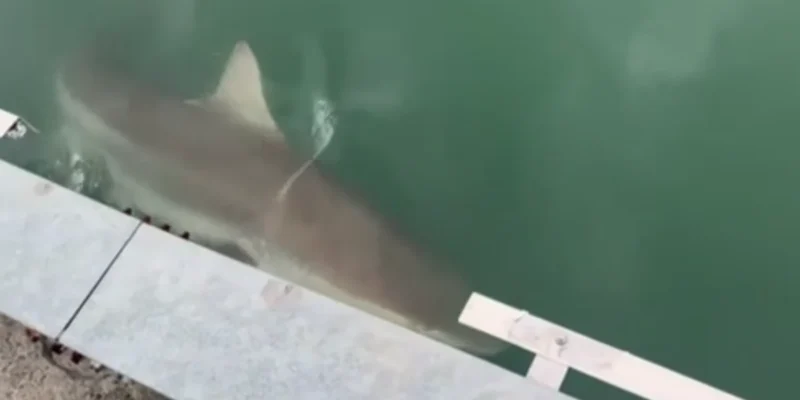
A large shark appeared in the North Port Waterfront Park in the South Korean port city of Busan on 18 September 2026. It was swimming in a canal connected to the sea near a public promenade. According to Coast Guard information reported by Yonhap, the first report from a passerby arrived at about 8:57 am local time.
Safety warning for visitors
The shark was estimated to be about three to four metres long. The city issued a warning message, and emergency personnel asked visitors to stay away from the water. SBS shows footage supplied in part by the Coast Guard.
Efforts to guide the shark ended in the afternoon
The Coast Guard deployed boats and specialist rescue personnel and initially tried to guide the animal towards the open sea. On advice from the National Institute of Fisheries Science, it did not attempt to capture it.
According to Yonhap, these efforts ended at about 3:15 pm. The research institute had recommended allowing the shark to find its own way out rather than provoking it through further intervention. The Coast Guard asked the port authority to put up warning signs and announced checks during its patrols.
Species identification remains provisional
According to Korean reports, the National Institute of Fisheries Science suspects a copper shark (Carcharhinus brachyurus), known in Korean as “무태상어”. This identification is provisional; the reports cited do not provide a confirmed identification. Nor do they confirm that the animal returned to the open sea.
