


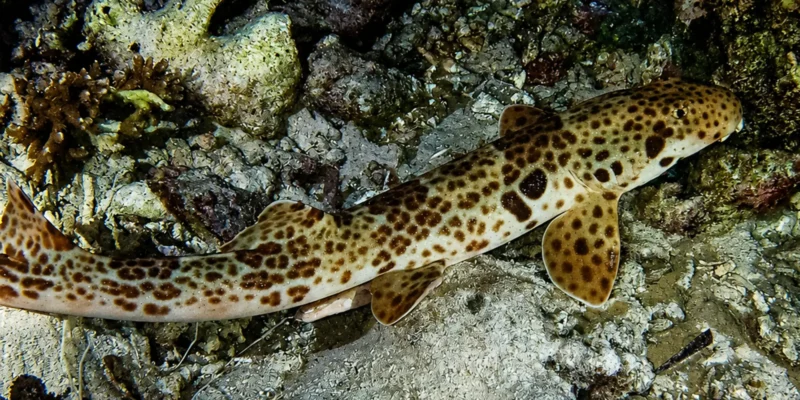
China Daily reports growing pressure on the Raja Ampat epaulette shark (Hemiscyllium freycineti). The small, nocturnal shark species lives in shallow coastal habitats in the Raja Ampat islands in Southwest Papua and is best known for its ability to “walk” with its pectoral and pelvic fins over reefs, seagrass and shallow bottoms.
Ten so-called walking shark species are known worldwide, six of which occur primarily in eastern Indonesian waters. The Raja Ampat epaulette shark can swim, but remains strongly tied to small territories. It is precisely this location loyalty that makes it sensitive when important reef, seagrass or mangrove areas are disturbed.
A shark with a very small radius of action
The report summarizes a study published in June 2026 that collected observational data between February 2024 and April 2025. A very high density of up to 2462 individuals per square kilometer was reported for the genus. At the same time, the data showed that 69 percent of immature animals were observed in coral reefs.
Coral reefs therefore primarily serve as nurseries. Adults were more commonly observed foraging among seagrass and mangrove roots. This division is important for protective measures because a single habitat type is not sufficient: young animals, adults and prey areas need contiguous, intact shallow water areas.
Tourism expansion hits the feeding places
Edy Setyawan from Elasmobranch Institute Indonesia, lead author of the study, particularly mentions the rapid expansion of tourist infrastructure as a risk in the report. In Raja Ampat, accommodations are being built on stilts over seagrass meadows in many places, including in the Arborek area. This is exactly where the sharks look for food.
The researchers also found hardly any movement between locations. The greatest distance measured was around 475 meters; no migration was observed between islands. So if a local habitat deteriorates, the species cannot simply escape on a large scale.
Climate change and wastewater
In addition to direct habitat change, the report cites rising water temperatures as a threat. The species can tolerate temperatures up to 36 degrees Celsius, according to the study, but more frequent marine heatwaves could still put a strain on health and long-term survival.
Less visible, but also problematic, is nutrient pollution from untreated wastewater from tourist use. Marine ecologist Agustin Capriati warns in the article that excess nutrients can accelerate algae growth and damage coral reefs. As reefs deteriorate, sharks gradually lose habitat.
Protection status alone is not enough
Indonesia placed walking sharks under full protection by ministerial decree in 2023. The Raja Ampat epaulette shark is listed as potentially endangered by the IUCN. According to Setyawan, the rule primarily prevents capture and consumption, but does not yet contain a clear plan on how to secure local habitats.
This is crucial for a species that is faithful to its location. If a shark rarely migrates between islands, protective measures must be taken where the animals actually live: on reef edges, in seagrass meadows, in mangroves and in shallow water areas used by tourists.
What Raja Ampat needs now
According to the report, Capriati calls for more monitoring in marine protected areas, including in the Dampier Strait. For a destination like Raja Ampat, this means controlling tourism not only through visitor numbers, but also through wastewater, building sites, distance to nurseries and the resilience of individual bays.
The case shows why small sharks are often overlooked in conservation. They are not large, not dangerous, and not as economically visible as other marine animals. This is precisely why their value as a local flagship species species for healthy reefs can easily be underestimated. For divers, the Raja Ampat epaulette shark is a special animal; for the ecosystem, it is an indication of how finely tuned and vulnerable shallow water habitats can be.