


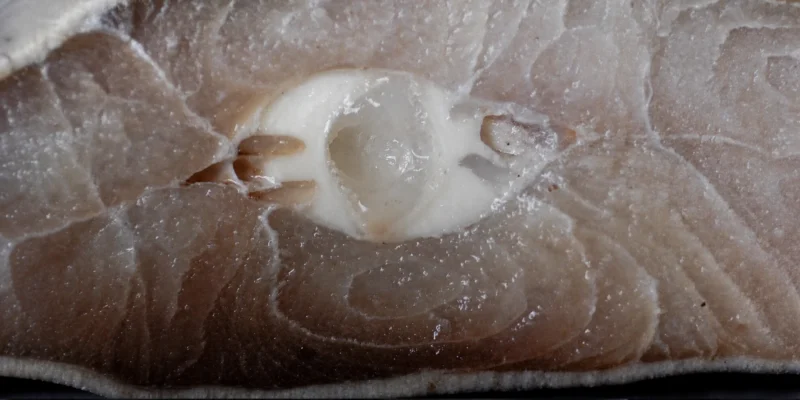
Brazil is the world’s largest market for shark meat. However, it usually does not appear in stores as a shark, but rather under the collective name “cação”. A new study in the journal Regional Studies in Marine Science now shows that this lack of transparency is not just a species protection problem: imported shark meat can expose consumers to significant amounts of mercury.
The research team led by Lucas Cabrera Monteiro examined 39 muscle samples from imported carcasses that had been marketed as “cação”. Using DNA barcoding, the researchers also determined the animal species. 38 samples came from the Blue Shark (Prionace glauca), another from the Blue Marlin (Makaira nigricans). The study thus confirms how little the sales name alone reveals about the content.
Almost all samples above the international limit
The total mercury concentrations measured were between 0.336 and 2.758 milligrams per kilogram of fresh weight. The average was 1.363 milligrams per kilogram. After evaluation, 95 percent of the samples exceeded the international safety limit used by the study; 77 percent were also above the Brazilian limit.
Mercury enters the oceans from natural and man-made sources and is partially converted into methylmercury. This particularly problematic substance accumulates along the food chain. Large, long-lived predators can therefore have significantly higher concentrations than many smaller fish. As top predators, sharks are high up in this food chain.
Children reach the tolerable weekly amount particularly quickly
The researchers also calculated the possible intake over a week. For children aged six to 13 years, the values were between 0.805 and 6.613 micrograms of mercury per kilogram of body weight. 91 percent of the meat samples examined would have resulted in the consumption amount exceeding the provisionally tolerable weekly intake.
In adults, the estimated intake ranged from 0.525 to 4.315 micrograms per kilogram of body weight; Here, 71 percent of the samples resulted in an exceedance. Based on the 90th percentile of exposure, the study calculated a maximum safe weekly portion of only about 40 grams for children and 75 grams for adults. The authors still recommend avoiding imported shark meat entirely if possible.
“Cação” disguises type and origin
The health risk hits a well-known problem in the Brazilian market: “cação” can stand for different species of sharks and rays. Without a clear species name, customers cannot assess the threat to a species, its origin, fishing method or typical pollutant levels. Controls also become more difficult when fillets and steaks no longer have any externally recognizable characteristics.
Extensive research has already shown that meat known as “cação” was even offered in schools, hospitals and other public institutions. We have summarized the background in our article “Shark meat on the menu”. The new laboratory study provides concrete measured values and directly connects the debate about labeling and shark protection with consumer protection.
Controls must combine species identification and pollutants
The authors call for stricter inspection procedures, better traceability and broader monitoring. This combination makes sense for two reasons: A chemical analysis shows whether a product poses a health problem; The genetic species identification shows which animal was actually traded and whether protection or trade rules apply.
This is an important point for shark protection. As long as shark meat is sold under a vague collective name, the demand remains invisible to many people. Clear labels, verifiable supply chains and regular pollution controls would not only protect consumers, but also make trade in endangered species easier to detect.
