


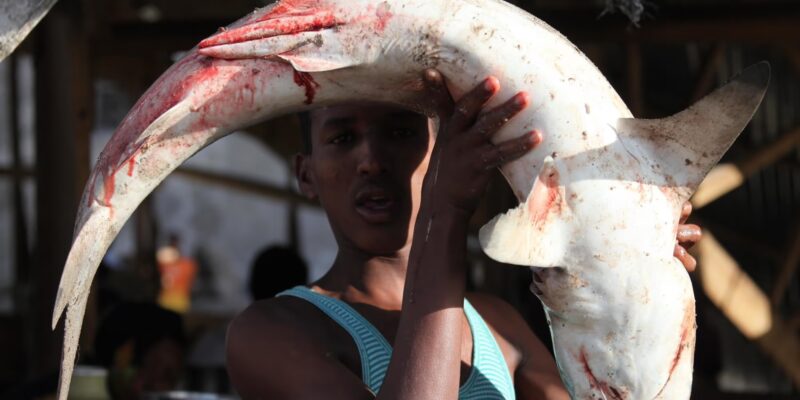
Brazil is the world’s largest importer of shark meat – and much of it ends up in public institutions such as nurseries, hospitals, barracks and prisons. An investigation by Mongabay shows: millions of people, including young children and patients, regularly consume shark meat, often without knowing it.
The meat is almost always declared as “cação” in government tenders – a generic term that obscures its true origin. Many Brazilians are unaware that they are eating shark.
The meat contains high concentrations of heavy metals such as mercury and arsenic, which accumulate in sharks’ bodies and pose a health risk, particularly for children, pregnant women and the sick.
In total, Mongabay identified over 1,000 tenders with a total volume of more than 5,400 tonnes of shark meat worth around 112 million reais (approximately 20 million US dollars). Over 5,900 public institutions in ten Brazilian states are affected – including nurseries, schools, hospitals and 92 prisons in the state of São Paulo.
With the import of shark meat – mainly from Spain and Taiwan – Brazil may also be contributing to global overfishing. While the fins are sold to Asia as a delicacy, the cheap meat ends up on the plates of public institutions.
“What is worrying is that this is not voluntary, as it would be in a restaurant,” says Solange Bergami, an educator from the greater Rio de Janeiro area. “It happens in public institutions, where you would actually assume that the food is safe.”