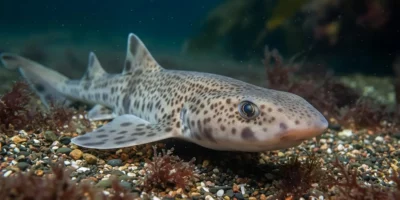
In Lysekil on Sweden’s west coast, shark conservation can begin with an unobtrusive egg case. From it, a young small-spotted catshark hatches in the aquariums of Havets Hus, grows for several years, is weighed, measured, tagged and then swims out into Gullmarsfjord.
On 23 June 2026, Havets Hus is releasing eight young small-spotted catsharks, according to WWF. The animals are part of a long-running programme built less on drama than on rearing, recoveries, telemetry and public marine education. That is exactly why the story is stronger than it first appears.
The project page of Havets Hus describes the animals’ journey from egg to release: the sharks are born in the aquarium, first fed finely chopped shrimp and later mussels, fish, shrimp and small pieces of squid. Once they are large enough, they move to the pier in front of the aquarium.
A small shark with a large education role
The small-spotted catshark (Scyliorhinus canicula) is called småfläckig rödhaj in Sweden. It is not a spectacular oceanic shark, but a bottom-living coastal species that lays egg cases and is harmless to people. For conservation education, that is an advantage: visitors see a native shark that does not live far away in the tropics, but off their own coast.
Havets Hus can show that shark conservation in Europe is not only about prohibition lists and international conferences. It also begins where children see a shark egg in an aquarium, recognise a tag on an animal and later understand why a recaptured shark must go back to sea.
In Sweden the species is now considered viable, but it remains protected there. That distinction matters: a positive trend does not mean the pressure has disappeared. Small coastal sharks remain vulnerable to bycatch, fishing pressure and changes in their habitats.
Measuring, tagging, finding again
Before release, the young catsharks are weighed and measured. They also receive a small green tag with a number. If a fisher later catches one of these sharks, Havets Hus can use the number, length and location to learn where the animal has moved. The shark must then be returned to the sea.
Those simple recoveries are surprisingly valuable. Since 2003, Havets Hus says it has released around 200 tagged catsharks born in the aquarium; WWF puts the total after this year’s Hajsläpp at 208 sharks and 13 rays. More than 20 of the sharks have later been reported again.
The finds show that the animals do not simply remain where they are released. They move along the Bohus coast, in Gullmarsfjord and as far as Norway. One particularly striking recovery came from Vestfold: a tagged shark released in 2005 was found dead on the Norwegian coast in 2015. Because it had already been four years old at release, it was clear that it had lived at least 14 years.
Telemetry shows more movement than expected
Alongside the visible plastic tags, Havets Hus works with WWF and researchers from the Swedish University of Agricultural Sciences using acoustic telemetry. Earlier released sharks carried transmitters whose signals were recorded by receivers in Gullmarsfjord and along the west coast.
The data are still being analysed, but WWF already notes two important clues: the sharks leave the release area faster than expected, sometimes within a few weeks, and they swim more overall than one might assume for a bottom-living species. A seemingly local aquarium animal becomes a building block for movement and behaviour data.
That is crucial for conservation work. Knowing only that a species occurs somewhere allows broad protection. Knowing how juveniles use space after release, when they leave and where they reappear can make protected areas, fisheries rules and public education more precise.
Thornback rays are part of the story too
The catshark is the focus of this Hajsläpp, but it is not the only animal in the programme. Havets Hus and WWF also work with thornback rays, a species under much heavier pressure in Swedish and European waters. Rays grow slowly, mature late and recover only with difficulty after populations have collapsed.
WWF currently classifies the thornback ray in Sweden as near threatened and stresses that it is protected there. Since 2021, Havets Hus has also released thornback rays born in the aquarium; in total, 13 tagged rays are now in the sea. The catshark day therefore carries a wider message about native cartilaginous fishes, not just one shark species.
Why this story matters now
The positive news from Lysekil sits against a serious background. WWF points to global declines of more than 70 percent in sharks and rays since 1970. In Swedish seas, almost every third fish species appears on the new Red List. The fact that the small-spotted catshark is doing better against that trend makes it instructive, not trivial.
It shows that protection can work when several things come together: catch limits, reintroduction, research, public attention and people who report a tag instead of keeping an animal. Shark conservation becomes concrete. It gets a number on a small green tag and a location on a map.
At the same time, Havets Hus uses the releases to talk about consumer choices. Its project page says it plainly: do not eat shark. Shark meat and shark products are not always clearly marketed as shark in Europe. Anyone buying fish should therefore look at origin, fishing method and credible environmental labelling.
From the aquarium back to the coast
For a diving audience, this story is especially appealing because it shifts the scale. Not every shark has to be huge to be important. Not every conservation story takes place on a famous reef. Sometimes a small native species, an aquarium with clearly explained rearing and a few recoveries along a cold coast are enough.
When the young catsharks off Lysekil disappear below the surface, the story does not end at the pier. It begins there. Perhaps one of them will be reported from a crab pot in a few years, perhaps one will swim to Norway, perhaps a transmitter will provide more data. Each trace makes Sweden’s west coast a little easier to read.
That is the strength of the project: it connects animal care, research, citizen science and a simple public message. A small-spotted catshark is not the emblem of the great oceans. But when it is accompanied from egg to sea and can later be found again, it becomes a very tangible example of how European shark conservation can work.