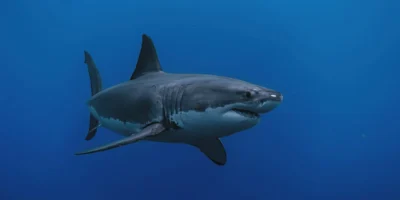
At first glance, the video feels almost unreal: an adult great white shark glides past technical divers in the open Mediterranean, calm and curious, accompanied by pilot fish. The footage was taken in the Strait of Sicily, the sea area between Sicily and Tunisia.
The clip, picked up by the BBC among others, came from a Healthy Seas Foundation mission with Ghost Diving and the Society for Documentation of Submerged Sites. The team was not looking for sharks, but for ghost nets: abandoned fishing gear caught on a wreck that continues to trap animals.
Why this footage is special
Reuters, the Guardian and Euronews describe the scene as one of the most extraordinary documented encounters with a great white shark in the Mediterranean. The reason is not that the species is new there. The reason is that living adult animals in this region are extremely rarely filmed directly underwater.
The Guardian placed the sighting between Tunisia and Sicily. Euronews reported that the shark circled the group, was not aggressive, and then disappeared back into the blue.
CBS also stressed that the Mediterranean is a known habitat for great white sharks, while real sightings remain rare and are usually known from the surface or from fishing records.
Great whites belong to the Mediterranean
The sober framing matters: this video does not show a sudden immigration and it does not signal a new danger for bathers. Great white sharks (Carcharodon carcharias) are historically documented in the Mediterranean. What has become rare today is not the stories about these animals, but the animals themselves.
A study in Frontiers in Marine Science describes the Mediterranean population as one of the least known and most threatened great white populations in the world. Researchers found white-shark eDNA at several sites during expeditions in the Sicilian Channel, but did not see animals directly. That is exactly why video of a living adult is so valuable.
The same work also explains why the Strait of Sicily makes biological sense: historical records, fishers’ knowledge, bluefin tuna migrations and possible nursery hints all meet there. It is a seascape with prey, depth, currents and, unfortunately, very high fishing pressure.
A rare animal in a heavily used sea
The Strait of Sicily is not an empty nature-film backdrop. An Acta Adriatica report already documented a young great white shark caught as bycatch in this region in 2015 and saw that record as evidence of the area’s importance for the species’ conservation.
Another recent piece of the puzzle comes from Spain: according to Pensoft/Phys.org, a juvenile great white that became entangled in fishing gear off the Spanish Mediterranean coast in 2023 was scientifically assessed in 2026. The researchers placed the case in a 160-year dataset and describe a continuous but very sporadic presence.
Taken together, the picture is quieter but more interesting than many headlines: the great white shark is neither a myth in the Mediterranean nor a new visitor. It is a native apex predator that has become only rarely visible in an overused sea.
What this means for divers
For divers, the footage is fascinating but not a reason to panic. The encounter happened offshore, far from a typical bathing beach or coastal dive site. The shark did not hunt the people and disappeared after a short time.
The deeper message is different: even in a sea that has been fished, crossed and watched for millennia, large wild animals can remain almost invisible. When they do appear, we should not produce fear first, but look more carefully.
The greater danger comes from humans
The CMS Shark MOU lists the great white as a migratory species in need of protection; fishing pressure, targeted persecution, trade in body parts and slow reproduction make it especially vulnerable. For the Mediterranean population, there is the added reality that it is regionally considered critically endangered.
That the shark appeared during a ghost-net recovery fits the story in a bitter way. The video shows not only a spectacular animal, but also the context in which it has to survive: wrecks full of lost nets, heavy fishing pressure and a sea in which apex predators have almost no room for error.
Perhaps that is the best way to read this rare footage: not as a sensation about a shark in the Mediterranean, but as a brief look at an almost invisible remnant population that is still there, and whose future depends on whether protection becomes more than a nice word.