


Galapagos shark - Carcharhinus galapagensis

Body structure, features & anatomy
The Galapagos shark Carcharhinus galapagensis is a large, powerfully built requiem shark with the classic outline of an oceanic island and outer-reef predator. It is heavier-bodied than many reef sharks but remains streamlined, with a broad snout and strong pectoral fins that help it patrol current edges, steep walls and seamount-like structures.
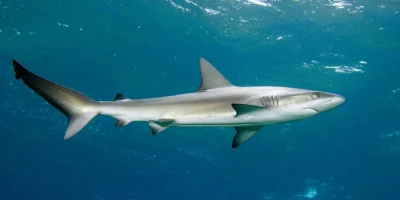
Its upper side is dark grey to grey-brown, while the belly is distinctly lighter. The fins are usually plain or only slightly dusky. A low interdorsal ridge between the two dorsal fins is an important field mark within the genus Carcharhinus.
Adults often reach two to three metres, and the maximum total length is given at about 3.7 metres. This makes the species one of the larger members of its genus, although regional size records and older measurements should be compared carefully.
Body shape
The body is built for sustained swimming in moving water. Galapagos sharks are especially typical of exposed islands, rocky reefs and steep outer reef slopes, where current and prey availability meet.

Identification features
- Colour: dark grey to brownish grey above, pale below; fins without conspicuous black tips.
- Interdorsal ridge: a low ridge between the first and second dorsal fins.
- Head: broad, rounded snout; jaws and teeth typical of hunting requiem sharks.
- Size: large, robust animals; older individuals look much heavier than grey reef sharks.
Confusion with similar species
In the field, Galapagos sharks are most often confused with dusky sharks Carcharhinus obscurus and, regionally, with large grey reef sharks. Identification depends on body proportions, dorsal-fin position, tooth shape, colour and habitat. As a rule of thumb, Galapagos sharks are strongly associated with remote oceanic islands and seamounts, while dusky sharks are more tied to continental shelves.
Anatomical context
Systematically, the species belongs to the requiem sharks (Carcharhinidae). Like other members of this family, it has mobile jaws, cutting teeth and a highly developed sensory system for smell, vibration, electrical signals and visual contrast.
New evidence for reliable species identification
The evaluation from 2026 underlines how difficult it is to distinguish Carcharhinus galapagensis from Carcharhinus obscurus and Carcharhinus amblyrhynchos. For reliable evidence of distribution, the author therefore only accepted evidence from museum specimens, verifiable photos or suitable SNP analyses. Simple mtDNA barcodes and eDNA cannot reliably separate Carcharhinus galapagensis and Carcharhinus obscurus because both share mitochondrial signatures.
Morphologically, a combination of features remains crucial. Galapagos sharks usually have 103 to 109 precaudal vertebrae, while Carcharhinus obscurus has 86 to 97. There are also differences in the height and shape of the dorsal fins, pectoral fins and body proportions. Habitat and location can support the identification, but are not a substitute for a good photo or anatomical or genome-wide data.
Distribution & Habitat
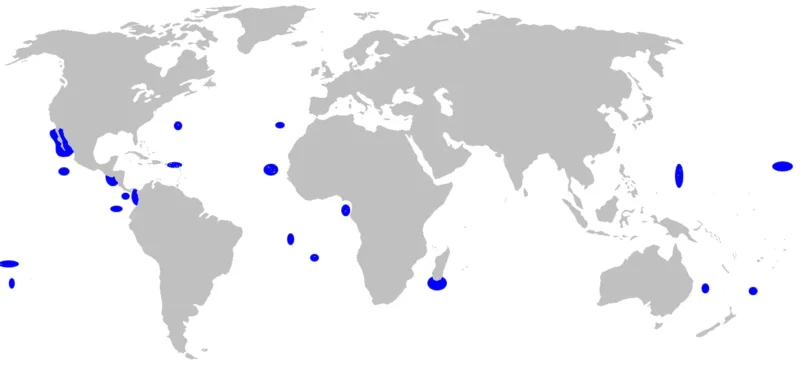
The Galapagos shark has a wide but strongly patchy distribution in tropical to warm-temperate seas. Despite its name, it is not restricted to the Galápagos Islands. The species is closely linked to oceanic islands, isolated reefs, seamounts and exposed outer reefs.
Important centres include the eastern Pacific around Galápagos, Revillagigedo, Clipperton, Cocos and Malpelo. Further occurrences are known from Hawaii, parts of the western and central Pacific, the western Indian Ocean and island or seamount systems in the Atlantic.
Habitat
Galapagos sharks prefer clear water on rocky and coral reefs, steep reef edges and current-rich island slopes. They are recorded from shallow water to several hundred metres, but many encounters occur along drop-offs and plateaus where currents concentrate prey.
Regional centres
- Eastern Pacific: Galápagos, Cocos, Malpelo, Clipperton and Revillagigedo.
- Central Pacific: Hawaii and other island groups.
- Atlantic: scattered island and seamount records.
- Indian Ocean: remote reef and island structures.
Spatial attachment
The patchy distribution is important for management. A species may be widespread globally and still vulnerable locally when animals concentrate at a few islands, reefs or seamounts.
Global reassessment in 2026
The global overview in Diversity distinguishes 69 confirmed and 27 unconfirmed or doubtful evidence. Of the confirmed occurrences, 53 are on oceanic islands, atolls or seamounts and only 16 on continental coasts. This means that the Galapagos shark is widespread in the Atlantic, Indian and Pacific Oceans, but globally it is concentrated on comparatively few, widely separated island areas.
A 161 centimeter long museum specimen collected at Rapa Nui in 1965 has been reidentified as a Galapagos shark and is now considered the first verified scientific evidence for Easter Island. The review also expands the documented depth range to 0 to 528 meters, but emphasizes that the animals spend most of their time between the surface and 100 meters deep. Many individuals stay within a radius of about 30 to 50 kilometers from their island habitat. However, rare migrations of more than 2,000 kilometers show that exchange between distant populations is possible.
Life history, diet & reproduction
Galapagos sharks are active, inquisitive predators of exposed island and reef systems. They may occur alone, but at prey-rich sites they can form loose aggregations. At seamounts, current edges and cleaning stations, divers often experience them as calm but very present large sharks.
The species is an opportunistic hunter. Its diet consists mainly of bony fishes, with squid, octopus, crustaceans, rays and smaller sharks added regionally. Larger individuals can take larger prey, including other cartilaginous fishes.
Life history
Individuals often use the same reef sections, island slopes and current areas over long periods. Telemetry indicates a mix of site fidelity and wider movements between islands, coasts and deep-water structures.
Behaviour at dive sites
At known dive sites, Galapagos sharks are often tolerant of calm divers, but they can approach directly and repeatedly. Their aggregations are loose and dynamic rather than tight coordinated schools.
Diet
The diet is strongly fish-based but varies with region, habitat and body size. Reef and bottom-associated bony fishes are important, while cephalopods and crustaceans supplement the diet.
Reproduction
The species is placental viviparous. Embryos develop inside the female and are nourished through a yolk-sac placenta. Litters usually contain several young, often reported in the range of 4 to 16, with pups born at roughly 60 to 80 cm total length.

Research status
Many details come from well-studied regions such as Hawaii and individual island groups. For other parts of the range, data on movements, maturity and reproduction remain thinner.
Habitat use across life stages
The global overview shows a clear separation of habitats by age. Newborns and small juveniles have been documented almost exclusively on oceanic islands, atolls and seamounts. The discovery of a young Galapagos shark in the Gulf of California is a striking exception. Sheltered shallow water areas can serve as nurseries for sharks, while larger animals are more common on deep outer reefs, drop-offs and in open water. However, not every island record automatically meets the scientific criteria of a confirmed shark nursery area.
For the population near Hawaii, the literature states sexual maturity after six to eight years for male Galapagos sharks and after around 6.5 to nine years for female Galapagos sharks. Another estimate puts the first reproduction at the earliest at ten years of age. This, along with possible two- or three-year reproductive cycles and litters of four to 16 young, explains why severely depleted island populations are slow to return. Long-distance migrating female and male Galapagos sharks may contribute to genetic exchange between island groups.
Threats & protection status
The Galapagos shark is currently listed globally as IUCN Least Concern (LC). This does not mean that every local population is secure. Its broad global range is combined with a strong dependence on islands, seamounts and reef edges, where animals can be concentrated and vulnerable.
Main threats
- Bycatch: taken in longlines, gillnets and other fisheries.
- Targeted catch: meat, fins or local markets can matter regionally.
- Hotspot risk: islands and seamounts concentrate animals spatially.
- Slow recovery: large body size and limited reproduction reduce resilience.
Regional situation
In many Pacific island areas the species is still regular or locally common, but heavily fished or poorly controlled regions can suffer local declines. Remote seamounts are especially difficult to monitor.
International framework
As a member of the family Carcharhinidae, the species is covered by CITES Appendix II trade controls for requiem sharks. Trade is not automatically banned, but it must be legal and non-detrimental.
Short conclusion
The key conservation task is to protect island and seamount hotspots, nurseries and movement corridors from overfishing and illegal catch.
Why local populations remain vulnerable despite Least Concern
The status Least Concern describes the global level. It does not mean that every Galapagos shark population on an island is safe. Close ties to individual locations, late maturity and concentration on a few islands make local Galapagos shark populations particularly vulnerable to longlines, bycatch and illegal fishing. The loss of an isolated Galapagos shark population also weakens the species’ genetic and spatial connectivity worldwide.
The St. Peter and St. Paul Archipelago in Brazil shows both the risk and the impact of consistent rules. The Galapagos shark, which used to be common there, was not reliably detected for almost 15 years after heavy fishing pressure and was documented again in 2010. After the ban on longline fishing around the archipelago in 2012, its presence increased. Whether this population will fully recover remains an open question due to slow reproduction. Protected areas therefore only help if fishing bans are actually monitored.
Galapagos sharks & humans
For divers, the Galapagos shark is one of the most impressive sharks of tropical islands and seamounts. It appears large, calm and very present, but can also be inquisitive and direct. That combination makes encounters memorable and calls for disciplined behaviour.
At Galápagos, Cocos, Malpelo, Revillagigedo and Hawaii, the species is part of the signature large-shark experience. A living shark has ecological, scientific and tourism value that often exceeds short-term fishing value.
Diving encounters
Galapagos sharks often patrol along reef edges, plateaus and current lines. They may approach divers in wide arcs, turn away and return. This is not automatically aggression; it is typical investigation by an attentive predator.
Practical guidance
- Stay calm: avoid fast escape movements.
- Keep visual contact: do not turn your back for long.
- Stay with the group: compact groups are easier to manage.
- Avoid feeding cues: spearfishing, bait and fish remains change behaviour.
- Follow local guides: they know currents, visibility and site behaviour.
Shark tourism and protection value
Well-managed shark tourism can make Galapagos sharks ambassadors for intact island ecosystems. The value depends on clear rules: limited disturbance, sensible group sizes, no uncontrolled feeding and long-term monitoring.
Fishing and bycatch
Outside protected areas, bycatch and targeted catch remain important pressures. Longlines, gillnets and fishing at island or seamount edges affect exactly the areas where the species concentrates.
Short conclusion
The Galapagos shark should not be sensationalised, but it should not be underestimated. For divers it represents wild island ecosystems; for conservation it shows why living sharks can be worth more than short-term extraction.
Why the species often remains unclear after incidents
The overview finds only a few bite events in which a Galapagos shark was suspected. The low number may be due to the remote habitats, but at the same time the similarity to other shark species makes any subsequent species identification difficult. An eyewitness description or the mere location of an incident is therefore not sufficient as reliable evidence of the species.
Clear photos or biological material such as a tooth fragment are more reliable, provided the study uses a method that actually separates the Galapagos shark from closely related shark species. For divers, the practical message remains unchanged: curious approaches are not automatically attacks, but clear threatening signals and repeated tight circles should be taken seriously and responded to with a calm, controlled withdrawal.
Profile
- First described:
- Max. size:
- Depth:
- Max. age:
- Max. weight:
- Water type:
- IUCN Status:
Taxonomy
- Kingdom:
- Phylum:
- Subphylum:
- Infraphylum:
- Parvphylum:
- Class:
- Subclass:
- Superorder:
- Order:
- Family:
- Genus:

News

Newsletter
Shark Alert in Your Inbox