


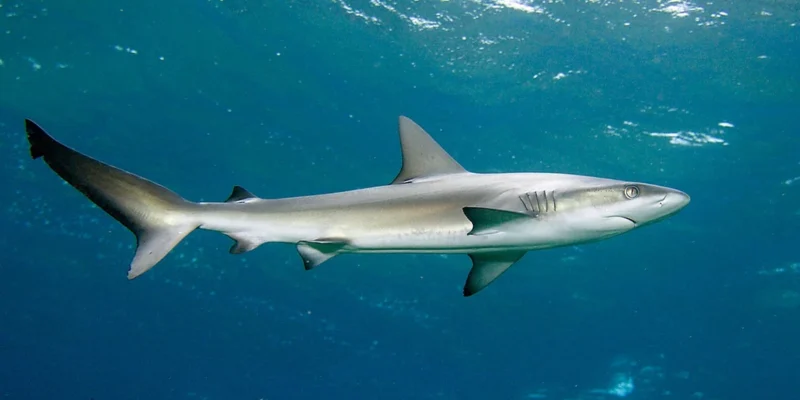
The Galapagos shark occurs in all three major oceans and is one of the most common large sharks around some islands. Yet a new global review in the journal Diversity portrays a species that is rare worldwide and strongly fragmented in space. Geographer Peter Gausmann assessed scientific literature, museum collections and public databases, consistently separating verifiable records from unsubstantiated reports.
The result is 69 confirmed occurrences and another 27 unconfirmed or doubtful reports. These figures are not a population estimate: a confirmed occurrence may represent a large local population or a single documented specimen. They nevertheless show how strongly current knowledge is concentrated around a small number of islands, atolls and seamounts.
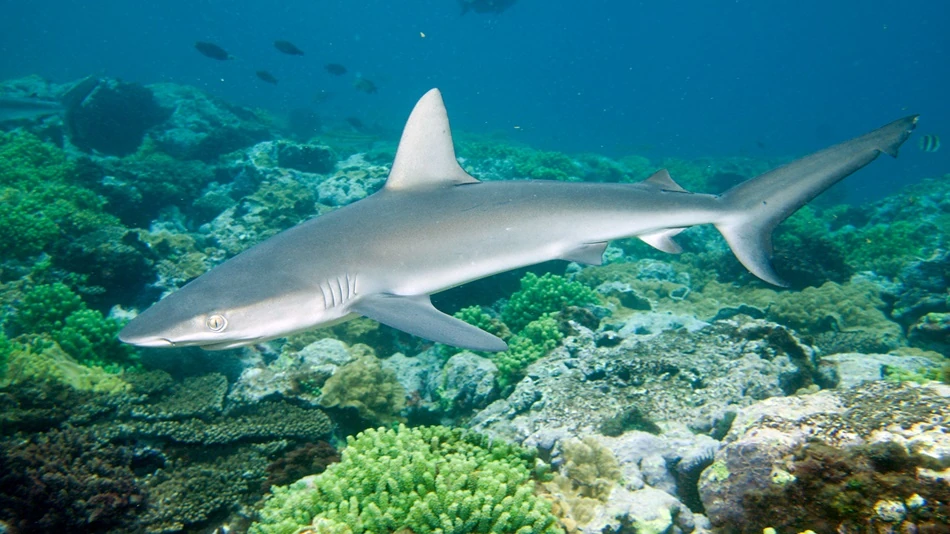
53 island occurrences, only 16 records from continental coasts
The global overview in Diversity distinguishes 69 confirmed and 27 unconfirmed or doubtful evidence. Of the confirmed occurrences, 53 are on oceanic islands, atolls or seamounts and only 16 on continental coasts. This means that the Galapagos shark is widespread in the Atlantic, Indian and Pacific Oceans, but globally it is concentrated on comparatively few, widely separated island areas.
What the review accepts as confirmed
The evaluation from 2026 underlines how difficult it is to distinguish Carcharhinus galapagensis from Carcharhinus obscurus and Carcharhinus amblyrhynchos. For reliable evidence of distribution, the author therefore only accepted evidence from museum specimens, verifiable photos or suitable SNP analyses. Simple mtDNA barcodes and eDNA cannot reliably separate Carcharhinus galapagensis and Carcharhinus obscurus because both share mitochondrial signatures.
Morphologically, a combination of features remains crucial. Galapagos sharks usually have 103 to 109 precaudal vertebrae, while Carcharhinus obscurus has 86 to 97. There are also differences in the height and shape of the dorsal fins, pectoral fins and body proportions. Habitat and location can support the identification, but are not a substitute for a good photo or anatomical or genome-wide data.
A museum specimen moves the first Rapa Nui record back to 1965
The 161-centimetre female is held by the Canadian Museum of Nature and was collected during a Canadian medical expedition in January 1965. Photographs of the preserved shark show, among other features, an interdorsal ridge, relatively large eyes and the characteristic positions and shapes of the fins, body and snout. The case also demonstrates why old museum collections remain valuable for modern distribution maps.
A 161 centimeter long museum specimen collected at Rapa Nui in 1965 has been reidentified as a Galapagos shark and is now considered the first verified scientific evidence for Easter Island. The review also expands the documented depth range to 0 to 528 meters, but emphasizes that the animals spend most of their time between the surface and 100 meters deep. Many individuals stay within a radius of about 30 to 50 kilometers from their island habitat. However, rare migrations of more than 2,000 kilometers show that exchange between distant populations is possible.
Young sharks stay near islands while adults become more mobile
The global overview shows a clear separation of habitats by age. Newborns and small juveniles have been documented almost exclusively on oceanic islands, atolls and seamounts. The discovery of a young Galapagos shark in the Gulf of California is a striking exception. Sheltered shallow water areas can serve as nurseries for sharks, while larger animals are more common on deep outer reefs, drop-offs and in open water. However, not every island record automatically meets the scientific criteria of a confirmed shark nursery area.
For the population near Hawaii, the literature states sexual maturity after six to eight years for male Galapagos sharks and after around 6.5 to nine years for female Galapagos sharks. Another estimate puts the first reproduction at the earliest at ten years of age. This, along with possible two- or three-year reproductive cycles and litters of four to 16 young, explains why severely depleted island populations are slow to return. Long-distance migrating female and male Galapagos sharks may contribute to genetic exchange between island groups.
Globally Least Concern, locally almost gone
The status Least Concern describes the global level. It does not mean that every Galapagos shark population on an island is safe. Close ties to individual locations, late maturity and concentration on a few islands make local Galapagos shark populations particularly vulnerable to longlines, bycatch and illegal fishing. The loss of an isolated Galapagos shark population also weakens the species’ genetic and spatial connectivity worldwide.
The St. Peter and St. Paul Archipelago in Brazil shows both the risk and the impact of consistent rules. The Galapagos shark, which used to be common there, was not reliably detected for almost 15 years after heavy fishing pressure and was documented again in 2010. After the ban on longline fishing around the archipelago in 2012, its presence increased. Whether this population will fully recover remains an open question due to slow reproduction. Protected areas therefore only help if fishing bans are actually monitored.
Protected areas need enforcement and connections
Site fidelity makes Galapagos sharks vulnerable, but it also offers a clear conservation opportunity. Well-placed no-take zones can protect juveniles and resident animals, provided illegal fishing is effectively controlled. Migrating sharks also cross unprotected high seas between islands, which is why the review supports connected corridors and coordinated rules across national borders, especially in the tropical eastern Pacific.
You are currently viewing a placeholder content from Facebook. To access the actual content, click the button below. Please note that doing so will share data with third-party providers.
More InformationWhat the study does not prove
This work is an extensive review of literature and databases, not a standardized global count. The 69 confirmed points therefore reveal neither the total number of Galapagos sharks nor the trend of every population. The map represents the present state of knowledge rather than a final range boundary.
That limitation is itself central to the study: a species can look widespread on a world map while consisting of small, weakly connected populations. Protecting individual islands therefore helps decide whether the global network of nursery grounds, residential areas and rarely used migration routes will persist.