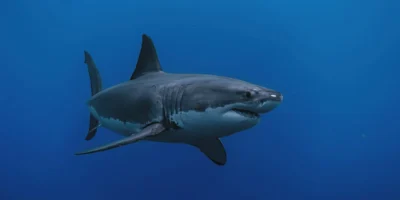
Off the South African coast, a research team investigated white sharks in a location that does not fit the classic image of their known hunting grounds. There is no large seal colony on the studied reef off Struisbaai. Nevertheless, several animals apparently gather there.
A video published by Discovery UK on August 3, 2026 follows marine biologist Alison Towner and shark researcher Oliver Jewell. Using cameras and sensors attached to the sharks’ dorsal fins, they investigate why the animals gather there. The footage shows a spectacular breach, large fish schools and rarely observed encounters between white sharks.
A hotspot without a seal colony
Many famous South African great white shark spots are close to South African fur seal colonies. Young seals provide large sharks with an energy-rich and seasonally predictable food source.
The studied reef off Struisbaai has no such colony. However, fishermen had repeatedly reported several great white sharks and sent photos and videos to the researchers. The increasing reports eventually led the team to the area near the southern tip of Africa.
However, the presence of great white sharks off Struisbaai is not entirely new. A regional scientific analysis already lists Struisbaai as an aggregation site alongside False Bay, Gansbaai, Mossel Bay, Plettenberg Bay and Algoa Bay. What is new and particularly interesting is the detailed footage of an apparently intensively used section of the reef.
A camera travels with the shark
The team uses two different systems. A compact camera is attached directly to the dorsal fin. A second device, called “Shark Shadow” in the film, hangs a few meters behind the shark and also carries a transmitter. If it reaches the water surface, it can transmit position data and thus help with its subsequent recovery.
One of the cameras documents how the shark suddenly accelerates and breaks the surface of the water. According to the film, the animal reached about 27 miles per hour—around 43 kilometers per hour—in just under three seconds.
What is particularly remarkable is the perspective. Great white shark jumps have often been filmed from boats and from the air. A complete acceleration sequence from the shark’s perspective provides additional information about body posture, speed and sequence of the maneuver. The measurement describes a single event recorded by this sensor and is not a general speed record for the species.
Fish schools may keep the sharks at the reef
The cameras show large schools of amberjacks or Yellowtail Kingfish around the reef. In the recordings, the fish react clearly to the presence of the sharks. This supports the assumption that it is not seals, but rather abundant fish that keep the animals in this area.
Great white sharks are more versatile hunters than their reputation as specialized seal hunters suggests. Studies from South Africa document fish, other sharks and rays, cephalopods and marine mammals as food. Which prey an animal prefers depends on, among other things, size, sex, season and habitat.
The reef could therefore offer the sharks a spatially concentrated and regularly available food source. The camera footage alone does not prove which animals are actually eaten there. This would require direct hunting observations, environmental DNA, isotope analyses or other long-term records.
Unexpected encounters between white sharks
In addition to possible prey, a shark also filmed a member of its species. The second animal approached quite closely before the shark in front responded with a powerful tail beat and opened the distance.
Such scenes are scientifically interesting because the social behavior of great white sharks is difficult to observe underwater. Encounters on bait boats show dominance hierarchies and displacement behavior, but may be influenced by boat or bait. A camera carried by a free-swimming shark provides a more natural perspective. The short sequence is still not enough to infer a stable social relationship.
Did orcas displace the sharks to Struisbaai?
The film links the observations to the disappearance of great white sharks from previous centers such as False Bay and Gansbaai. Since 2017, several white sharks killed by orcas have been found in South Africa. Observations and scientific analyses also show that surviving sharks sometimes leave areas for long periods of time after hunting orcas appear.
Orcas and the risk they pose are therefore an important explanation for local changes, but probably not the only factor. Fisheries, prey availability, environmental conditions and long-term changes in the ecosystem can also play a role.
The large-scale analysis of the South African data found clear local declines, but no clear evidence of a corresponding decline in relative abundance along the entire coast. Some of the animals may have shifted their range. This is exactly why new tagging data is so important.
A refuge—but not yet a new white-shark capital
At the end of the film, Towner describes Struisbaai as a possible new white-shark capital of South Africa and one of the last refuges of the species. The footage provides compelling clues: several sharks, abundant prey, good visibility and apparently repeated use of the reef.
However, several years of data are required for a scientifically reliable classification as a permanent refuge. What matters is whether the sharks return regularly, how long they stay and whether there are different age and sex groups there. The links to other areas also need to be further investigated.
Recent South African satellite-tagging data show how large-scale these movements can be. An animal tagged off Struisbaai in 2023 moved between the Alphard Banks and the Agulhas Marine Protected Area before its transmitter was recovered at the starting location.
South Africa has been protecting great white sharks since 1991 and was the first country with such legal protection. Court rulings on the capture of white sharks show that this protection can be enforced. Nevertheless, bycatch, shark-control nets and other human influences remain relevant.
The camera images do not yet solve the mystery of Struisbaai. But they show why this area is important for research: Here, the hunting, movement and encounters of white sharks can be observed from a perspective that humans normally cannot see.