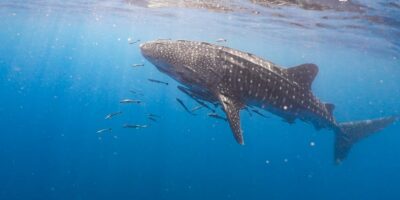
A whale shark was filmed by drone in the bay of Mejillones in northern Chile on November 13, 2026. Nature photographer Pablo Dorrego documented the animal along with an oceanic giant manta ray. The Universidad de Antofagasta describes the clear images as exceptional evidence in continental Chilean coastal waters.
Historical information refers to a whale shark caught in 1958 off Iquique. Further evidence is known from Rapa Nui, but the tropical species is only rarely observed on the mainland coast of Chile. The new images are therefore not evidence of a permanent settlement, but rather a well-documented snapshot of a widely migrating animal.
More than five degrees above the November average
Carlos Bustamante from the Universidad de Antofagasta Shark Conservation Program associates the sighting with a strong thermal anomaly. According to the university, the sea temperature in Mejillones was at times more than five degrees above the usual average of 16.9 degrees Celsius in November. At the same time, El Niño strengthened in the equatorial Pacific.
Universidad Católica de la Santísima Concepción also considers warmer surface water to be a plausible explanation. Whale sharks live predominantly in tropical and subtropical waters and are often observed at temperatures above 21 degrees. Warm water can also change the distribution of plankton and small fish that filter-feeding animals follow.
However, the coincidence does not prove that El Niño brought this individual whale shark to Mejillones. Migration also depends on food, currents and individual routes. Only further sightings and oceanographic data could show whether such visits are actually becoming more frequent during the current warm phase.
The record provides data for shark conservation
Chile has banned the capture, possession and marketing of whale sharks, great white sharks and basking sharks since 2009. The country has also strengthened the international protection of several species of sharks and rays. For rare visitors, it is still crucial that boats keep a sufficient distance and do not cut off the swimming path.
The shark protection program recommends that you do not pursue, touch or feed the animals. Drones should also be used in such a way that they do not change behavior. Responsibly captured photos and videos, on the other hand, can help document size, patterns and length of stay and compare future observations.
A rare visitor, not a new permanent resident
The discovery shows how quickly large-scale changes in the Pacific can become visible on a single coast. It is not known whether the whale shark Mejillones only visited briefly or stayed in the region for a longer period of time. It is therefore particularly important for research to systematically collect further reports without deriving a permanent shift in the distribution area from just one spectacular video.