


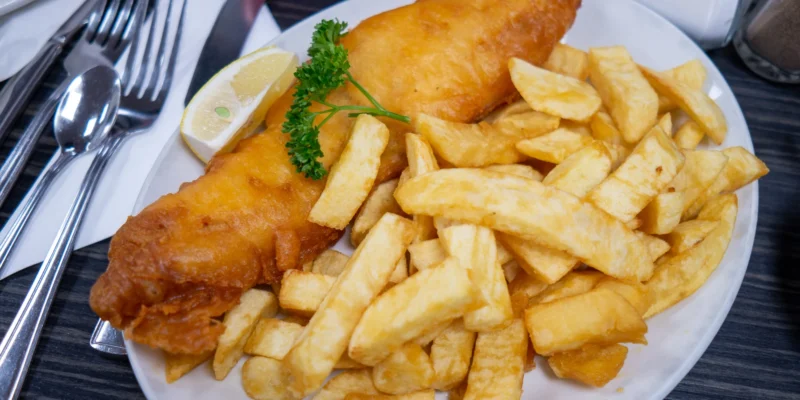
Whoever orders shark at a fish-and-chips shop in Western Australia often does not find out which species actually ends up on the plate. A new study in Marine and Freshwater Research examined cooked shark fillets using DNA methods. Of 167 products that could be evaluated, 56.3 percent were ambiguous and 35.3 percent were mislabeled.
This does not mean that 91.6 percent of all samples were wrong at the same time: the categories partially overlap and describe different problems. Labels such as “shark,” “fish and chips,” or “flake,” which do not specify a definite species, were considered “ambiguous.” Products were labeled as incorrect if the genetically determined species did not match the specified label.
167 DNA samples from 132 stores
Between March 2023 and February 2024, the research team purchased a total of 174 cooked products in 132 stores. 108 stores were located in the greater Perth area, 24 in other parts of Western Australia. Sufficient high-quality DNA could be obtained from 167 samples.
A section of the mitochondrial COI gene was analyzed, which is often used as a genetic barcode for species identification of fish. The sequences were compared with references from GenBank and the Barcode of Life Database, and for cartilaginous fish additionally examined using phylogenetic methods.
Eleven shark species, two chimeras, and three bony fish
In the 167 products, the researchers identified a total of 16 species: eleven sharks, two chimaeras, and three bony fish. The most common were the black shark with 55 samples, the Australian smooth-hound with 32, and the Bartel smooth-hound with 28 samples. In 19 products, there was the South African Cape elephantfish, a chimaera and therefore not a shark.
Five samples were provisionally assigned to the sandbar shark. Because its COI sequences could hardly be distinguished from those of the bignose shark, the team additionally examined a section of the mitochondrial control region. For 55 samples classified as dusky sharks, the genetic distinction from the Galapagos shark was also difficult; however, distribution and fishery data supported the assignment to the dusky shark.
The label “Shark” hid particularly many species
The most common term on menus was simply “shark” and appeared on 89 products. Behind this were mainly soupfin sharks, Australian smoothhounds, whiskery smoothhounds, and Cape elephantfish. While this designation is not necessarily wrong for a real shark product, it provides consumers with hardly any information about the species, origin, or conservation status.
42 products were offered as ‘gummy shark’. In fact, DNA tests most frequently found whiskery smooth sharks among them, followed by Australian smooth sharks and dark sharks. Of 22 products offered as ‘bronze whaler’, twelve contained dark sharks and five Australian smooth sharks.
When the staff were asked for a specific type in cases of ambiguous designations, 64.1 percent of the 78 responses were incorrect. Deliveries within a store were also not entirely consistent: For two purchases under the same designation about six months apart, only 16 of 28 products contained the same type.
Incorrect labeling is not automatically fraud
The researchers warn against interpreting every deviation as intentional deception. Dark shark, Australian smooth-hound, and Bartel smooth-hound achieve similar prices in Western Australia. When multiple similar species are processed and packaged together in a catch, labels can be lost or become inaccurate along a complex supply chain, without a financial advantage being intended.
For consumers and fishery controls, the result remains problematic. Without clear species names, it is hardly possible to assess origin, fishing method, protection status, and sustainability. The voluntary Australian Fish Names Standard does define trade names, but it is not consistently mandatory for cooked or domestically sold products.
Globally, 43.7 percent came from endangered species
According to the global IUCN classifications, 43.7 percent of the products contained species from threatened categories. This particularly included deepwater sharks as well as certain sandbank sharks and a shortfin mako. According to a specifically Australian assessment, however, only the mako sample fell into a threatened category. The difference shows that global and regional classifications can reflect different stocks and standards.
Only 26 percent of the products directly carried an origin label. When information from the staff was also taken into account, there was some origin information for 47 percent. However, the DNA of the used COI segment cannot determine the fishing region; the researchers could only compare the information with the known distribution areas of the identified species.
The study therefore calls for stricter and more uniform labeling regulations for Australian seafood. A precise species designation would not guarantee sustainable fishing, but it would be a necessary basis for traceability, credible controls, and an informed purchasing decision.