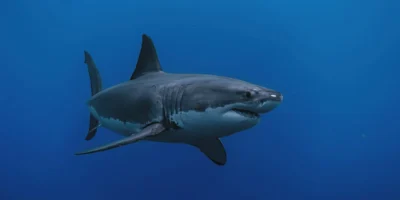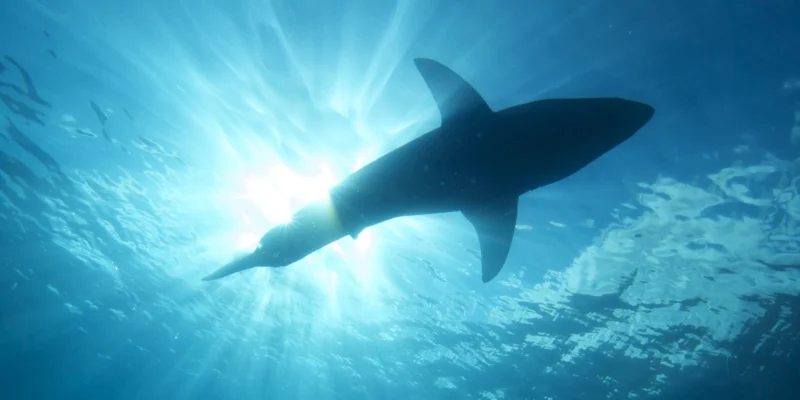
When Tropical Storm Hilary reached the Southern California coast on August 20, 2023, many juvenile white sharks (Carcharodon carcharias) temporarily left a known nursery off Torrey Pines and Del Mar. Of the 22 acoustically tagged animals, more than half temporarily disappeared from the monitored coastal section. Almost all returned within three weeks.
According to the research team, a new open-access study in Movement Ecology provides the first direct evidence of how juvenile white sharks respond to an extreme storm event. The data do not show permanent abandonment of the nursery, but a partial and mostly brief evacuation followed by a rapid return.
22 sharks and more than half a million signals
The investigation was possible because a dense network of underwater receivers was already installed before the rare storm. The 22 sharks recorded, 13 females and nine males, were wearing acoustic transmitters. Between August 1st and September 10th, 2023, the system registered more than 524,000 signals from the animals.
Prior to Hilary, 16 to 19 tagged sharks per hour were typically detected in the nursery. During the storm the number dropped to eight. The individual absences lasted between two hours and 15 days. Only one shark that disappeared when the storm hit was not detected again in the closely monitored area later in 2023.
A storm can also disrupt the measurement technology
With acoustic telemetry, fewer signals do not automatically mean that an animal has left the area. Wind, waves, underwater noise or tilted receivers can affect transmission. Especially during a storm, an apparent decrease could therefore be a measurement error.
The team used 20 permanently installed synchronization transmitters whose positions were known to model the changing reception power. This data was incorporated into a Bayesian state space model that distinguishes between the actual presence of a shark and the probability of its detection. A reduced comparison model without time-dependent correction led to almost the same results. The entire receiver network remained sufficiently reliable despite losses at individual stations.
The probability of escape increased 28 times
Outside the storm, the median hourly modeled probability of a present shark leaving the nursery was 1.1 percent. Under the strongest storm conditions, it rose to 31.1 percent. This corresponds to an increase of more than 28 times.
The response varied among individuals. Sharks from every age class examined left the area, but the pattern was clearer among the younger animals, about one to two years old, than among individuals estimated to be three to four years old. Males left more often than females; however, the researchers note that males were disproportionately represented in the younger age groups.
The strongest clue leads to water temperature
Of six environmental factors examined, the rapid decline in sea surface temperature was the strongest predictor of nursery abandonment. The water cooled from 20 to 13.9 degrees Celsius in less than 24 hours. The low point coincided with the lowest number of sharks detected.
White sharks can keep parts of their bodies warmer than the surrounding water. Juveniles are probably less efficient at doing so than large adults and therefore depend more strongly on favorable ambient temperatures. Earlier research in Southern California had already shown that juvenile white sharks seek warmer areas during strong upwelling of cold water and often move away when temperatures fall below about 14 degrees Celsius.
With Hilary, the water only stayed below this mark for about one to four hours. This could explain why most animals did not disappear for the season but returned after the brief disturbance. The statistical connection makes cooling probably the most important trigger, but it doesn’t prove that every single animal left solely because of the temperature.
Air pressure, waves and fresh water as further signals
Falling air pressure, stronger waves and falling salinity were also associated with a higher probability of migration, although less so than temperature. Heavy rain and runoff brought large amounts of fresh water into the coastal area. Measurements in the narrow estuary area of Los Peñasquitos Lagoon fell from approximately 33.5 to up to 0.7 PSU on the day of the storm. These values do not apply to the entire coastal area, but mark the point in time of the freshwater plume.
However, turbidity and local wind speed were not convincing direct predictors. The location in the lee of Point La Jolla also protected Torrey Pines and Del Mar from some of the southern wave energy. Wind and waves may have influenced the behavior indirectly because the mixing of the water column triggered the strong cooling.
La Jolla Cove may have served as a refuge
Before and during the storm, the receivers showed more signals in La Jolla Cove, about seven kilometers south. The bay was comparatively protected from the strong southerly winds and is located immediately next to the La Jolla Canyon, which offers quick access to water more than 200 meters deep.
A shark equipped with a pressure sensor was recorded near the canyon on the day of the storm at a depth of 132 meters – the deepest dive during the study period. This is a striking single observation point, but not proof that all the missing animals swam into the canyon. For most of the absences, it was impossible to determine where the Sharks went.
A nursery that is reforming
The shallow, warm coastal waters of Southern California provide juvenile great white sharks with abundant prey and protection from larger predators. Their rapid return to exactly the same location underscores that the habitat remained valuable despite the short-term disturbance. The nursery proved to be stable and flexible at the same time: many animals were able to avoid unfavorable conditions without permanently giving up the area.
UC San Diego places the findings in context by asking how a recovering apex-predator population copes with extreme weather events. One nursery during one storm does not support a general forecast for all white sharks. The study nevertheless offers a rare, high-resolution snapshot and a method for better separating animal behavior from technical measurement uncertainty during future events.
What more frequent extreme events could mean
Short-term evasive movements are apparently part of the behavioral repertoire of young white sharks. Disorders could become problematic if they occur more frequently, last longer or affect several important nurseries at the same time. The youngest animals in particular seem to react sensitively to abrupt changes in temperature.
For protection and coastal management, it is not only crucial where sharks gather under normal conditions. Equally important are accessible refuges, deep canyons and alternative coastlines during exceptional conditions. Long-term receiver networks can show whether the rapid return after Hilary is typical or whether stronger and longer storms fundamentally change the use of nurseries.