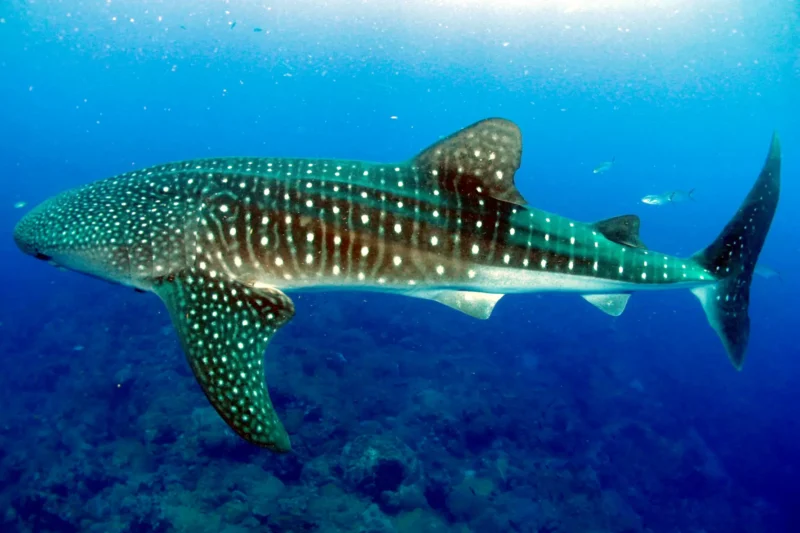
Whale sharks are the undisputed giants of our seas and the largest fish on Earth. They can grow to over 12 metres in length and weigh up to 20 tonnes. These gentle giants, which feed mainly on plankton, krill and small fish, have roamed our oceans in their current form for over 28 million years and survived ice ages and mass extinctions. Yet despite their enormous size and years of research, nature still harbours a fascinating secret to this day: Where do the whale shark pups spend their first years of life?
A statistical wonder: millions of pups, but no traces
For a long time, science didn’t even know how whale sharks are born. It wasn’t until 1996 that the discovery of a pregnant female — affectionately called “Mega Mama” — provided the proof: whale sharks are ovoviviparous and can carry over 300 embryos at different stages of development at the same time.
Considering there are tens of thousands of sexually mature females, basic arithmetic would suggest that millions of mini whale sharks should be released into the oceans every few years. These newborns, also called neonates, are tiny at birth, only 40 to 60 centimetres in size — miniature copies of the adult animals. But reality is completely different: in over 50 years, fewer than 40 of these newborns have been scientifically documented worldwide. This complete absence of juveniles is so extreme that it seems almost statistically impossible.
The groundbreaking discovery of the ‘death zones’
In 2025, a team led by Dr Freya Wormsley published a study that could finally solve this puzzle. Instead of continuing to search for pregnant females, the team analysed the few known sightings of baby whale sharks and matched them with ocean data such as water depth, currents and temperatures.
The result was astonishing: sightings of baby whale sharks are clustered near so-called oxygen minimum zones (OMZs). These are natural layers of the ocean, typically occurring at depths of 200 to 1,000 metres, and containing extremely low levels of dissolved oxygen.
For most large marine predators such as tunas, swordfish or pelagic blue sharks, these zones are physiological nightmares – they avoid them because they cannot breathe efficiently there. For the slow-moving baby whale sharks, however, these “death zones” seem to serve as living shields and predator-free nurseries. Interestingly, whale sharks are evolutionarily related to epaulette sharks, which are known to withstand extreme oxygen deprivation for hours unharmed.
Additionally, these oxygen-poor zones often lie directly beneath highly productive surface waters, which means the small sharks can feed on abundant plankton near the surface. In particular, off the coasts of western America, West Africa (e.g. Angola and Cape Verde) and India, such areas appear to provide ideal conditions.
Brilliant plan or a quirk of nature?
How the babies reach these zones is not yet fully understood. The researchers have two main theories:
- The deliberate birth: Pregnant female whale sharks travel deliberately to these marine regions to give birth to their young in a safe environment. This would make whale sharks fish with extremely highly developed behaviour.
- Vertical habitat compression: The females give birth somewhere in the open ocean and the still-weak pups are driven by ocean currents into these zones, where the oxygen-poor depths force them to the surface.
A race against time
However, this fascinating discovery also carries an urgent warning. As global warming alters ocean currents, oxygen minimum zones are expanding ever further – they now cover between 14 and 32% of the world’s oceans. That could mean the potential habitat for whale shark pups increases, but it also risks cutting them off from their vital food sources or drifting them into more dangerous waters.
To secure the future of these gentle giants, scientists are now racing to fit pregnant females and juvenile sharks with transmitters earlier. If we can predict exactly where the ocean nurseries are, shipping routes, fishing pressure and marine protected areas could be adjusted proactively.