


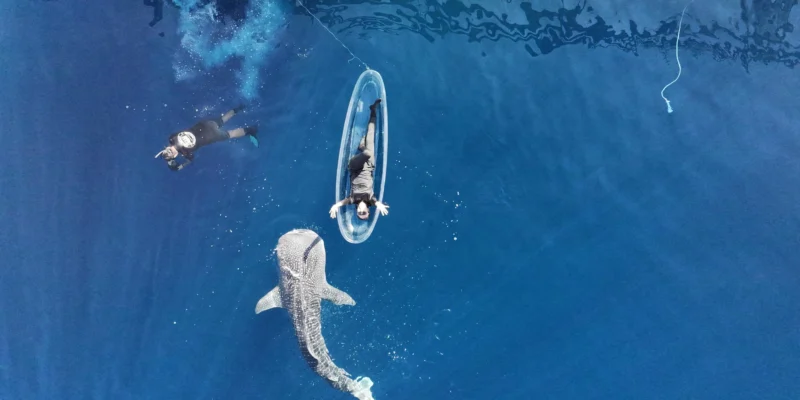
In Saleh Bay on the Indonesian island Sumbawa, researchers have documented an exceptionally small Whale shark. The study, published in the journal Diversity, describes five sightings in August 2024 and the accidental capture of a male juvenile on September 6, 2024. At an estimated 1.35 to 1.45 meters long, it corresponded to a newborn whale shark.
According to Conservation International, this is the first confirmed record of a neonatal whale shark in Indonesia. The animal got caught in a traditional Bagan lifting net, was measured and then released again. The team estimated his age to be around four months.
Five sightings could show the same animal
In August, a 1.2 to 1.5 meter long whale shark was seen in the bay five times. Because the size was only estimated visually and there are no clear photo identifications for all encounters, it cannot be said with certainty whether there were multiple animals or always the same individual. The study explicitly addresses this uncertainty.
Even the discovery does not prove that the whale shark was born in Saleh Bay. An animal this small could have entered the bay from another area. To date, no place in the world has been unequivocally confirmed as the birthplace of the species. This is precisely why reliable observations of newborn animals are so valuable.
Why whale shark births remain a mystery
Whale sharks are the largest fish on earth, but little is known about mating, pregnancy and birth. Newborns are seen extremely rarely. The team points to only 33 neonatal occurrences in the scientific literature. The find on Sumbawa therefore provides a rare lead for the question, where whale shark babies spend their time.
Saleh Bay is a semi-enclosed, productive bay with abundant plankton. Such conditions can provide food and comparatively protected shallow water areas for small whale sharks. However, whether the area serves as a nursery must be checked through repeated evidence of very young animals, dates of stay and, if possible, individual photo identification.
Fishermen and researchers work together
Bagan platforms use light to attract small fish, regularly attracting whale sharks. This poses a risk of unintentional catches, but also creates an opportunity for systematic monitoring. In Saleh Bay, fishermen report sightings and help to gently free the animals.
Since 2017, more than a hundred whale sharks have been recorded in the bay based on their individual spot patterns. The long-term photo archive makes the location in Pacific Ocean an important observation area, even if it is primarily juvenile and non-newborn animals that are documented.
Possible nursery, birthplace not yet confirmed
Konservasi Indonesia and government agencies are working on a marine sanctuary for whale sharks in Saleh Bay. The new evidence strengthens the rationale for more closely monitoring sensitive areas, feeding conditions and fishing encounters. However, it alone is not enough to scientifically establish the status of a nursery.
The cautious conclusion is therefore: Saleh Bay apparently offers suitable conditions for a very young whale shark and could be part of a previously hidden nursery area. Future sightings, genetic samples and movement data should clarify whether births actually take place there.