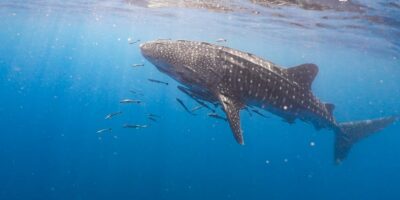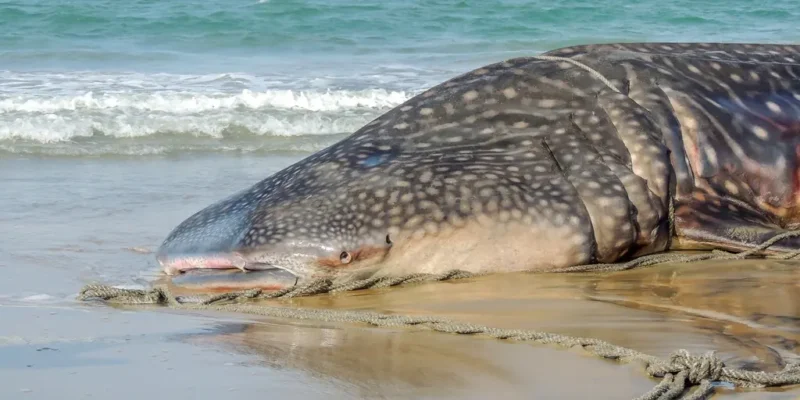
Two men were arrested in the Peruvian coastal town of Salaverry after they allegedly cut a stranded whale shark. According to a report from RPP, police officers found the animal, approximately three meters long, near the artisanal fishing pier on November 18, 2026.
According to witnesses, the whale shark was still alive when several men pulled it ashore. There he is said to have suffered injuries from which he died. The police arrested two men aged 36 and 45. She is being investigated on suspicion of illegally taking a protected aquatic species. The described process and criminal responsibility have not yet been conclusively determined.
Whale sharks are permanently protected in Peru
The Peruvian Ministry of Production lists the whale shark on its list of protected species. Ministerial Resolution 150-2016-PRODUCE prohibits extraction in Peruvian marine waters, landing, transport, storage, processing and marketing. Even an animal that is caught by chance must be released as safely as possible and the process documented.
The protection is biologically based. Whale sharks grow slowly, reach sexual maturity late and only produce offspring at long intervals. Losses of individual animals can therefore have a greater impact on a population than with short-lived fish species. The International Union for Conservation of Nature classifies the largest fish on earth as endangered.
Why the whale shark became stranded remains unclear
It has not yet been publicly clarified why the animal ended up near the jetty and what condition it was in before the men intervened. Without a veterinary examination, neither the original cause of the stranding nor the exact contribution of subsequent injuries to the death can be determined with certainty.
For authorities, a case like this is more than just a question of arrest. You must secure evidence, document the condition of the animal and clarify whether a professional rescue would still have been possible. At the same time, coastal communities need clear contacts so that rare strandings are reported quickly and onlookers or commercial interests do not hinder the rescue.
The investigation must establish what happened
The arrests do not mean a conviction. Among other things, what needs to be checked is who pulled the animal out of the water, when the cuts were made and what evidence can be attributed to the individual participants. Only further investigations by the police and public prosecutor’s office can clarify which allegations will stand up in court.
Regardless of the outcome, the case shows how vulnerable a protected whale shark can be, even right at a harbor. A trapping ban is only effective if reporting structures, rescue and prosecution work together, even when an animal is stranded unexpectedly.