


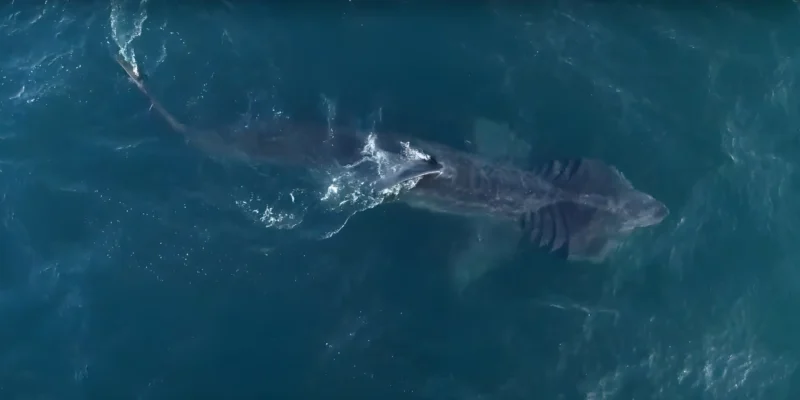
Observers are experiencing a season off the Isle of Man in 2026 that seemed almost unimaginable just a few years ago. As The Guardian reports, more than 100 basking shark sightings had already been reported by mid-August. The large dorsal fins appear particularly frequently in the southwest of the island around Port Erin Bay, Bradda Head and Fleshwick.
The public sighting database of Manx Whale and Dolphin Watch has been collecting such reports since 2005. The current entries document swimming, circling, presumably feeding and occasionally jumping animals at several coastal locations. This is a clear signal of an exceptional year of observation, but not yet a count of different individuals.
You are currently viewing a placeholder content from Facebook. To access the actual content, click the button below. Please note that doing so will share data with third-party providers.
More InformationFrom 885 sightings to a single animal
The contrast to previous years is drastic. In 2009, 885 sightings were recorded around the island. After that, reports plummeted until only a single basking shark was recorded in 2022. The tagging research underway at the time was stopped because there were hardly any sharks left on site for further work.
Basking sharks typically migrate through the island’s waters between May and August. They follow seasonal food patches and can migrate over long distances: Tagged sharks from the northeastern Atlantic were later found in regions as far away as Morocco and Newfoundland. They may also reproduce around the Isle of Man, but this has not been proven.
Why a copepod bloom attracts basking sharks
The basking shark (Cetorhinus maximus) is the second largest fish on Earth, but feeds on tiny organisms. With its mouth open, it swims through water rich in plankton and filters primarily zooplankton. Copepods are especially important. These small crustaceans that form dense swarms when conditions are favorable.
According to local fishing experts, there was a good copepod bloom this summer. This provides a plausible explanation for the many near-surface observations: Where food is concentrated, several sharks can temporarily stay in the same area and feed on the surface for a longer period of time. However, this alone is not a direct proof of cause and effect.
Sightings are not a count of individual sharks
More than 100 sightings does not automatically mean more than 100 different animals. A basking shark can be reported on multiple days or from multiple locations. Weather, water turbidity, observation effort and information on social media also influence how many reports are received. Dorsal fins are more easily discovered in a clear, calm summer than in rough seas.
You are currently viewing a placeholder content from Facebook. To access the actual content, click the button below. Please note that doing so will share data with third-party providers.
More InformationNevertheless, opportunistic observations are scientifically valuable. Over many years, they show when and where basking sharks regularly appear and how the relative abundance changes. Photos of dorsal fins can also help identify individual animals based on notches, scars and fin shape. To assess population trends reliably, additional standardized surveys and, where possible, individual photo-identification are needed.
The cable hypothesis remains unclear
When sightings collapsed, several explanations were discussed: less food, warmer water and electromagnetic fields from submarine cables. The latter could influence the sensitive orientation of sharks and deter animals from migration corridors. The fact that the sharks have returned in 2026 despite the existing cables speaks against simple, permanent deterrence.
This does not disprove a possible cable effect. Food availability, currents, temperature and migration patterns change simultaneously, and a strong plankton year can override other influences. In order to determine the contribution of individual factors, telemetry data, cable operation and environmental measurements would have to be evaluated together over several years.
How sightings support conservation
Many sightings can be recorded from land without disturbing the animals in the Atlantic. Good observation points are elevated coastal areas; From the boat, the speed and distance should be chosen so that the swimming path remains clear. Basking sharks must not be chased, touched or forced to change direction.
The date, time, exact location, number, estimated size and behavior are particularly helpful for reports. Photos or videos aid verification if they are taken from a sufficient distance. In this way, a spectacular season becomes more than a series of beautiful encounters: a long-term data set that can reveal return patterns, migration routes and important feeding areas.