


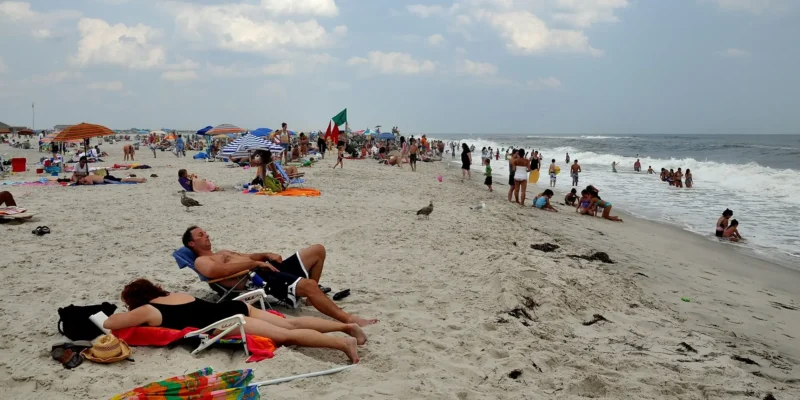
Update from July 9, 2026: The incident on Jones Beach State Park on Long Island is now listed as a shark bite. NBC New York reported that a swimmer there was bitten by a shark on July 3, 2026; The New York State Department of Environmental Conservation therefore classifies the case as a transient contact bite and sees no evidence of a targeted predatory attack.
This changes the cautious initial version from a suspected shark bite to a confirmed shark bite. What remains unchanged, however, is that the shark species has not been confirmed, the injury was not life-threatening according to available reports, and there is no reliable evidence that the shark specifically pursued a human as prey.
What happened
According to ABC7NY The incident occurred shortly after noon near Field 6. The man was injured in his left foot, treated by Jones Beach lifeguards and rescue workers and then taken to Nassau University Medical Center.
ABC7NY described the wound as deep and tooth-shaped on the bottom of the foot. A person who was in the water reported the swimmer came out of the water holding his foot; shortly afterwards all bathers were taken out of the water.
Reaction on the beach
The Associated Press story at NY1 cites the New York State Office of Parks, Recreation and Historic Preservation as the responsible source. Accordingly, swimming was suspended while lifeguards and emergency services searched for sharks or other dangerous marine fauna.
After around an hour without finding anything, bathers were allowed back into the water, but only up to their waist. This restriction fits with the usual security logic on patrolled beaches: first check the area, then reopen bathing operations gradually and within clear boundaries.
Shark species remains unknown
There is still no specific shark species used for the classification. Previous reports cited assumptions from the beach environment, but there is no officially confirmed species identification. Sightings, injury patterns and individual observations are not enough.
Separation is therefore important: the bite itself is now confirmed, but the type is not. The DEC classification as a transient contact bite also suggests a brief encounter in the surf area rather than behavior that should be described as a targeted attack on a human.
Why Jones Beach is being closely watched right now
The incident occurred during a busy Fourth-of-July weekend. In the same context, ABC7NY referred to drone surveillance and recent shark sightings on New York beaches, including Rockaway Beach. Such sightings do not automatically lead to bite injuries, but they do explain why lifeguards temporarily take swimmers out of the water.
Early summer and summer regularly bring more prey fish off Long Island and therefore more sharks near the coast. This is a normal ecological pattern. For beach visitors, alarmism is less important than the willingness to immediately take lifeguard instructions, red flags and drone warnings seriously.
What beachgoers can take away from it
If you are bitten by a shark in busy, shallow water, three things are important: get out of the water quickly, control the bleeding, and get professional help. This is exactly what happened on the Jones Beach. The quick reaction of lifeguards and rescue workers is more important than speculation about an unconfirmed species.
The following also applies to swimmers: do not stay near large schools of fish, avoid cloudy water and dusk, do not ignore any fish or leftover bait in the area and leave the water without discussion when lifeguard signals.
Calm classification instead of beach panic
The case remains a non-fatal shark bite while swimming at Jones Beach State Park Field 6. It should be taken seriously, but it does not change the basic classification: sharks belong to the Atlantic off Long Island, bite injuries remain rare, and reliable information about the species should only be accepted when authorities or experts confirm it.